
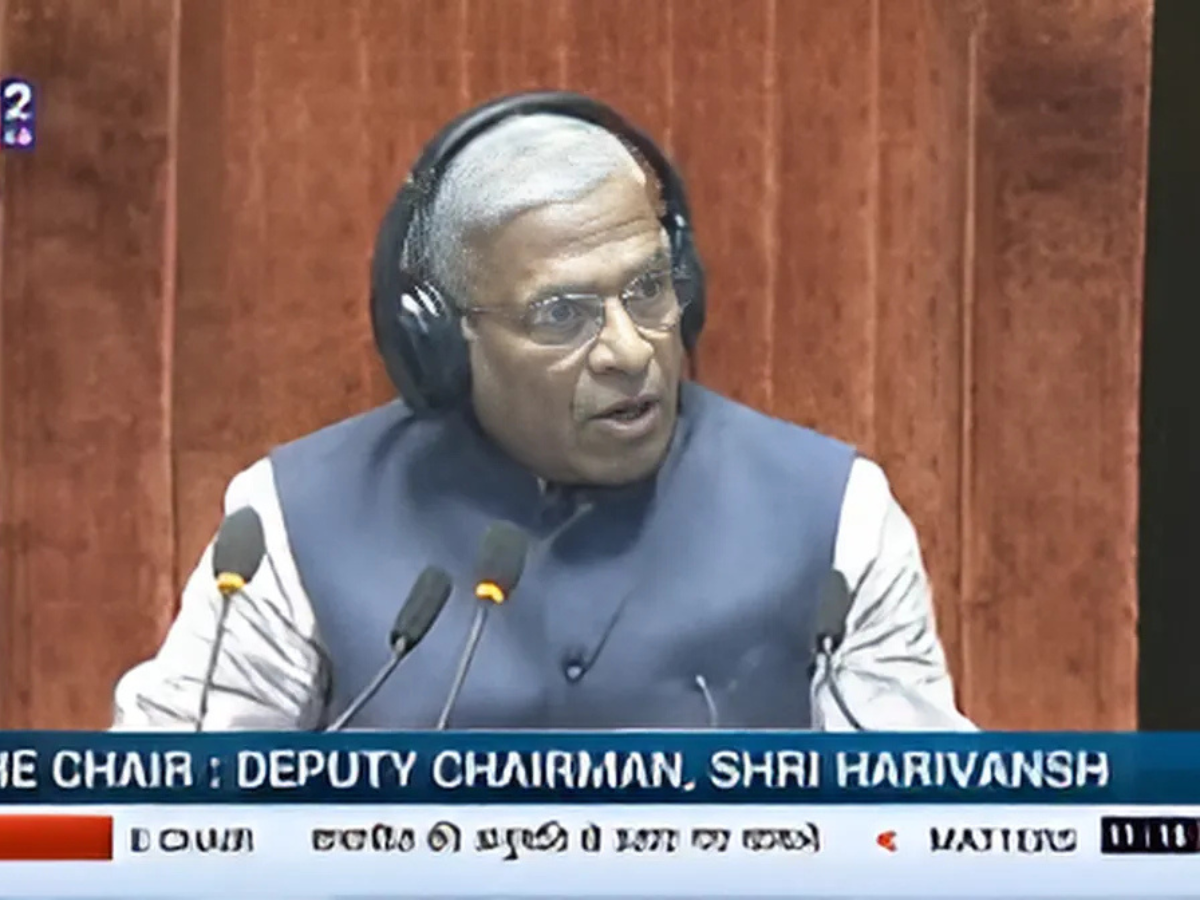

Deputy Chairman of the Rajya Sabha, Shri Harivansh, on Tuesday raised serious concerns over the continuous disruptions in the Monsoon Session of Parliament. Speaking from the Chair, he pointed out that despite several appeals from the Chair, some members willfully violated Rule 235 and Rule 238, disturbing the decorum of the House.
He cited multiple incidents, including one on July 28, when a member from YSRCP was interrupted mid-speech by another member who approached the microphone from a distance and disrupted the address.
Questioning the Dignity of Parliamentary Conduct
Shri Harivansh referred to July 31, when during a Suo Motu statement, members raised slogans and surrounded the speaking member. He questioned whether such behavior was not an infringement on the public’s right to information. Similarly, on August 1, while a member was making a significant submission during Zero Hour, another member interfered by approaching from afar and disrupting the address. These incidents, recorded on July 25, 28, 29, 31, and August 1, were formally entered into House records. Shri Harivansh urged members to introspect whether such conduct enhances or undermines the dignity of the House.
Security Measures Triggered by Breach in Well Area
The Deputy Chairman also reminded the House that raising slogans in the well area (well of the house), which is a designated space in Parliament, is strictly prohibited. In previous sessions, members have thrown chairs from the Secretary-General’s area. As a result, parliamentary security personnel had to cordon off the area to ensure the safety of the House and its members. Shri Harivansh emphasized that the presence of security staff in the House is not a new occurrence. These personnel are highly trained and operate without the use of force, always upholding the dignity of Parliament.
So finally the Modi Govt has accepted today that CISF personnel were indeed deployed in the Rajya Sabha last week to prevent Opposition MPs from exercising their democratic right of protest.
You can call them by whatever name but the fact remains that they were all from the… pic.twitter.com/6gqK0dDiAz
— Jairam Ramesh (@Jairam_Ramesh) August 5, 2025
Indiscipline Cannot Be Justified as Democratic Protest
Citing procedural rules, Shri Harivansh stated that if members are not speaking from their designated seats, their statements do not go on record. He strongly questioned how repeated violations of rules and House decorum could be classified as democratic protest. He reminded the members that even back in April 1998, the then Deputy Chairman had termed such conduct as “most disgusting.”
Significant Loss of Parliamentary Time
Highlighting the impact of repeated adjournments, Shri Harivansh informed the House that while 150 starred questions, 150 Zero Hour submissions, and 150 Special Mentions were scheduled for the session, only 13 starred questions, 5 Zero Hour submissions, and 17 Special Mentions could be taken up so far. Due to the disorderly conduct, the House has lost approximately 41 hours and 11 minutes of valuable time. The Deputy Chairman concluded by saying that this hampers the collective responsibility that Members of Parliament owe to the nation.
Rajya Sabha Deputy Chairman Harivansh on continued to express concern over the increasing number of improper notices submitted under Rule 267. He informed the House that 34 such notices were received, but most of them failed to mention the specific rules they intended to suspend, which is a mandatory requirement under Rule 267. Some of the notices, he said, were not even in the correct motion format. He pointed out that despite clear instructions from the Chair on December 8 and 19, 2022, members were not following the proper procedure for filing such notices.
Subjudice Matters and Rule Violations Highlighted in House
Harivansh also noted that some members continue to raise issues in the House that are currently subjudice and therefore cannot be discussed. He reminded the House that such actions violate the established parliamentary norms. He suggested that members could raise relevant topics through short-duration discussions or other permissible procedures instead of misusing Rule 267. He emphasised the need for seriousness while invoking Rule 267, warning that casual use of the rule often leads to disruptions in the House proceedings when such notices are either accepted or debated.
Historical Data Shows Rare Use of Rule 267 for Substantive Debate
The Deputy Chairman referred to historical data to show how sparingly Rule 267 has been used in the past. He stated that between 2000 and 2004, not a single Rule 267 notice was accepted. Between 2004 and 2009, only four substantive discussions were allowed under this rule. From June 2009 to May 2014, the House received 491 notices under Rule 267, but only one led to suspension of business for a substantive discussion. From 2014 till the last session, 3,102 such notices were received, and only six were admitted for detailed debate.
Swastika Sruti is a Senior Sub Editor at NewsX Digital with 5 years of experience shaping stories that matter. She loves tracking politics- national and global trends, and never misses a chance to dig deeper into policies and developments. Passionate about what’s happening around us, she brings sharp insight and clarity to every piece she works on. When not curating news, she’s busy exploring what’s next in the world of public interest. You can reach her at [swastika.newsx@gmail.com]




