
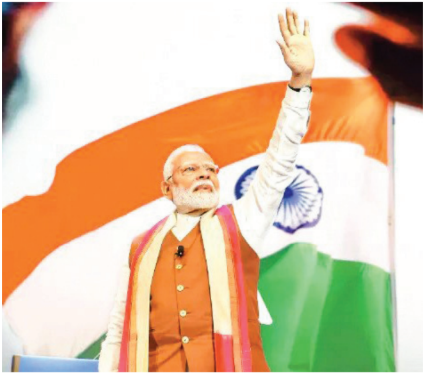

As Prime Minister Narendra Modi turns 75 years, he stands at a unique crossroad. This is his third term as Prime Minister, he has broken Indira Gandhi’s record of delivering 11 consecutive speeches on Independence Day from the Red Fort (Modi has delivered 12 so far). However, it is not Indira as much as Jawaharlal Nehru’s record of being in office for 17 years that Modi wants to beat. For that he will have to win another term and judging by the looks of it that plan is very much in his In-Tray.
However, politics is not just a numbers game it is also about setting legacies and creating institutions. When we talk about Nehru, a certain perception comes to mind about all that is Nehruvian. However, under the current dispensation, a lot of that has been modified. What then is the dominant image one gets about Modi’s India?
The very first thing that comes to mind that this is no longer India but Bharat. The BJP under Modi stresses a great deal in finding the right label. And the nationalised Bharat suits his mindset much more than the internationalised India. And so, when the current foreign minister S. Jaishankar writes a book he (very naturally) calls it, “Why Bharat Matters”.
It is not just the usage of the name but along with it what is also being inculcated is a pride in all that is Indian and Bhartiya. The western-liberal outlook that was so in vogue during the Congress era is no longer de rigueur. It has been replaced by a strong pride in Hindu nationalism and one that clearly appeals to the masses that felt at odds with the convent educated elite that ruled India during the Congress era. The cadres needed an easily identifiable enemy to wage their political battles against; and Modi was quick to give them one, neatly packaged with a very catchy label : the Lutyens Elite.
But labels aside, if there is one gift that Modi has given to the nation it is the rediscovery of India as Bharat. There is a sense of pride in our historic past, our mythology and language. Writers are encouraged to write books drawn from our own mythology instead of looking westwards. Yoga Day is an international event and visiting cards are being printed in Hindi on one side, and English on the other.
The last is what it should be, a fine balance of both the worlds. That is a message that the PM needs to hammer home because while he is right in shoring our national pride, the party faithful forget that we live in a borderless world. It is all very well to encourage school children to take pride in learning Hindi, but why should this be at the cost of English? One is the language of identity while the other is the language of commerce. Both are essential. Or take the instance when a former Union Minister is caught on camera asking school children to name the first man to travel in outer space. When the kids say Neil Armstrong, he corrects them saying that its Hanuman ji. This surely cannot be Modi’s Idea of Bharat. So while he has given his party faithful direction, he now needs to hand them a compass.
Both sides will be loth to admit it but as Dr Karan Singh pointed out to NewsX recently that while its common to compare Modi with Indira Gandhi in the sense that both were strong leaders, he found more similarity between Nehru and Modi. “There are only three prime ministers who have completed three terms, Nehru, Indira and Modi though Indira’s term was not continuous…I find (Modi) more comparable with Jawaharlal Nehru. Both of them were charismatic leaders, both drew huge crowds, both travelled a lot and were idolated in the country. So its very interesting, while both are ideologically poles apart, if you take their careers, there is a lot in common…both want to leave a legacy.”
While Nehru’s task was that of nation building, the ask before the current Prime Minister is of consolidation and growth. While it is still to early to define Modi’s legacy his politics have a certain definitive trajectory.
Religion is very much a key part of the identity question. Finally, under Modi the majoritarian Hindu community feels that it is the dominant voice in its own land. Soon after Modi took over as Prime Minister in 2014, one must have noticed the angry Hanuman posters (in bright saffron) that adorned the rear windshields of passenger cars. The aam Hindu was angry. He – or she — had been angry for long, but only now under Modi, felt confident enough to advertise the fact. This was a backlash of the politics of appeasement played by the Congress. If you recall, the first term of the Modi government was full of tests to prove one’s patriotism – there were crowds in cinema halls that heckled those who did not stand up while the national anthem was being played. So much so the Supreme Court had to intervene to say it was not mandatory. And so on. But over time, other political parties began buying into the same narrative as opposition leaders began to add temple stopovers to their election campaign routes and their party manifestos took care to include the interests of the majority while reaching out to the minority. This balance is yet to be reciprocated by the BJP which is very proud of the fact that Modi’s council of ministers does not have a single Muslim in it. However, having said that, the Hindu no longer feels like a second-class citizen in Bharat. In fact, with the Ram Janam Bhoomi Temple rebuilt at Ayodhya, the angry Hindu is now reassured that this is one legacy that no opposition party will undo. Even in a post Modi era.
Prime Minister Narendra Modi has reached the milestone of age 75 years, and his tenure can be measured in the multiple reforms he has pursued, both ambitious and controversial. Some of these have transformed India’s economic and policy landscape, while others, like demonetisation, continue to remain subjects of debate. Among his recent reform priorities, the focus on semiconductors stands out as a potentially transformative step for India’s technological and economic future.
In one of his speeches, PM Modi emphasised that the growth of the semiconductor industry will shape the next era of India’s economic rise. With initiatives like the recent Semicon India 2.0, the government has been laying the groundwork for creating a strong domestic semiconductor ecosystem in energy efficiency, sustainability and AI. Previously, Semicon 1.0 focused on basic chip manufacturing for consumer electronics.
The Semiconductor Mission has also been launched not only to build infrastructure for chip manufacturing like the recently unveiled indigenous chip Vikram 32 but also to attract global investment and foster collaboration with international leaders in technology. Encouragingly, several major semiconductor companies like Micron have shown interest in India, creating the possibility of establishing manufacturing hubs within the country.
India’s semiconductor industry is still in its early stages compared to global leaders. US, Taiwan, Japan, and China have advanced fabrication facilities, deep research ecosystems, and significant investments in semiconductor design and manufacturing. Taiwan’s TSMC and South Korea’s Samsung lead in cutting-edge chip production, while the US focuses on design, R&D, and high-tech equipment. Japan contributes through materials and components, and China is rapidly expanding its domestic capabilities with state support. In contrast, India depends heavily on imports, with limited fabrication capacity and R&D infrastructure. However, government initiatives and private sector investments are aiming to build a self-reliant ecosystem and close this gap over time. With that in mind, today India is home to multiple manufacturing plants like Kaynes Semicon Plant in Sanand, Gujarat, HCL-Foxconn JV in Uttar Pradesh, a TATA plant in Assam and a CG plant in Sanand. At the same time, Taiwan is looking for alternative geographies to set up new manufacturing units and India could offer itself as a low cost destination.
The importance of semiconductors cannot be overstated. They form the backbone of modern digital economies, powering everything from smartphones and computers to advanced defence systems and space technologies. For India, securing a domestic semiconductor ecosystem is not just about industrial growth, it is also about strategic autonomy and Make in India. In an era of heightened geopolitical tensions and supply chain vulnerabilities, India cannot afford to remain dependent on the United States or China or Taiwan for chips that underpin critical infrastructure. Achieving self-reliance in semiconductors will determine India’s resilience in the global digital economy towards a Viksit Bharat 2047.
However, the road to a robust industry in India is fraught with challenges. Semiconductor manufacturing is highly capital intensive and resource-intensive, requiring massive amounts of water and uninterrupted electricity- both resources that remain strained in many parts of India. Furthermore, as highlighted by Union Minister Ashwini Vaishnaw in a recent interview, India’s semiconductor ambitions cannot rest on design alone. Building strong manufacturing and testing capabilities and nurturing a talent pipeline for chip innovation are equally crucial. Without strengthening the manufacturing ecosystem, India risks becoming a follower in a high-stakes global market.
There are also concerns about execution. India has often launched visionary programs that falter at the implementation stage, leading to missed opportunities. While the vision for a semiconductor-driven future is ambitious and necessary, its success will depend on consistent follow-through, policy stability, and effective public-private partnerships. One of the major challenges so far has been that the private sector has not invested to its potential in the sector. The government has made commitments that have not been as soundly supported by the private sector as they could have. Even in the US, when the semiconductor industry started, the companies in those states played a key role- which is always critical to the development of a sector.
India must urgently build its semiconductor manufacturing ecosystem, first to serve its own growing technological and strategic needs, and then to become a trusted supplier for the world. Unlike the software industry, where service-based models and outsourcing allowed India to succeed globally, the semiconductor sector can be entirely domestic led with domestic demand and domestic manufacturing.
Prioritizing domestic manufacturing ensures supply security, reduces strategic risk, and builds self-reliance. Once the foundation is strong, India can scale production and export globally, becoming a key player in semiconductor supply chains. A decisive, inclusive approach- where both government and industry invest, is vital to future-proof India’s technology landscape. India’s semiconductor push is both an opportunity and a necessity. Yet, the real test lies ahead-whether this vision translates into tangible factories, design labs, and a skilled workforce. One hopes that the semiconductor story concretizes into real progress. India’s future as a digital powerhouse depends on it.
Rajesh Mehta is an International Affairs expert working in areas like Market Entry, Innovation & Public Policy.
Priya Sahgal
Shubhi is a seasoned content writer with 6 years of experience in digital media. Specializing in news, lifestyle, health, sports, space, optical illusions, and trending topics, she crafts engaging, SEO-friendly content that informs and captivates readers. Passionate about storytelling, Shubhi blends accuracy with creativity to deliver impactful articles across diverse domains.




