
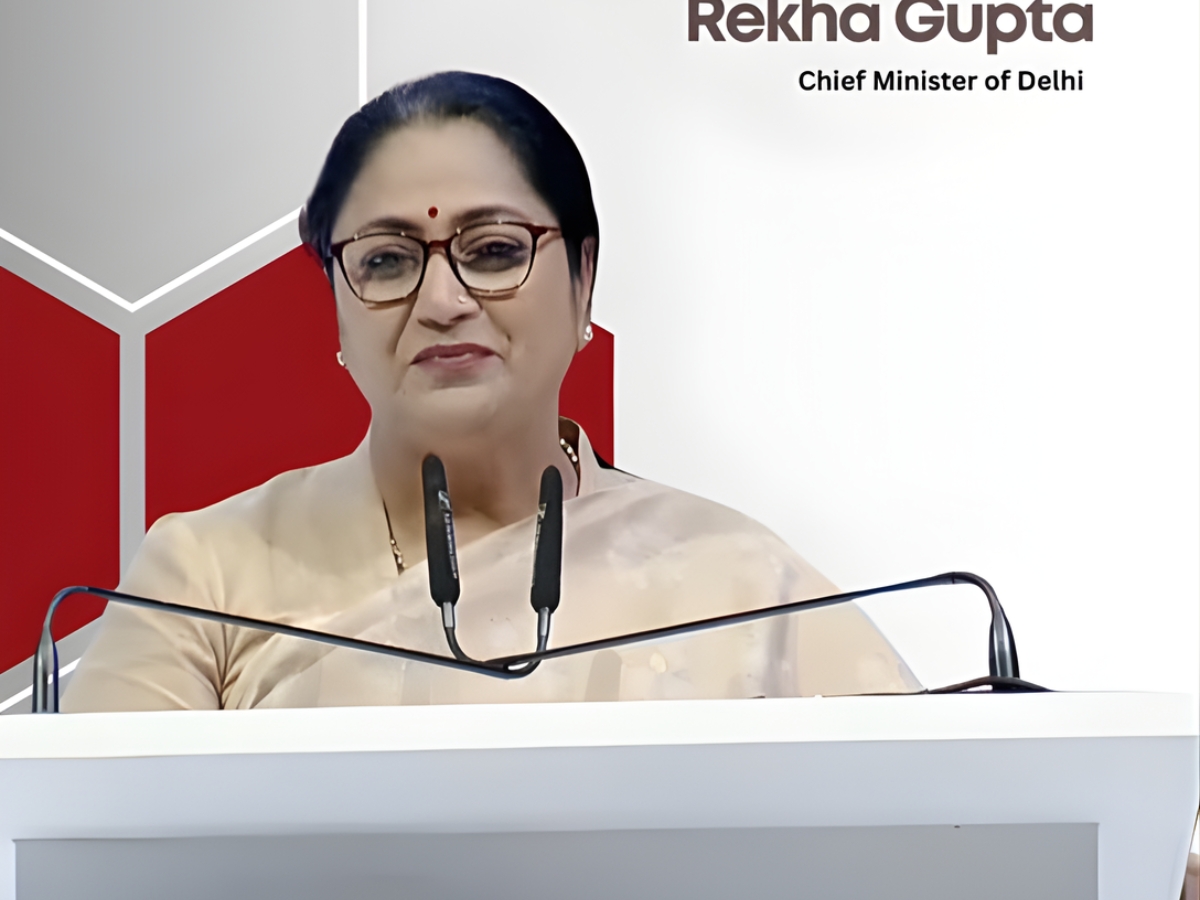

Addressing delegates at the NXT 2026 summit, Delhi Chief Minister Rekha Gupta began her remarks by congratulating the participants and acknowledging their presence at the event.
“I also extend my heartfelt congratulations and best wishes to all the delegates present here. Today’s conversation is about discussing our plans for the future,” she said.
Delhi CM noted that many of the questions being raised about India’s future direction had already been addressed by Prime Minister Narendra Modi through his vision for the country’s long-term development.
“All of you have heard the Prime Minister of India, Narendra Modi. I would like to say that the way India is progressing under Modi’s leadership, and the way he has planned for India in the 21st century, provides an answer to the question many of you are asking: What is next?” she said.
She added that policymakers and innovators today are asking key questions about the future: What is the next idea? What is the next technology? What is the next form of governance? What are the next opportunities?
Vision of Viksit Bharat 2047
Rekha Gupta said the government has already presented a clear roadmap to address these questions through the vision of Viksit Bharat 2047, which outlines the country’s development trajectory leading up to the centenary of independence in 2047.
“To prepare for all of this, Prime Minister Narendra Modi has presented the vision of Viksit Bharat 2047, a plan for the year 2047. It is, in itself, a national resolve for the entire country and for every citizen of India. It is our promise,” she said.
She emphasised that the vision represents a collective commitment by the nation.
“Our promise is to ourselves about the direction in which we want to take our country. I can say that our resolve includes not only technology but also innovation. With inclusive growth, India is moving forward,” Gupta said.
According to her, the guiding principle behind this roadmap is human-centric development, which she described as the central mission of India’s progress.
“Most importantly, human-centric development is our mission, and with that mission the country is progressing,” she said.
People-Driven Development and Technology
Gupta stressed that India’s development model today is driven by citizens and supported by expanding technological capabilities across industries.
“The development we see today is people-driven development. Today, every industrial sector and every service sector is empowered by technology, and India is continuously working to strengthen it,” she said.
She added that technological empowerment across sectors is helping accelerate the country’s growth trajectory.
Next-Generation Economic Reforms
Speaking about the future, Gupta highlighted the importance of the next phase of reforms, particularly in the economic sphere.
“When we talk about what comes next, we talk about next-generation reforms. In these reforms, the first focus is on economic reforms,” she said.
She expressed satisfaction with the progress India has made in this area.
“I am very happy to say that India has achieved a remarkable position in economic reforms. A country that the world once knew as a developing nation has now reached the level of a developed country,” Gupta said.
Financial Inclusion and Digital Governance
Gupta also pointed to financial inclusion as a major pillar of India’s transformation, highlighting the government’s Pradhan Mantri Jan Dhan Yojana initiative.
“Through the Jan Dhan Yojana, we moved forward in the direction of financial inclusion—ensuring that every citizen has a bank account,” she said.
She explained that the system of linking bank accounts with Aadhaar identification has enabled citizens to receive government benefits directly through the Direct Benefit Transfer mechanism.
“Through their bank accounts, Jan Dhan accounts, and Aadhaar identity cards, citizens can directly receive benefits from the government through Direct Benefit Transfer (DBT), which is a highly transparent system,” she said.
Gupta described DBT as one of the most powerful examples of digitalisation in the country.
“Today, DBT has become a powerful example of digitalisation and technology in our country—something that is a matter of pride for the entire nation and a model for the world,” she said.
India’s Digital Payments Revolution
She further emphasised India’s advances in digital financial systems, saying the country is witnessing a major shift in the way transactions are conducted.
“I also believe that when it comes to digital payments, India is working in a truly revolutionary way,” Gupta said.
Prime Minister Modi on Global Energy Crisis
Earlier during the summit, Prime Minister Narendra Modi addressed the broader global situation, including the impact of the ongoing Iran war and the resulting global energy crisis.
Speaking at the NXT Conclave held at Bharat Mandapam, Modi said the conflict has disrupted supply chains worldwide and affected countries across the globe.
“No country is untouched by the impact of this global crisis caused by war. To a greater or lesser extent, everyone is affected by this crisis,” the Prime Minister said.
He explained that the government is actively engaging with international leaders while working to ensure stability in India’s domestic energy supply.
According to PM Modi, India is taking steps to navigate the volatility in global energy markets while pursuing long-term strategies to strengthen domestic energy infrastructure and reduce reliance on foreign fuel supplies.
He added that the government is working at multiple levels to manage disruptions caused by the war-driven energy shock.
About the NXT Summit
The three-day summit is organised under the ITV Network’s NXT initiative in association with the Sunday Guardian Foundation and NewsX.
The NXT initiative was launched by Kartikeya Sharma, while the summit is organised in collaboration with the Sunday Guardian Foundation chaired by Aishwarya Pandit Sharma.
The forum aims to create a platform for discussions on governance, technology, and economic transformation, while showcasing India’s development model and its growing influence in global conversations on innovation, policymaking, and international cooperation.
Zubair Amin is a Senior Journalist at NewsX with over seven years of experience in reporting and editorial work. He has written for leading national and international publications, including Foreign Policy Magazine, Al Jazeera, The Economic Times, The Indian Express, The Wire, Article 14, Mongabay, News9, among others. His primary focus is on international affairs, with a strong interest in US politics and policy. He also writes on West Asia, Indian polity, and constitutional issues. Zubair tweets at zubaiyr.amin




