
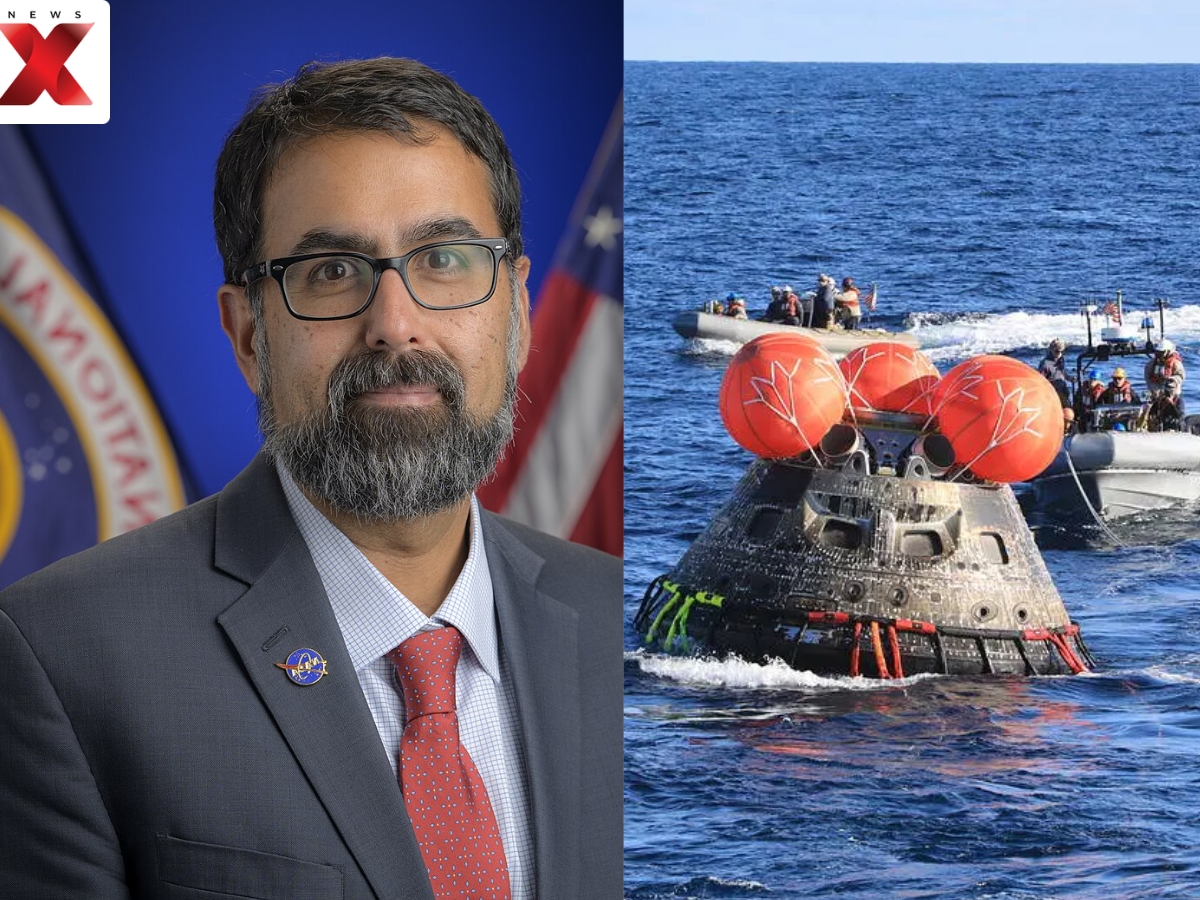

The Artemis II capsule and its four-member crew safely splashed down in the Pacific Ocean on Friday after nearly 10 days in space. This was the first human journey to the vicinity of the moon in over half a century. However, what has caught attention in India is the role of the Indian-origin NASA Associate Administrator, Amit Kshatriya. He serves as the agency’s de facto chief operating officer. He is among the top-ranked civil servants at the National Aeronautics and Space Administration (NASA). Amit leads NASA’s 10 centre directors and mission directorate heads. He also works as a senior advisor to Administrator Jared Isaacman.
Who is Amit Kshatriya? Indian-Origin Senior NASA Official Behind Artemis II Mission
Amit Kshatriya’s parents are Indian immigrants. He was born in Brookfield, Wisconsin.
He has a Bachelor of Science in mathematics from the California Institute of Technology and a Master of Arts in mathematics from the University of Texas at Austin.
He has previously worked in the gas industry and the medical sector before joining NASA.
He joined NASA in 2021 at its headquarters as an assistant deputy associate administrator for the Exploration Systems Development Mission Directorate. From here, he became an integral part of Artemis 1 and later Artemis 2.
NASA’s Orion Capsule Parachutes Into Sea
NASA’s gumdrop-shaped Orion capsule, dubbed Integrity, parachuted gently into calm seas off the Southern California coast shortly after 5:07 p.m. Pacific Time (0007 GMT on Saturday), concluding a mission that four days prior took the astronauts 252,756 miles away from Earth, deeper into space than anyone had flown before.
The Artemis II flight, traveling a total of 694,392 miles (1,117,515 km) in two Earth orbits and a climactic lunar flyby some 4,000 miles from its surface, was the debut crewed test flight in a series of Artemis missions that aim to return astronauts to the lunar surface starting in 2028.
NASA Calls Artemis II Mission Splashdown ‘Perfect Bulls Eye’
The splashdown under partly cloudy skies was carried by live video feed in a NASA webcast. “A perfect bull’s eye splashdown for Integrity and its four astronauts,” NASA commentator Rob Navias said moments after the landing.
“We are stable one – four green crew members,” mission commander Reid Wiseman radioed just after splashdown, signaling the capsule was upright and that all four astronauts were in good shape.
It took NASA and U.S. Navy recovery teams less than two hours to secure the floating capsule and retrieve the four crew members – U.S. astronauts Wiseman, 50, Victor Glover, 49, and Christina Koch, 47, along with Canadian astronaut Jeremy Hansen, 50.
The crew’s homecoming was the riskiest test of the mission and its Lockheed Martin-built LMT.N Orion spacecraft, proving the capsule’s heat shield could withstand the extreme forces of re-entry from a lunar-return trajectory.
The capsule plunged into Earth’s atmosphere at 32 times the speed of sound, with atmospheric friction pummeling its heat shield at temperatures of some 5,000 degrees Fahrenheit (2,760 degrees Celsius). A sheath of ionized gas enveloped the vehicle, causing a planned radio blackout of over six minutes at the peak of re-entry stress.
The tension broke as contact was re-established some 40 seconds later than expected, and two sets of parachutes billowed from the nose of the free-falling capsule to slow its descent to about 15 mph (25 kph) before Orion gently hit the water.
Is The Success Of Artemis II Mission A Stepping Stone For Mars Mission?
The quartet blasted off from Cape Canaveral, Florida, on April 1 aboard NASA’s giant Space Launch System rocket, orbiting twice around Earth before sailing on for a rare journey around the far side of the moon.
In so doing, they became the first astronauts to fly around Earth’s only natural satellite since the Apollo program of the 1960s and ’70s. Glover, Koch and Hansen also made history as the first Black astronaut, the first woman and first non-U.S. citizen, respectively, to take part in a lunar mission.
The crew’s peak distance of 252,756 miles away broke the record of roughly 248,000 miles set in 1970 by the crew of Apollo 13.
“This is an incredible test of an incredible machine,” said NASA’s associate administrator, Amit Kshatriya.
The voyage, following the uncrewed Artemis I test flight around the moon by the Orion spacecraft in 2022, marked a critical hardware test for a planned attempt later this decade to land astronauts on the lunar surface for the first time since Apollo 17 in late 1972.
NASA is seeking to achieve a crewed moon landing ahead of China, which is aiming to put its own crews there around 2030. The agency more broadly aims to establish a long-term lunar presence as a stepping stone to eventual human exploration of Mars. In a historical parallel to the Cold War era of Apollo, the Artemis II mission has played out against a backdrop of political and social turmoil, including a U.S. military conflict that has proven unpopular at home.
(With inputs from Reuters)
Zubair Amin is a Senior Journalist at NewsX with over seven years of experience in reporting and editorial work. He has written for leading national and international publications, including Foreign Policy Magazine, Al Jazeera, The Economic Times, The Indian Express, The Wire, Article 14, Mongabay, News9, among others. His primary focus is on international affairs, with a strong interest in US politics and policy. He also writes on West Asia, Indian polity, and constitutional issues. Zubair tweets at zubaiyr.amin




