
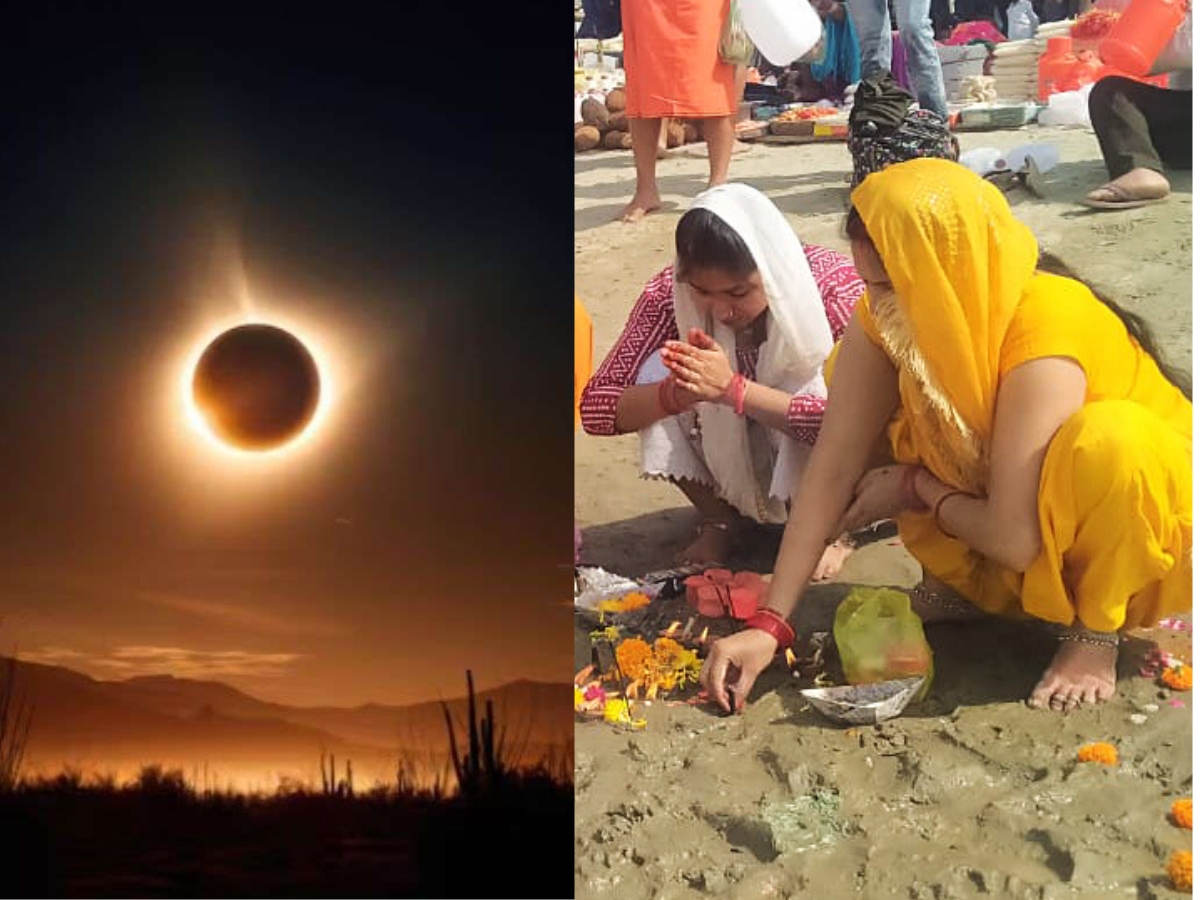

Surya Grahan 2026: The first solar eclipse of 2026 will occur on February 17 and will be an annular, or “kankan,” solar eclipse. During this phenomenon, the Moon is expected to cover nearly 96% of the Sun, leaving a bright ring-like outline visible in the sky. While the celestial event will last for more than four hours, it will not be visible from India. As a result, religious restrictions such as the Sutak period will not apply in the country.
Here is a detailed guide addressing all the key aspects of Surya Grahan 2026.
Solar Eclipse 2026: Date And Timings In India
According to Indian Standard Time (IST), the solar eclipse will begin at 3:26 pm on Tuesday, February 17, and conclude at 7:57 pm, lasting approximately 4 hours and 31 minutes.
The peak phase of the eclipse is expected between 5:13 pm and 6:11 pm IST.
Surya Grahan 2026 Sutak Period
In Hindu traditions, the Sutak period associated with eclipses is considered inauspicious, and people avoid performing auspicious activities during this time. For a solar eclipse, Sutak is traditionally believed to begin 12 hours before the start of the eclipse.
Based on the February 17 schedule, the Sutak period would begin at 4:26 am and continue until the eclipse ends in the evening.
However, an important clarification applies in this case.
Will The Solar Eclipse Be Visible In India?
No. The annular solar eclipse on February 17 will not be visible in India.
The event will instead be observable from parts of southern Africa, Antarctica, and South America. Countries including Zimbabwe, Zambia, Tanzania, Namibia, Mauritius, Botswana, Mozambique, Argentina, and Chile fall within the visibility zone.
Traditional Practices: What People Avoid During An Solar Eclipse
Based on traditional beliefs:
Worship is usually avoided during the eclipse period.
Idols are not touched and auspicious activities are postponed.
Cooking or eating food is avoided.
Pregnant women, children and elderly individuals are often advised to remain indoors.
If the eclipse is considered inauspicious, some people chant mantras dedicated to the Sun or Lord Shiva. Reciting the Guru Mantra or Vishnu Sahasranama is also believed to be beneficial.
Surya Grahan 2026: What Are The Real Health Risks?
From a scientific perspective, there are no hidden or delayed health effects associated with a solar eclipse. The Sun does not emit extra radiation during an eclipse, and there is no impact on blood, digestion, pregnancy or immunity.
The only real medical risk is solar retinopathy, an eye injury caused by looking directly at the Sun. During an eclipse, people may stare longer than usual because the brightness appears reduced, which can damage the retina without immediate pain.
Pregnant Women And Children During Surya Grahan 2026:
There is no medical evidence linking solar eclipses to pregnancy complications. Advice such as staying indoors or avoiding food and travel during Surya Grahan is rooted in tradition rather than science.
Children, however, require extra supervision because they may attempt to look at the Sun out of curiosity. Parents should ensure that children do not view the eclipse without certified protective equipment.
People with existing eye conditions are also advised to avoid any direct viewing of the Sun.
Also Read: Solar Eclipse 2026: When Will India Witness The February ‘Ring of Fire’? Check Date And Timing
Zubair Amin is a Senior Journalist at NewsX with over seven years of experience in reporting and editorial work. He has written for leading national and international publications, including Foreign Policy Magazine, Al Jazeera, The Economic Times, The Indian Express, The Wire, Article 14, Mongabay, News9, among others. His primary focus is on international affairs, with a strong interest in US politics and policy. He also writes on West Asia, Indian polity, and constitutional issues. Zubair tweets at zubaiyr.amin




