
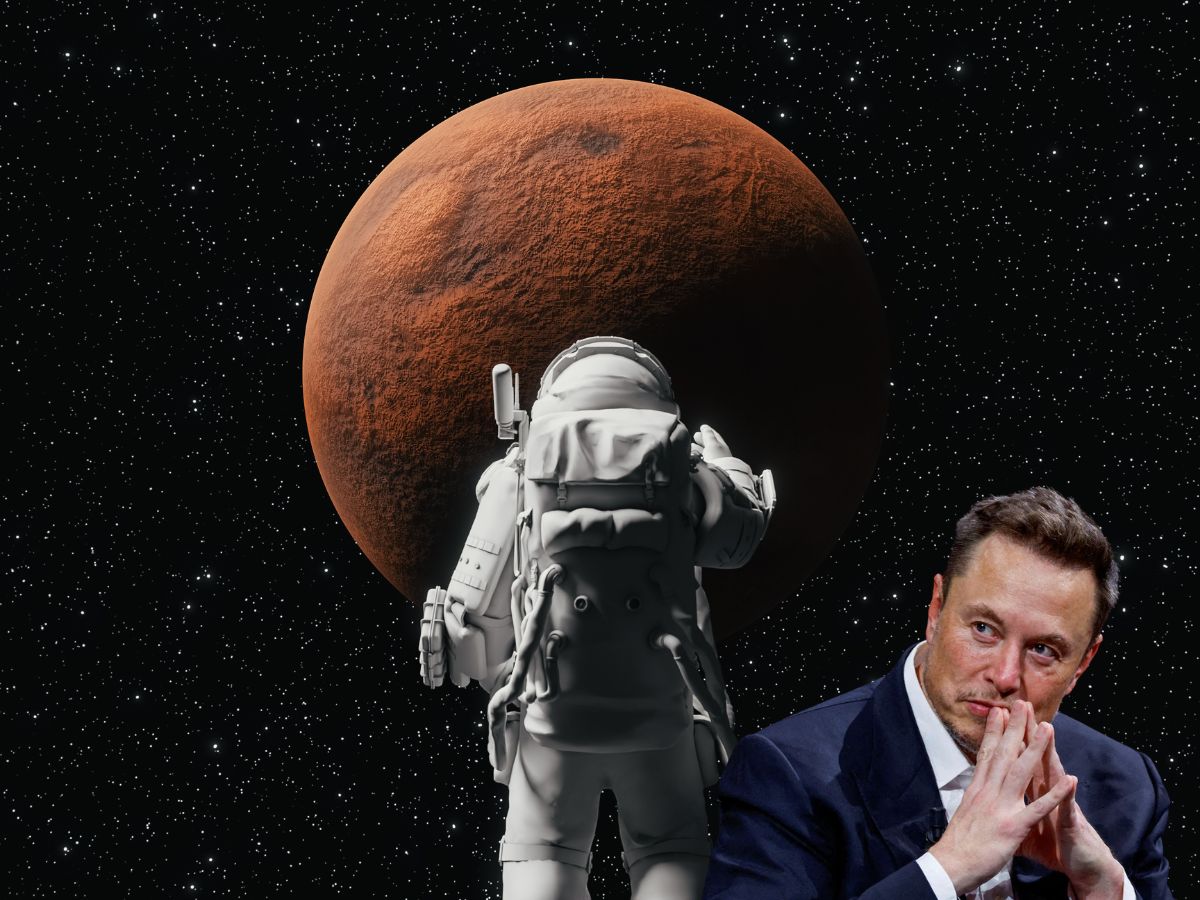

For years, Elon Musk insisted he wanted to be remembered as the man who took humanity to Mars. The billionaire entrepreneur repeatedly framed the Red Planet as the ultimate destination for building a self-sustaining human settlement beyond Earth.
Now, however, Musk is shifting focus. The near-term priority for SpaceX, he says, may not be Mars but something closer a “self-growing city” on the Moon.
In his words, the “overriding priority is securing the future of civilization,” and the Moon is simply “faster” to reach and develop.
The shift has sparked intense discussion online, with supporters calling it a practical step toward interplanetary life and critics questioning whether such ambitious visions are realistic.
Why the Moon Is “Faster” Than Mars
Technically, the Moon is a far easier destination for early human settlements than Mars.
Missions to Mars can only launch when Earth and the Red Planet align, a window that opens roughly every 26 months. Even then, the journey takes about six months.
By contrast, missions to the Moon can launch far more frequently, with launch windows opening roughly every 10 days and travel taking only two days.
This proximity offers a major advantage for testing technologies needed for long-term space habitation. Life-support systems, habitats, recycling systems and agricultural experiments could all be tested on the Moon much faster than waiting years between Mars missions.
If something goes wrong, astronauts could return to Earth within days rather than months.
Because of this rapid testing cycle, Musk has suggested that a Moon city could be completed in under a decade, while the timeline for a permanent Mars settlement may shift five to seven years later than earlier expectations.
NASA’s Artemis Program Fuels the Lunar Push
The renewed focus on the Moon also aligns with the plans of NASA, which is preparing to return humans to the lunar surface through the Artemis program.
NASA has already completed the uncrewed Artemis I mission and plans to send astronauts around the Moon on Artemis II in 2026, followed by a crewed landing later in the decade.
In 2021, NASA selected a modified Starship lunar lander built by SpaceX in a contract worth about $2.9 billion, placing Musk’s company at the centre of the upcoming lunar landing missions.
Meanwhile, rival aerospace company Blue Origin is also developing a competing lunar lander after receiving a separate NASA contract.
Together, these developments are creating what many observers describe as a new lunar race, driven by both government funding and private space companies.
A Testing Ground for Mars
According to Musk and many engineers, the Moon is not meant to replace Mars but to serve as a proving ground.
Technologies that would be essential for a Mars colony including long-duration life support, in-situ resource utilisation, radiation protection and reusable spacecraft operations could all be tested first on the lunar surface.
Researchers are already studying ways to turn lunar ice and soil into oxygen, water and fuel, reducing the need to launch supplies from Earth.
If successful, these technologies could dramatically reduce the cost and risk of sending humans deeper into space.
Environmental Concerns Around Rocket Launches
Despite the excitement around lunar exploration, scientists warn that a growing number of rocket launches could have environmental consequences.
Studies have shown that rockets release carbon dioxide, water vapour and black carbon into the upper atmosphere. Researchers say large-scale launch activity could potentially interfere with global climate goals if not carefully managed.
Elon Musk spewing his nonsense that money will be irrelevant soon and we’ll be on Mars.
Utter fucking nonsense.
Frankly, and directly and accurately, this is utter nonsense coming from Elon Musk. The billionaires who capture the economy and money will NOT share it with… https://t.co/biTUhb5mwd
— CounterPoint Global (@mariocavolo) March 13, 2026
At the same time, a Moon base could become one of the most demanding sustainability experiments ever attempted, forcing engineers to create near-perfect recycling systems for air, water and energy.
Some experts believe innovations developed for lunar habitats could eventually benefit life on Earth, from advanced recycling systems to drought-resistant farming techniques.
Internet Is Divided however
The idea of a Moon city has triggered mixed reactions online now.
Some social media users praised Musk’s vision, arguing that advances in artificial intelligence, robotics and solar energy could radically transform the global economy and make large-scale space settlements possible.
Others dismissed the idea as unrealistic, accusing billionaires of promoting futuristic visions while ignoring economic inequality and environmental challenges on Earth.
Critics also questioned whether promises of a future where resources become abundant and money loses meaning are practical or simply speculative predictions.
A Step Toward Humanity’s Space Future?
Despite the debate, the renewed focus on the Moon reflects a growing global push toward space exploration.
Governments and private companies are increasingly investing in technologies that could allow humans to live and work beyond Earth.
For Musk, the Moon is not the final destination but a stepping stone toward Mars a place where the technologies needed for an interplanetary civilisation can be tested and perfected.
Whether humanity builds a city on the Moon before reaching Mars remains uncertain. But one thing is clear: the conversation about humanity’s future in space has moved closer to home.
Sofia Babu Chacko is a journalist with over five years of experience reporting on Indian politics, crime, human rights, gender issues, and stories about marginalized communities. She believes journalism plays a crucial role in amplifying unheard voices and bringing attention to issues that truly matter. Sofia has contributed articles to The New Indian Express, Youth Ki Awaaz, and Maktoob Media. She is also a recipient of the 2025 Laadli Media Awards for gender sensitivity. Beyond the newsroom, she is a music enthusiast who enjoys singing. Connect with Sofia on X: https://x.com/SBCism




