

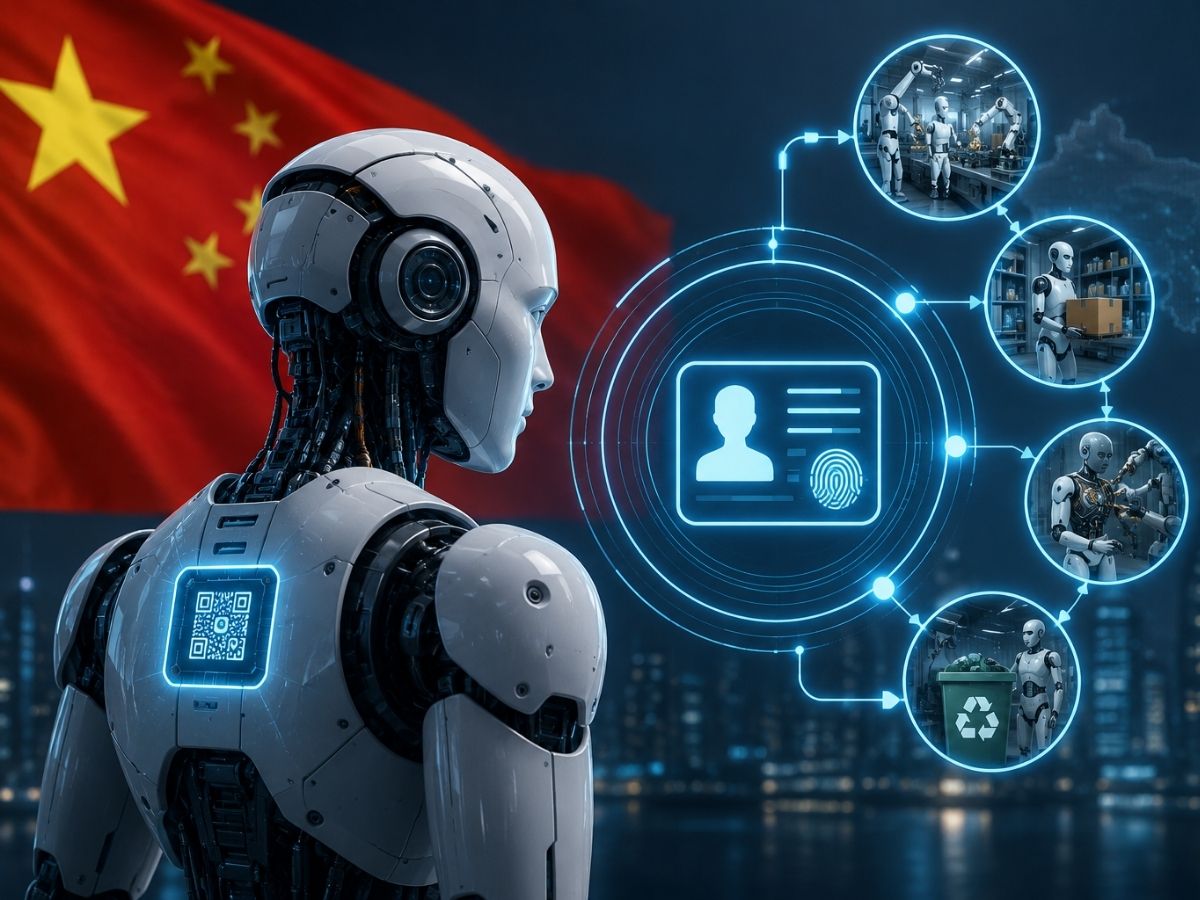
The identification numbers are primarily used to keep track of humans by governments and organisations. These numbers or ID cards help governments and organisations to verify identities and maintain records. Now, China is doing something similar for humanoid robots. It has introduced a national digital identity system that will assign every AI-powered robot its own unique code. This ID card will essentially be a digital passport that follows the machine from the factory floor to maintenance, recycling, and eventual retirement.
What the ID Code Actually Contains
China has launched the Humanoid Full Lifecycle Management Service Platform, a national initiative to assign unique digital identity numbers to every humanoid robot manufactured in the country. The system is led by the Humanoid Robotics and Embodied Intelligence Standardisation committee, operating under China’s Ministry of Industry and Information Technology.
So what exactly goes into this code? Quite a lot, actually. The 29-digit number is broken into four parts: a 2-digit country code, a 4-digit enterprise code, a 6-digit product model code, and a 17-digit serial number. Together, they tell you exactly where the robot came from, who built it, what model it is, and which specific unit it is out of every machine that manufacturer has ever made.
The code captures everything including manufacturer details, hardware specifications, AI capability level, software training history, and production records. It is modelled on China’s 18-character national citizen ID system but adds 11 extra characters to cover operational data specific to machines. Think of it like a human Aadhaar card, but one that also knows how worn out the robot’s joints are and when it last received a software update.
What is striking is how far along this already is. China already has over 100 humanoid manufacturers, and more than 28,000 robots across 200 models have already been assigned a digital ID even before the public announcement of the platform. The system was not announced and then built. It was quietly built first.
Why China Is Doing This Now
The timing is not accidental. China’s humanoid robot industry is growing faster than the rules around it, and that gap is starting to create real problems. This initiative builds on the Humanoid Robot and Embodied AI Standard System 2026 Edition, which was designed to shift the industry from technical demonstrations toward properly regulated commercial use.
There is also a very human reason behind all of this. If a humanoid robot injures a worker or damages property, regulators need a clear chain of information connecting that incident to a specific machine, its manufacturer, and its full operational history. Without a standard tracking system, figuring out who is legally responsible when a robot hurts someone becomes an absolute mess.
Unlike wheeled robots that stay stable on their own, bipedal humanoids exist in a state of managed instability. If they suffer a power failure or an algorithmic error, a 150-pound robot can fall and cause serious injury or property damage. The ID system is how China plans to make sure someone is always accountable when things go wrong.
A Country Already Living With Robots
China is not treating humanoid robots as a distant future project. They are already here, doing real jobs. Robots have been deployed in convenience stores in Beijing, tea farms in Hubei, and power grid operations across the country. A humanoid named Lightning completed a half-marathon in Beijing earlier this year, finishing the 21-kilometre course autonomously. China’s State Grid Corporation alone plans to deploy 8,500 robots, including humanoids and robot dogs, for power grid maintenance and operations.
When machines are already walking into workplaces, public spaces, and eventually homes, giving each one a traceable identity is not bureaucratic overreach. It is just common sense. China appears to have recognised that early, and has moved to build the regulatory infrastructure before the robots become impossible to keep track of.
Syed Ziyauddin is a media and international relations enthusiast with a strong academic and professional foundation. He holds a Bachelor’s degree in Mass Media from Jamia Millia Islamia and a Master’s in International Relations (West Asia) from the same institution.
He has work with organizations like ANN Media, TV9 Bharatvarsh, NDTV and Centre for Discourse, Fusion, and Analysis (CDFA) his core interest includes Tech, Auto and global affairs.
Tweets @ZiyaIbnHameed





