
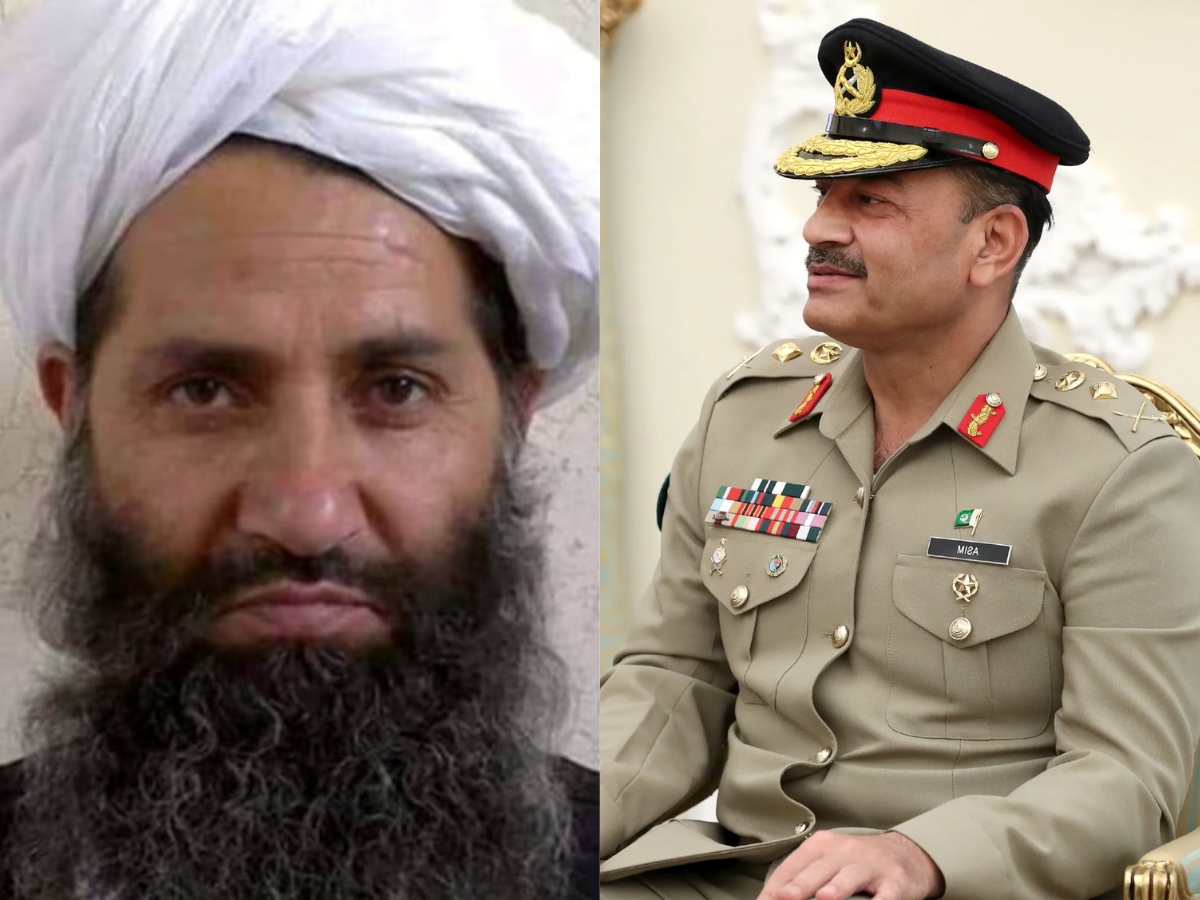

Unconfirmed reports suggest that Pakistani Air Force airstrikes may have targeted Taliban Supreme Leader Hibatullah Akhundzada in Kandahar, a city widely recognized as his base. A new round of airstrikes between Afghanistan and Pakistan has sharply escalated tensions. Airstrikes were reported in Kabul and Kandahar just hours after Afghan forces claimed to have launched attacks inside Pakistan.
A journalist in southern Kandahar reported hearing jets overhead, in the same city where the supreme leader Akhundzada resides.
Pakistan Declares Open War Against Taliban
Pakistan’s Defence Minister described the situation as an “open war” with Kabul, while Interior Minister Mohsin Naqvi called the strikes a “befitting response to the Afghan Taliban’s open aggression.”
Early Friday, Afghanistan’s government spokesperson Zabihullah Mujahid confirmed that Pakistan conducted airstrikes in Kabul and two other provinces, Kandahar in the south and Paktia in the southeast. The strikes came hours after Afghanistan announced a cross-border attack on Pakistan late Thursday, framing it as retaliation for prior Pakistani airstrikes.
According to the Associated Press, at least three explosions were heard in Kabul, though there was no immediate information on precise targets or casualties.
Two senior Pakistani security officials, speaking on condition of anonymity to AP, stated that Pakistan’s military targeted Afghan military facilities in Kabul, Kandahar, and Paktia. They claimed that two brigade bases were destroyed but did not provide casualty details.
🚨🇦🇫 Unconfirmed reports that Pakistani Air Force airstrikes targeted Taliban supreme leader Hibatullah Akhundzada in Kandahar.
Earlier claims said Kabul, but Kandahar is reportedly where Akhundzada is actually based.
That detail makes this more plausible.
Pakistan struck TTP… https://t.co/JmxHcBB3vn pic.twitter.com/FwJ62f9J49
— Mario Nawfal (@MarioNawfal) February 27, 2026
Afghanistan Retaliates Against Pakistani Insurrections
Afghanistan stated that its cross-border attacks late Thursday were in response to what it described as “deadly Pakistani airstrikes” on Afghan border areas the previous Sunday.
“In response to the repeated rebellions and insurrections of the Pakistani military, large-scale offensive operations were launched against Pakistani military bases and military installations along the Durand Line,” Mujahid said in a post on X.
Afghanistan’s defense ministry said operations took place along the border in six provinces, lasting approximately four hours and ending at midnight.
Pakistan, Afghanistan Give Conflicting Reports
The 2,611-kilometer border between Afghanistan and Pakistan, known as the Durand Line, has been a longstanding point of dispute. Afghanistan has never formally recognized the boundary, adding layers of complexity to cross-border military tensions.
Both sides offered sharply contrasting accounts of casualties and damage. The Afghan Defense Ministry said 55 Pakistani soldiers were killed, several captured alive, 19 Pakistani army posts destroyed, and two bases demolished. Afghan losses were cited as eight soldiers killed and 11 wounded.
Pakistan’s Information Minister Attaullah Tarar, however, said that only two Pakistani soldiers were killed and three were wounded, while claiming 36 Afghan fighters were killed. He described Pakistan’s actions as a “strong and effective response” to what he called “unprovoked firing” from Afghanistan.
Who Is Taliban Supreme Leader Hibatullah Akhundzada?
Mullah Hibatullah Akhundzada, also known as Shaikh-ul Hadith Mawlavi Hibatullah Akhundzadah, is the Supreme Leader of the Islamic Emirate of Afghanistan. Born in 1960 or 1961 in the Sperwan area of Panjwai district, Kandahar, he hails from the Noorzai tribe, a prominent group in the Taliban’s southern heartland.
Akhundzada is the son of Mullah Mohammad Akhund, a religious scholar and local mosque imam, under whom he studied. His family migrated to Quetta following the Soviet invasion, where he continued his education at a seminary in the Sarnan neighborhood.
Akhundzada is a deeply conservative religious authority with no combat background. He survived two assassination attempts, one in 2012 and another in 2019, by Afghan forces.
Zubair Amin is a Senior Journalist at NewsX with over seven years of experience in reporting and editorial work. He has written for leading national and international publications, including Foreign Policy Magazine, Al Jazeera, The Economic Times, The Indian Express, The Wire, Article 14, Mongabay, News9, among others. His primary focus is on international affairs, with a strong interest in US politics and policy. He also writes on West Asia, Indian polity, and constitutional issues. Zubair tweets at zubaiyr.amin




