
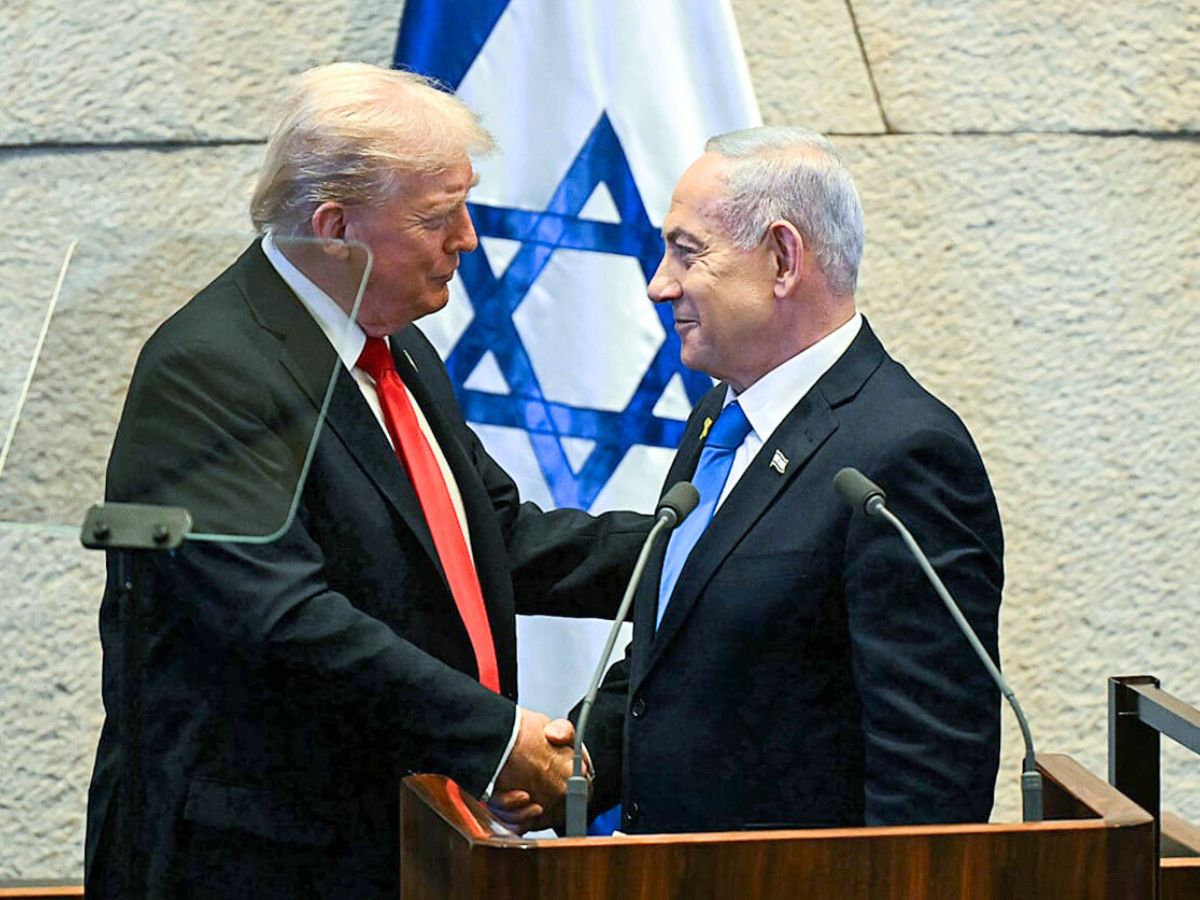

Israel’s Prime Minister Benjamin Netanyahu on Wednesday has agreed to join US President Donald Trump’s controversial “Board of Peace”, a body proposed to oversee post-war governance and reconstruction in Gaza, marking a major shift after Israel earlier raised sharp objections to the panel’s composition.
The decision signals a recalibration in Israel’s approach to Trump’s Gaza plan, even as questions remain over the board’s authority, legitimacy and implications for the future of the war-battered territory.
Trump’s ‘Board of Peace’ for Gaza-What we know
The “Board of Peace”, chaired by Trump, was initially conceived as a small group of world leaders tasked with overseeing the Gaza ceasefire and managing the transition to post-war governance.
However, the Trump administration has since expanded the idea into a broader international body, with invitations extended to dozens of countries and prominent global figures.
Trump has hinted that the board could eventually broker conflicts beyond Gaza, turning it into a parallel diplomatic platform with ambitions that stretch far beyond the Israel-Palestine theatre.
Under the ceasefire agreement, the board’s Gaza Executive Committee will be responsible for implementing the second phase of the deal, including security arrangements, the disarmament of Hamas, the rebuilding of Gaza and supervision of a committee of Palestinian technocrats who will handle day-to-day governance in the Strip.
Why Israel initially objected ‘Board of Peace’
Before Netanyahu’s reversal, his office had publicly criticised the board’s composition, particularly the inclusion of Turkey, a key regional rival of Israel, in the Gaza executive committee.
Israel said the appointments were not coordinated with the Israeli government and were “contrary to its policy”, without clarifying its specific objections.
The controversy also exposed divisions within Israel’s ruling coalition. Finance Minister Bezalel Smotrich, a far-right ally of Netanyahu, strongly opposed the board and called for Israel to take unilateral responsibility for Gaza’s future instead of allowing an international body to shape its governance.
Why did Netanyahu change course now?
Netanyahu’s decision to accept Trump’s invitation comes amid mounting diplomatic pressure and as Trump prepares to unveil further details about the board at the World Economic Forum in Davos, Switzerland.
By joining the board, Netanyahu ensures Israel will have a direct role in shaping Gaza’s political and security future rather than being excluded from decisions that could have lasting implications for its national security.
At the same time, the move risks deepening internal rifts within his coalition, especially with far-right partners who view the plan with suspicion.
Who has joined and who is yet to respond?
Several countries have already agreed to join Trump’s Board of Peace, including the United Arab Emirates, Morocco, Vietnam, Belarus, Hungary, Kazakhstan and Argentina.
Others, such as the United Kingdom, Canada, Egypt, Russia, Turkey and the European Union, have confirmed receiving invitations but are yet to announce their positions.
The hesitation among major global players underscores the uncertainty surrounding the board’s structure, mandate and international legitimacy.
Trump’s UN remarks trigger controversy
The initiative has deepened further controversy after Trump suggested the Board of Peace could potentially replace the United Nations. When asked whether the board should supplant the UN, Trump said “it might”, criticising the world body for not living up to its potential while also acknowledging that it should continue to exist.
The remarks drew swift reactions from Europe. French Foreign Minister Jean-Noël Barrot said France supports Trump’s peace plan but opposes the creation of a new organisation that would replace the United Nations.
Trump also took a swipe at French President Emmanuel Macron, saying he was unlikely to join the board and claiming “nobody wants him”, comments that further fuelled diplomatic tensions.
The Gaza Executive Board and key figures
Alongside the Board of Peace, the White House has announced the formation of a separate Gaza Executive Board, which will oversee the practical implementation of the ceasefire’s second phase. This includes security arrangements, disarmament processes and reconstruction efforts.
Prominent figures associated with the board include US Secretary of State Marco Rubio, Trump envoy Steve Witkoff, Trump’s son-in-law Jared Kushner, former British Prime Minister Tony Blair, World Bank President Ajay Banga and former UN Middle East envoy Nickolay Mladenov, who will supervise day-to-day operations.
The executive board will also oversee the National Committee for the Administration of Gaza, which is expected to manage civilian governance in the territory.
Gaza’s ground reality and why governance matters
Despite the ceasefire, Gaza remains gripped by a deep humanitarian crisis. Since the truce was announced, hundreds of Palestinians have reportedly been killed. Israel continues to restrict the flow of food and aid, while large parts of the population live in makeshift shelters with little protection from extreme weather. Cases of hypothermia have been reported during winter cold spells.
The Board of Peace is also expected to supervise Gaza’s reconstruction after more than two years of war left much of the Strip destroyed and tens of thousands of Palestinians dead.
What can we expect for Gaza from the Board of Peace?
Several critical questions remain unresolved. It is still unclear whether Hamas will agree to disarm, who will form the international security force, and whether Palestinians will accept a governance model imposed largely from outside.
Netanyahu’s decision to join Trump’s Board of Peace places Israel inside a complex and politically charged experiment in post-war governance. Whether the initiative becomes a pathway to lasting peace or another contested geopolitical structure will depend on how these unanswered questions are resolved in the coming weeks.
Sofia Babu Chacko is a journalist with over five years of experience covering Indian politics, crime, human rights, gender issues, and stories about marginalized communities. She believes that every voice matters, and journalism has a vital role to play in amplifying those voices. Sofia is committed to creating impact and shedding light on stories that truly matter. Beyond her work in the newsroom, she is also a music enthusiast who enjoys singing.




