
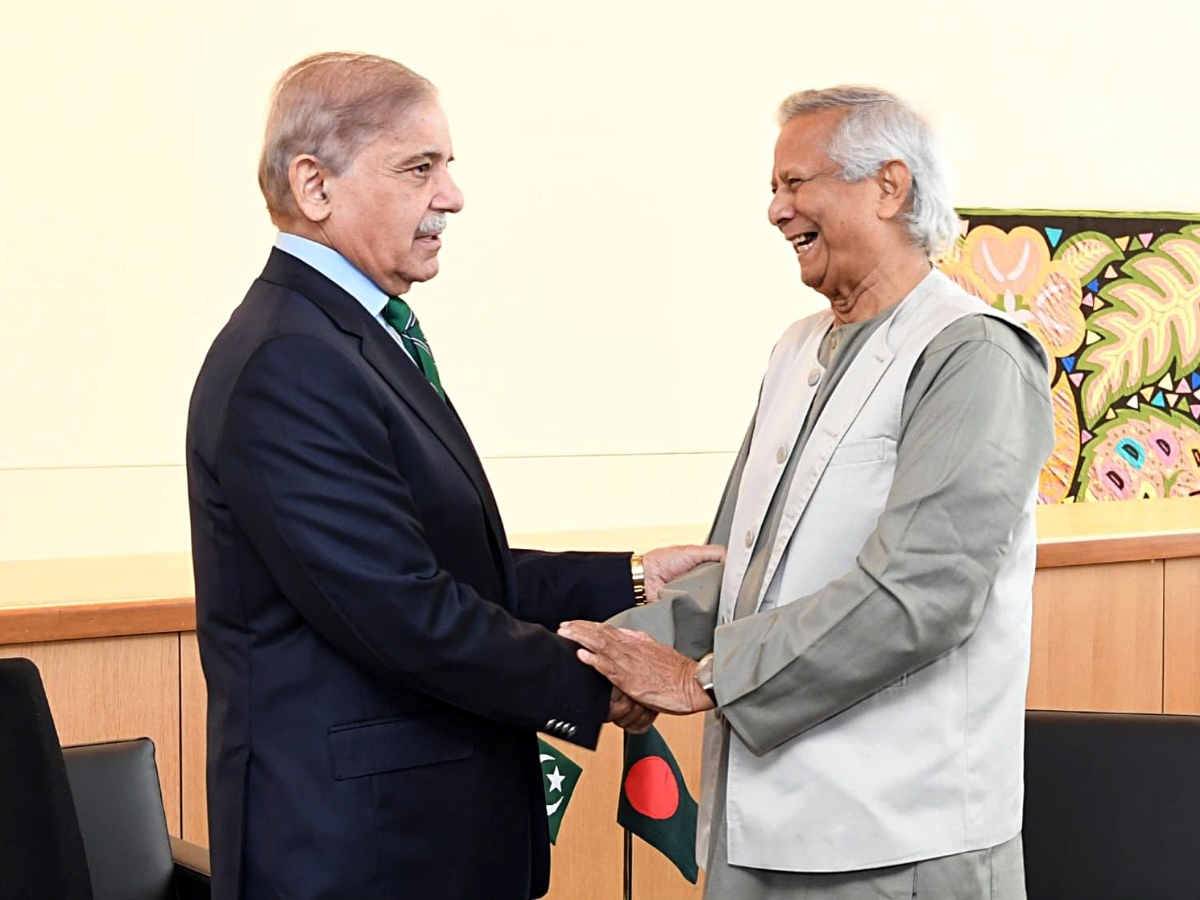

Muhammad Yunus, the outgoing interim adviser, delivered a farewell address on Monday, just ahead of the formation of Bangladesh’s new government led by Bangladesh Nationalist Party (BNP) Chairman Tarique Rahman. He spoke about Bangladesh’s sovereignty and economic ambitions while also triggering debate over regional references that appeared to touch on India’s strategic interests.
Yunus’ tenure coincided with heightened tensions with India, particularly around minority rights and trade disputes, while ties with Pakistan saw improvement, though not without domestic debate.
Muhammad Yunus on Sovereignty and Foreign Policy Independence
Throughout his speech, Muhammad Yunus repeatedly stressed that Bangladesh had reclaimed its “sovereignty, dignity, and independence” in foreign policy, asserting that the country was “no longer guided by others’ directives.”
Also Read: ‘Doing A Deal With Iran Is Not Easy,’ Says Marco Rubio Amid Nuclear Talks Tensions
Reflecting on his administration’s achievements, Yunus claimed his government restored three core pillars of foreign engagement: sovereignty, national interests, and dignity. He also pointed to institutional reforms, stating that approximately 130 new laws and amendments had been introduced alongside 600 executive orders, of which 84% were implemented.
Muhammad Yunus Makes Reference to India’s Northeast
A key point of controversy emerged when Yunus spoke about future economic integration involving Nepal, Bhutan, and the “Seven Sisters” – a term commonly used to refer to India’s northeastern states – without directly mentioning India.
“Our open seas are not just borders – they are gateways to the global economy. With Nepal, Bhutan, and the Seven Sisters, this region has immense economic potential. Economic zones, trade agreements, and duty-free market access can establish us as a global manufacturing hub,” he said.
By grouping India’s northeastern region alongside sovereign nations within a single economic framework, Yunus appeared to blur established political distinctions.
He further elaborated that Bangladesh’s maritime access could serve as a strategic link connecting landlocked neighbours to global markets, positioning the country as a central hub in a sub-regional economic network.
Muhammad Yunus on China-Backed Projects
The outgoing leader’s tone sharpened further as he highlighted the need for “strategic balance” in international relations and pointed to deepening cooperation with China, Japan, the United States, and Europe.
He cited progress on Chinese-supported projects, including the Teesta River initiative, located near India’s strategically sensitive Siliguri corridor, and the development of a 1,000-bed international hospital in Nilphamari.
“We have also deepened cooperation with China. Significant progress has been made on the Teesta River project and a 1,000-bed international hospital in Nilphamari,” Yunus said.
Also Read: Muhammad Yunus Resigns As Bangladesh Interim Leader Ahead Of Tarique Rahman’s Oath-Taking
Zubair Amin is a Senior Journalist at NewsX with over seven years of experience in reporting and editorial work. He has written for leading national and international publications, including Foreign Policy Magazine, Al Jazeera, The Economic Times, The Indian Express, The Wire, Article 14, Mongabay, News9, among others. His primary focus is on international affairs, with a strong interest in US politics and policy. He also writes on West Asia, Indian polity, and constitutional issues. Zubair tweets at zubaiyr.amin




