

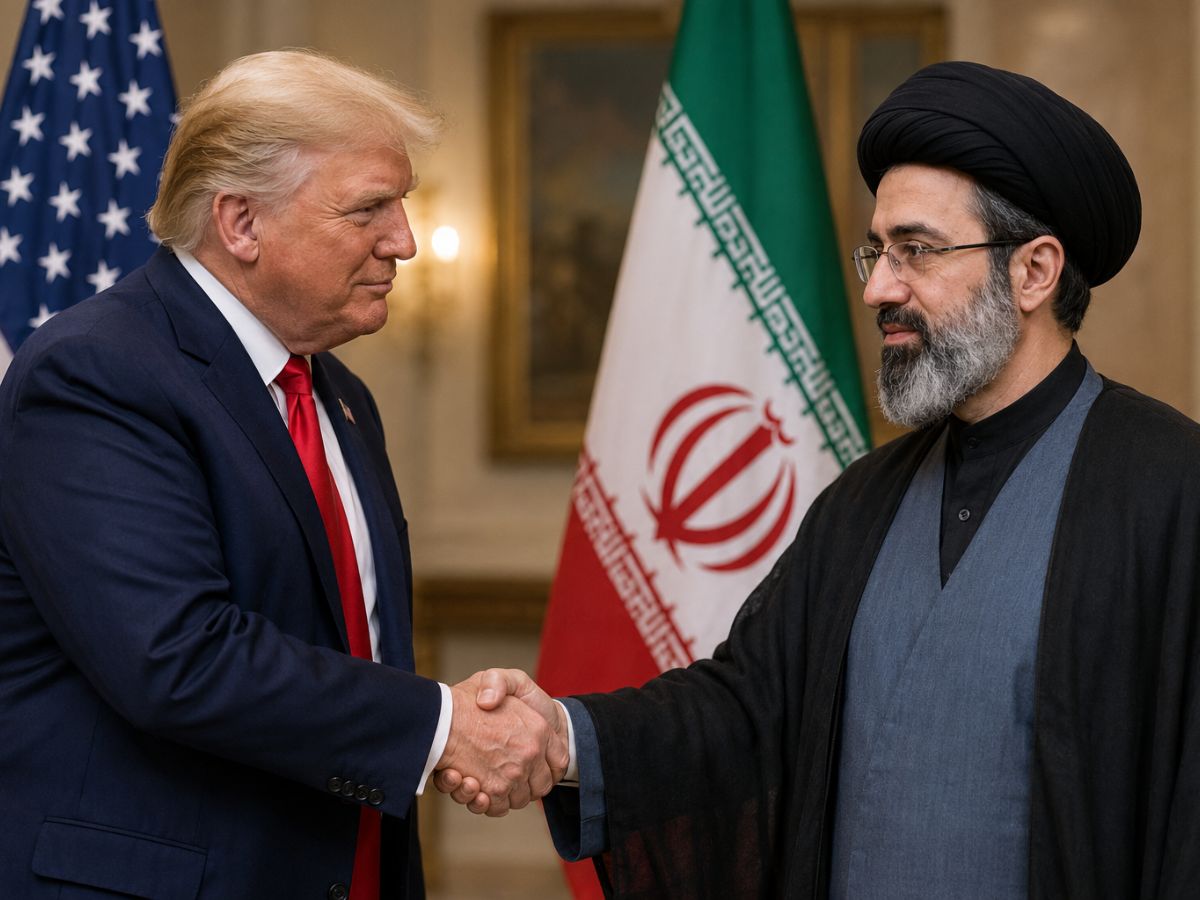
President Donald Trump on Thursday chickened out once again after threatening to bomb Iran. The POTUS cited a major breakthrough was achieved in talks with Iran. He claimed that Tehran has agreed to let go of the development and acquisition of nuclear weapons. Trump said that the deal will be signed formally within a few days. Reports say that Iran finalized and submitted a draft agreement to Qatari authorities on Wednesday night. The President claimed that the Iranian Supreme Leader, Mojtavba Khamenei, has accepted the deal. According to reports, the deal will be signed in Geneva and will be called the ‘Islamabad Accord’. Vice President JD Vance is likely to travel to Geneva, where the deal is reportedly being signed in the coming days.
“We just made a great settlement of the war with Iran,” Trump said. “And we’re going to be subject to finalization of documents, we should get done over the next few days,” he added.
He stressed that Iran had committed to permanently forgoing nuclear weapons.
“[Iran] will not only not have – they will not purchase, develop in any way, any shape, in any way, shape, or form, a nuclear weapon. They will not have a nuclear weapon,” Trump added. “It’s a great thing,” Trump said. “Stock market’s up 1,000 points. That means they like the deal.”
What Is Inside The US-Iran Peace Deal
If the deal is signed, the memorandum of understanding (MOU) will serve as the foundation for a broader round of nuclear negotiations between Washington and Tehran.
No Nuclear Weapons
The central point in the MoU is that Iran can not develop nuclear weapons. Reports say that Iran has agreed not to buy or develop a nuclear warhead.
“Most importantly, we have a deal that Iran will never have a nuclear weapon, which was the whole purpose of what we had to go through to get this, so it was a big, very big thing,” Trump said.
Despite the commitment contained in the proposed agreement, the issue is far from settled. Trump’s administration remains cautious because Iran had also pledged not to develop nuclear weapons under the 2015 nuclear agreement reached during former President Barack Obama’s administration. As a result, additional negotiations are expected after the MOU is signed.
Abandoning The Enriched Uranium
The United States is seeking the complete abandonment of Iran’s uranium enrichment program. Washington is also expected to pursue the destruction, degradation, or transfer of the remaining “nuclear dust” that remains buried beneath Iranian nuclear facilities targeted during last June’s “Operation Midnight Hammer” strikes.
On Iran’s Missile Program, Proxies
Trump also assured Israeli Prime Minister Benjamin Netanyahu during a phone call on Thursday that future negotiations would address Iran’s missile program as well as Tehran’s support for regional proxy groups, including Hamas, Hezbollah, and the Houthis.
In a readout of the conversation, Netanyahu’s office said, “The Prime Minister expressed his appreciation for President Trump’s commitment that the final agreement at the conclusion of negotiations will include the removal of enriched material, the dismantling of enrichment infrastructure, limits on missile production, and the cessation of Iran’s support for its terrorist proxies in the region.”
Will Iran Open Strait of Hormuz?
Another key component of the emerging agreement involves the Strait of Hormuz. Iran has reportedly agreed to reopen the strategic waterway during a proposed 60-day ceasefire and negotiation period, provided the United States lifts its blockade of Iranian ports.
The blockade has reportedly been costing Tehran an estimated $500 million per day. However, Trump indicated that the blockade would remain in place until the agreement is formally completed. In a post on Truth Social, he wrote, “The Naval Blockade will remain in full force and effect until this Transaction is finalized.”
Iran has asserted ownership claims over the Strait of Hormuz and recently established a “Persian Gulf Strait Authority” to impose fees on commercial vessels seeking passage through the route. The United States has opposed those charges, maintaining that the strait is an international waterway and should remain accessible without tolls. It remains unclear how the reopening process would be implemented or whether it would involve efforts to remove naval mines from the area.
Economic Incentives For Iran
While progress has reportedly been made on security and nuclear issues, the largest unanswered question concerns economic incentives for Iran. Tehran has consistently demanded access to frozen Iranian assets and the easing of US sanctions as part of any agreement involving nuclear concessions. The United States has signaled that it may be willing to unfreeze some Iranian funds in exchange for steps on the nuclear front. However, the timing and mechanism for releasing those assets have remained major obstacles throughout the negotiations.
Two US officials told Axios on Thursday that negotiators had made progress on developing a mechanism for the release of funds under the proposed agreement.
Will US Lift Sanctions Against Iran?
Iran has also repeatedly sought the lifting of US sanctions. However, Secretary of State Marco Rubio told Congress last week that sanctions relief would only be considered if Iran makes measurable and verifiable changes to its nuclear program.
Also Read: Iran-US-Israel War LIVE and Latest Updates
Zubair Amin is a Senior Journalist at NewsX with over seven years of experience in reporting and editorial work. He has written for leading national and international publications, including Foreign Policy Magazine, Al Jazeera, The Economic Times, The Indian Express, The Wire, Article 14, Mongabay, News9, among others. His primary focus is on international affairs, with a strong interest in US politics and policy. He also writes on West Asia, Indian polity, and constitutional issues. Zubair tweets at zubaiyr.amin





