
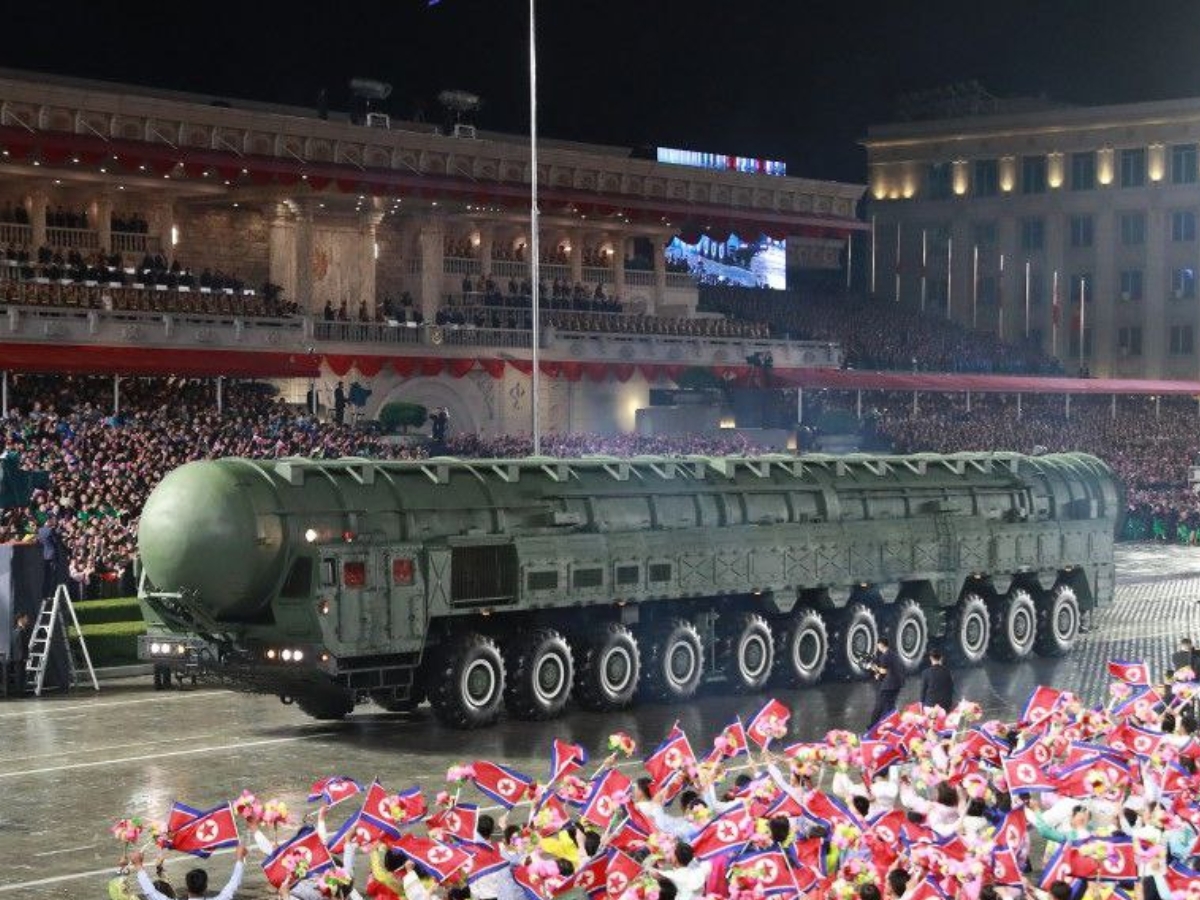

Hwasong-20 Missile: North Korean leader Kim Jong Un unveiled a new long-range intercontinental ballistic missile (ICBM) during a grand military parade in Pyongyang on Friday. The event, which featured several foreign dignitaries, marked the 80th anniversary of the founding of the ruling Worker’s Party.
Hwasong-20: New Missile Displayed as “Most Powerful” Strategic Weapon
The newly revealed Hwasong-20, which has not yet been flight-tested, was described by the state-run Korean Central News Agency (KCNA) as possessing the “most powerful nuclear strategic weapons system.
Alongside the Hwasong-20, North Korea also displayed an array of shorter-range ballistic missiles, cruise missiles, and supersonic weapons during the parade.
Kim Jong Un Calls for Building an “Invincible Force”
In his address, Kim emphasized the need to enhance the country’s military capabilities, declaring that the armed forces “must continue to evolve into an invincible force that eliminates all threats.”
The parade was attended by foreign leaders, including Chinese Premier Li Qiang, former Russian President Dmitry Medvedev, and Vietnamese Communist Party chief To Lam.
North Korea unveils the Hwasong-20, a new solid-fueled ICBM, hailed as its most powerful nuclear weapon yet.
The three-stage missile can allegedly reach the entire U.S. mainland (up to 15,000 km) and carry multiple nuclear warheads (MIRVs).
It uses a new high-thrust solid-fuel… pic.twitter.com/NElr66b1KQ
— Clash Report (@clashreport) October 11, 2025
Kim met Medvedev on Friday, during which the Russian official praised the “sacrifice of North Korean soldiers fighting with Russia in Ukraine.” Kim expressed his willingness to deepen cooperation with Moscow, saying he hoped to “strengthen ties with Russia and work together toward common goals.”
North Korea Continues To Defy US
Last summer, Kim Yo Jong, the sister of Kim Jong Un, issued a warning to the United States against attempting to resume denuclearization talks. She cautioned that any pressure campaign aimed at dismantling Pyongyang’s nuclear program would be seen as “nothing but a mockery.”
“If the US fails to accept the changed reality and persists in the failed past, the DPRK – US meeting will remain as a ‘hope’ of the US side,” Kim Yo Jong said, referring to North Korea by its official name, the Democratic People’s Republic of Korea (DPRK).
North Korea Developing Weapons Rapidly Since China Visit
Since Kim’s last meeting in Beijing, North Korean state media has frequently highlighted new or upgraded weapons systems. These include the Hwasong-11Ma, a short-range ballistic missile equipped with a maneuverable hypersonic warhead, and the newly displayed Hwasong-20.
The Hwasong-11Ma made its first public appearance at a military exposition in Pyongyang just a week ago. The Hwasong-11 series is based on Russia’s Iskander missiles, which have been used extensively in Russian strikes on Ukraine.
Hwasong-11Ma And Hwasong-20: Hypersonic Capabilities and Advanced Warhead Design
The upgraded Hwasong-11Ma is reportedly fitted with a boost glide vehicle – a flattened, finned glider that allows the warhead to follow an unpredictable flight path, complicating detection and interception efforts. These maneuvers occur at speeds exceeding five times the speed of sound, qualifying the missile as hypersonic.
Missile experts say the Hwasong-20 appears significantly heavier, with a larger and rounder nose cone, suggesting the potential to carry multiple independently targetable re-entry vehicles (MIRVs). This technology would enable a single missile to deliver several warheads to different targets simultaneously, posing a serious challenge to U.S. missile defense systems.
“I suspect Russia might have helped the North develop the Hwasong-20,” missile expert Lee said, drawing a comparison to Russia’s Topol-M missile, a solid-fueled ICBM with a range of 11,000 kilometers (6,800 miles).
Zubair Amin is a Senior Journalist at NewsX with over seven years of experience in reporting and editorial work. He has written for leading national and international publications, including Foreign Policy Magazine, Al Jazeera, The Economic Times, The Indian Express, The Wire, Article 14, Mongabay, News9, among others. His primary focus is on international affairs, with a strong interest in US politics and policy. He also writes on West Asia, Indian polity, and constitutional issues. Zubair tweets at zubaiyr.amin




