
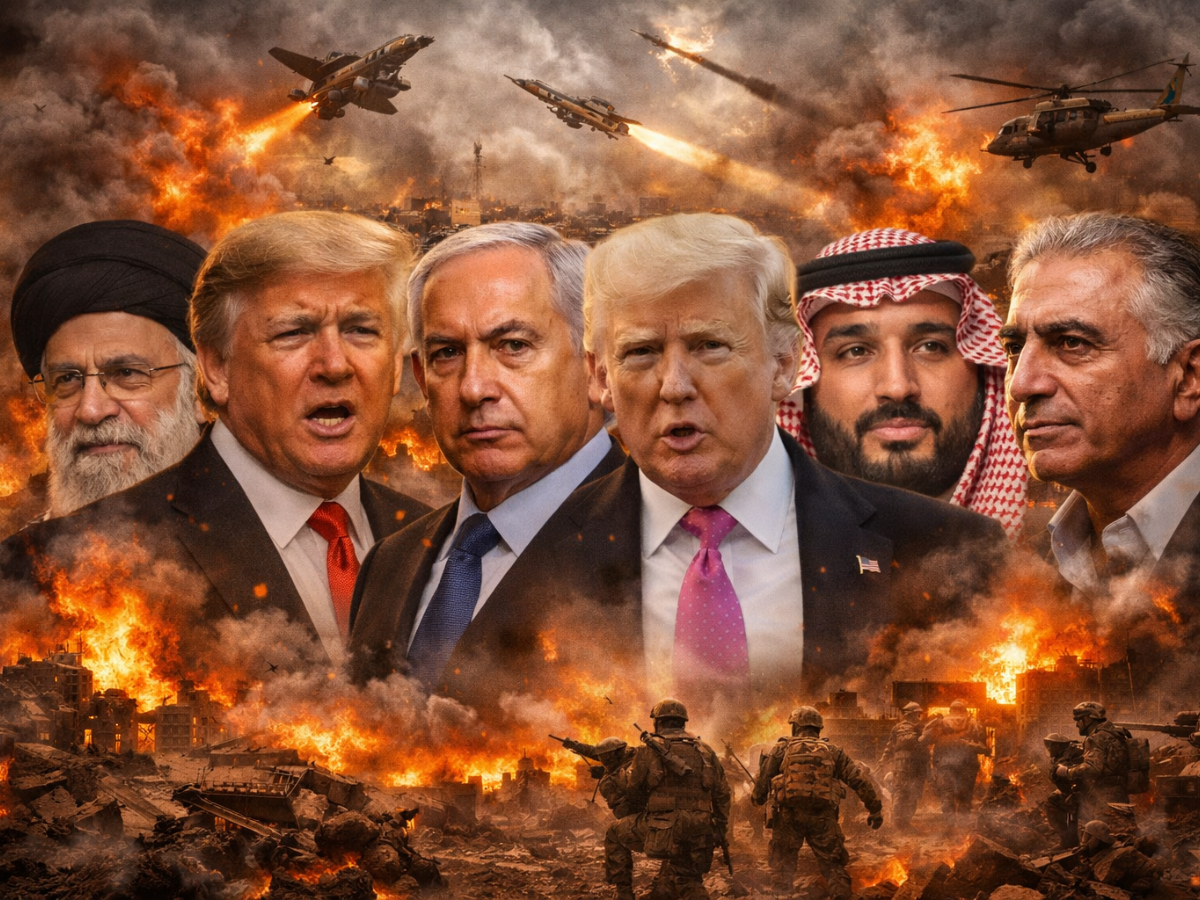

The Middle East is witnessing another war, this one has the potential to make the decades-long turmoil in the region that has engulfed many countries look like a backyard squabble. The strikes on Iran conducted by the United States and Israel have escalated tensions sharply.
Donald Trump
At the centre of the crisis in Washington is former US President Donald Trump, who publicly confirmed “major combat operations” early on the day of the strikes. Trump said the offensive was necessary to remove what he described as a direct threat from Iran’s nuclear and missile programmes. Critics argue his approach has moved away from diplomacy toward coercion and possible regime change, pushing Tehran into a corner rather than opening space for talks.
Benjamin Netanyahu
In Israel, Prime Minister Benjamin Netanyahu has repeatedly stressed that Iran poses an “existential threat” to his country. His government backed pre-emptive military action and coordinated closely with US forces to hit strategic Iranian targets. Israeli military sources have described the offensive as essential for national security.
Mohammad bin Salman
Saudi Arabia’s Crown Prince Mohammad bin Salman is another influential figure in the region’s unfolding crisis. Riyadh has traditionally backed stronger measures against Iran. Saudi has always viewed Tehran’s regional influence as a direct threat to Saudi interests. While Saudi officials have stopped short of committing troops, they have signalled political support for actions that counter Iranian power. Bin Salman’s stance reflects the broader Sunni–Shia rivalry shaping Middle Eastern alliances.
Ayotullah Ali Khamenei
On the Iranian side, the deaths of senior commanders have shaken Tehran’s leadership. Major General Mohammad Pakpour, who had led the Islamic Revolutionary Guard Corps until recently, was killed in the strikes. He had taken over after the earlier killing of former IRGC chief Hossein Salami in 2025. Their losses have dealt a heavy blow to Iran’s military command structure.
Pakpour was known for his hard-line rhetoric. Just weeks before his death, he warned Israel and the United States against “miscalculation,” saying Iran’s forces were “more ready than ever” and had their “finger on the trigger.” His killing marks both a symbolic and strategic escalation.
At the top of Iran’s political system stands Supreme Leader Ali Khamenei, who has rejected accusations that Iran seeks nuclear weapons and insists the programme is peaceful. Khamenei has framed the strikes as aggression against Iranian sovereignty and vowed resistance.
Reza Pahlavi
Meanwhile, exiled opposition figure Reza Pahlavi has used the crisis to criticise the Islamic Republic, arguing that the current leadership has isolated Iran and exposed it to repeated military confrontations. He has called for political change inside Iran, saying ordinary citizens are paying the price for the regime’s policies.
Analysts like Karim Sadjadpour warn that military pressure often hardens Tehran’s stance instead of drawing it back to negotiations. Diplomats say only sustained talks can prevent the crisis from spiralling into a wider regional war. For now, powerful leaders on all sides are steering events, and their next moves could determine whether the region plunges deeper into conflict or finds a path back to dialogue.




