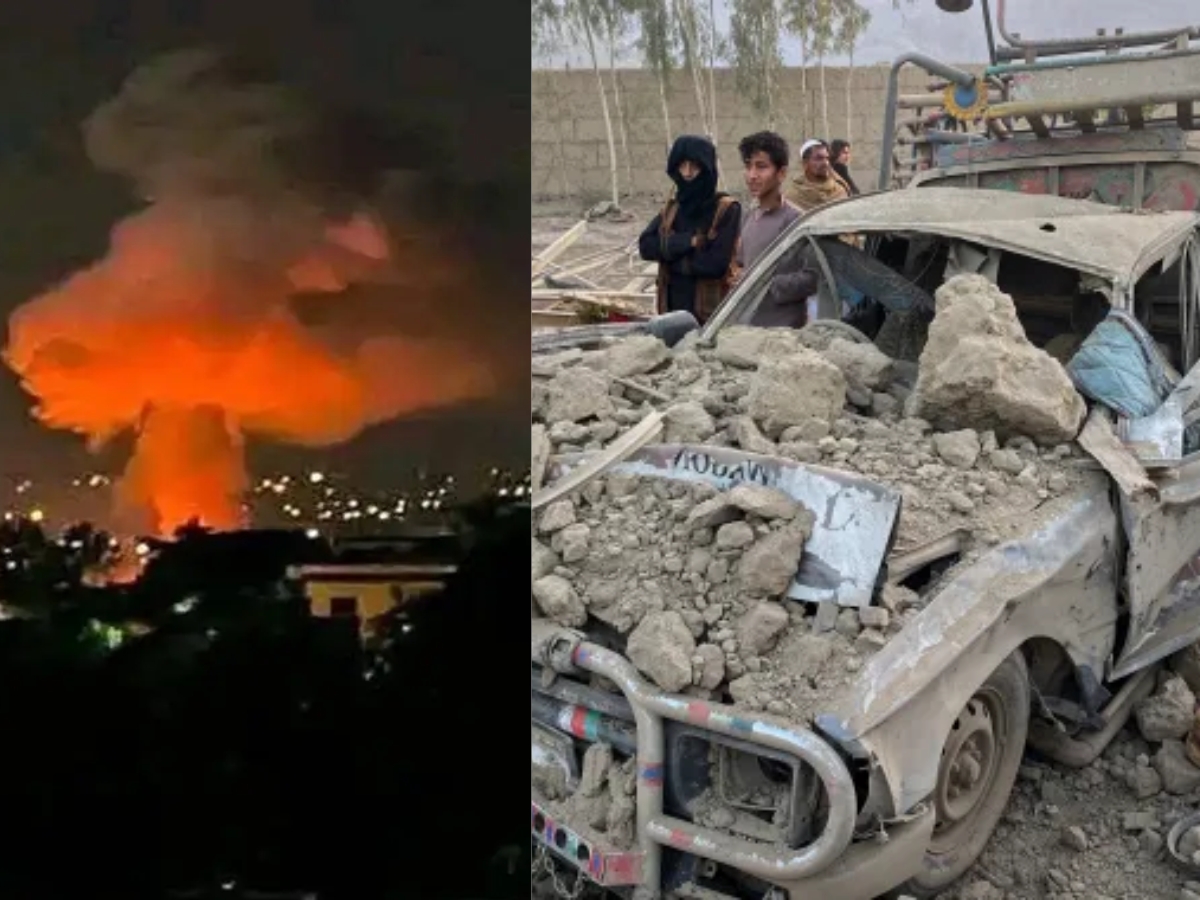

Pakistan and Afghanistan are in open war now, as announced by Defence Minister Khawaja Asif after Islamabad carried out huge airstrikes against the Taliban. Pakistan has announced the launch of “Operation Ghazab Lil Haq,” while Afghanistan’s Taliban authorities say their forces have carried out retaliatory operations across multiple eastern provinces.
Pakistan Announces “Operation Ghazab Lil Haq”
State broadcaster PTV News reported that Islamabad initiated “Operation Ghazab Lil Haq” against what it called Afghanistan’s “unprovoked” strikes. Kabul has claimed that Afghan forces had killed 55 Pakistani soldiers in cross-border strikes.
Afghanistan’s Deputy Spokesperson Hamdullah Fitrat said Taliban units had seized 19 Pakistani military outposts and captured a headquarters at Anzar Sar in Khost province.
Writing on X, Fitrat stated that “heavy retaliatory offensive operations” were launched by the 203 Mansouri Corps and the 201 Khalid bin Walid Corps. He claimed up to 55 Pakistani soldiers were killed, with several bodies recovered and others taken alive. According to him, operations were ongoing across Paktia, Paktika and Nangarhar, including the Torkham Gate crossing.
Pakistan Rejects Afghan Casualty Figures, Says Over 130 Taliban Fighters Killed
Pakistan strongly denied Kabul’s account.
Information Minister Attaullah Tarar said two Pakistani soldiers were killed and three wounded, while 36 Afghan fighters had died in the fighting. He described Afghan claims as exaggerated and termed the cross-border action “unprovoked aggression.”
In a post on X, Tarar said Pakistan was delivering a “strong and effective response” to what he called unprovoked firing and would continue to defend its territorial integrity.
Mosharraf Ali Zaidi, spokesperson for Prime Minister Shehbaz Sharif, also rejected Afghan claims that Pakistani soldiers had been captured.
In a subsequent post on X, Zaidi said at least 133 Afghan fighters were killed and more than 200 wounded. He further claimed that 27 Afghan posts were destroyed and nine fighters captured. While he did not specify locations, he added there would be “many more casualties estimated in strikes in Kabul, Paktia and Kandahar military targets.”
Pakistan Declares All-Out War Against Afghanistan
Prime Minister Shehbaz Sharif said on Friday that Pakistan’s armed forces were fully capable of defeating any hostile move following airstrikes on neighbouring Afghanistan.
“Our forces have the full capability to crush any aggressive ambitions,” Sharif said in a post shared on the Pakistani government’s X page.
He added, “The entire nation stands shoulder to shoulder with the Pakistan armed forces,” signalling political support amid intensifying cross-border tensions.
Pakistan’s Defence Minister Khawaja Asif declared an “open war” with Afghanistan’s Taliban government, marking a sharp escalation in rhetoric and posture.
Announcing the shift, Asif wrote on X, “Our patience has reached its limit. Now it is open war between us and you.”
Which Afghan Cities Were Hit By Pakistan?
Pakistan carried out airstrikes targeting Afghan cities, including Kabul, Kandahar and Paktia, after a fresh round of clashes.
AFP reported that jets were heard over Kabul and Kandahar, with journalists on the ground describing multiple loud explosions followed by gunfire lasting more than two hours.
Afghan Taliban spokesperson Zabihullah Mujahid confirmed the Pakistani strikes but said there were no casualties.
Pakistan’s Interior Minister Mohsin Naqvi described the military action as a “befitting response,” saying the armed forces acted after Afghan troops allegedly attacked Pakistani border personnel.
Later, President Asif Ali Zardari said on X, “Pakistan will not compromise on peace and territorial integrity.”
“Our armed forces’ response is comprehensive and decisive. Those who mistake our peace for weakness will face a strong response – and no one will be beyond reach,” he added.
What Taliban Said About Its Retaliatory Operations Against Pakistan
Afghanistan said its military response followed earlier Pakistani strikes.
According to The Associated Press, Afghan authorities stated that their forces launched cross-border attacks late Thursday in response to Pakistani airstrikes on Afghan territory.
In a detailed press release, Afghanistan’s Ministry of National Defense said the operation began at 8 pm on Thursday, corresponding to the 9th of Ramadan 1447. The ministry described the action as retaliation for what it called a Pakistani violation of Afghan territory that killed women and children.
“A few days ago, the Pakistani military circles, with great audacity, violated Afghan territory, breached our borders, and martyred women and children here,” the statement said.
The ministry said Afghan forces conducted coordinated counterattacks in eastern and southeastern sectors across the Durand Line near Paktika, Paktia, Khost, Nangarhar, Kunar and Nuristan provinces.
What Triggered The Latest Pakistan-Afghanistan War?
The latest escalation appears to have been triggered by Pakistani strikes along the border on Sunday.
Pakistan’s military said it had killed at least 70 militants in those operations. Kabul rejected the claim, reportedly stating that dozens of civilians, including women and children, were killed instead.
Afghanistan’s defence ministry said “various civilian areas” in eastern Afghanistan were hit, including a religious madrassa and several homes. It described the strikes as a violation of Afghan airspace and sovereignty.
The current crisis follows months of mounting strain.
Deadly border clashes in October last year left dozens of soldiers, civilians and suspected militants dead on both sides, pushing relations to a low point.
The violence at the time followed explosions in Kabul that Afghan officials blamed on Pakistan. In response, Islamabad carried out strikes deep inside Afghanistan, saying it was targeting militant hideouts.
Although a ceasefire brokered by Qatar largely held, intermittent fire continued along the border. Several rounds of peace talks in November failed to produce a formal agreement, leaving the situation fragile.
Pakistan-Afghanistan Disputed Border: The Durand Line Issue
The Durand Line, a long-contested boundary dating back to the colonial era, has frequently fuelled tensions between the two sides.
Pakistan accuses Afghan-based militants of staging attacks inside Khyber Pakhtunkhwa and Balochistan. Kabul, meanwhile, rejects the legitimacy of the boundary and accuses Islamabad of violating Afghan sovereignty.
Zubair Amin is a Senior Journalist at NewsX with over seven years of experience in reporting and editorial work. He has written for leading national and international publications, including Foreign Policy Magazine, Al Jazeera, The Economic Times, The Indian Express, The Wire, Article 14, Mongabay, News9, among others. His primary focus is on international affairs, with a strong interest in US politics and policy. He also writes on West Asia, Indian polity, and constitutional issues. Zubair tweets at zubaiyr.amin