
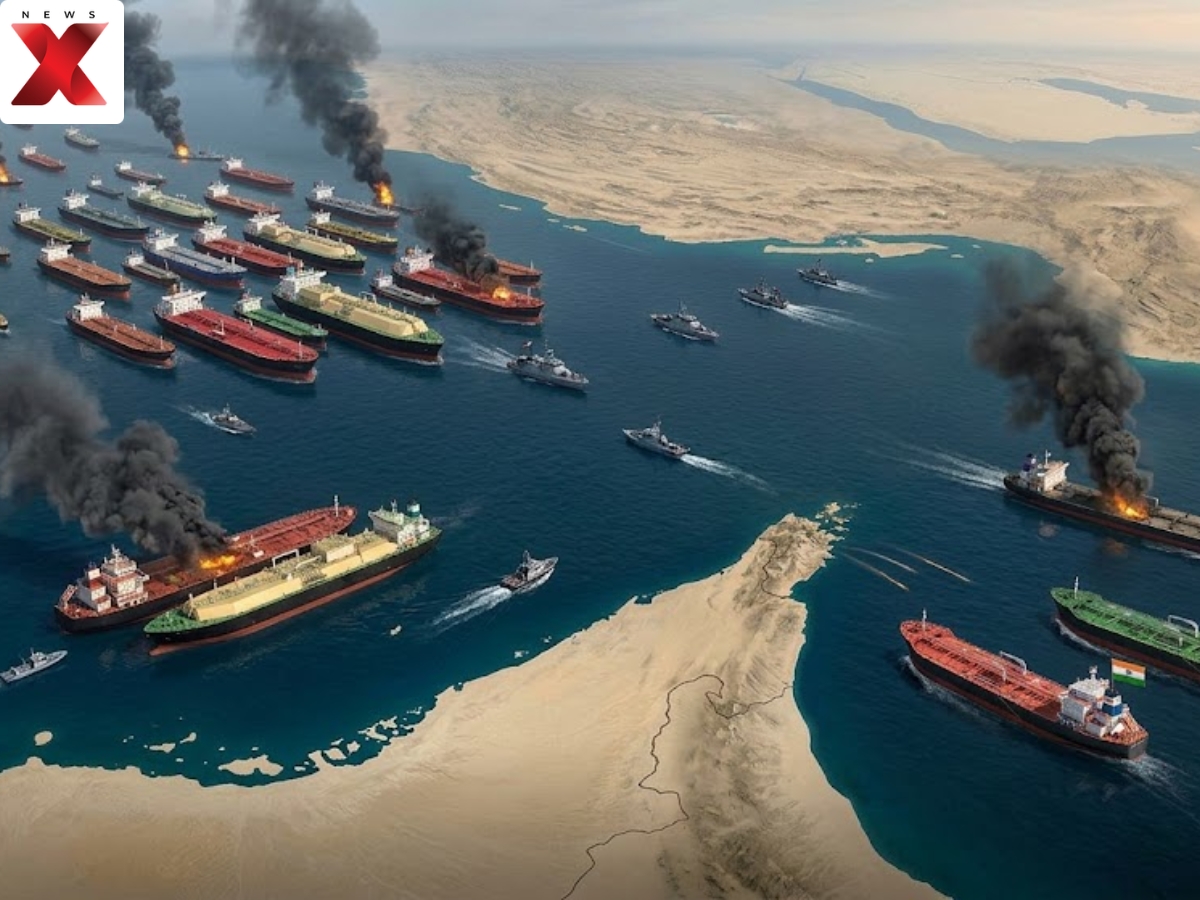

The Strait of Hormuz has effectively been shut to commercial shipping since late February. The disruption in the strategically vital strait, a narrow maritime corridor linking the Persian Gulf with the Gulf of Oman, followed joint military strikes on Iran by the United States and Israel. The ongoing war in the Middle East or Gulf region has triggered a dangerous escalation across one of the world’s most critical energy routes.
The closure has created an unprecedented disruption in energy markets and raised fears of broader economic consequences.
Why Strait Of Hormuz Is Important
Roughly 20% of the world’s oil trade and an equivalent share of global liquefied natural gas (LNG) supply normally pass through the strait. Under normal conditions, nearly 20 million barrels of crude oil move through the strait every day. In addition, approximately 10.8 billion cubic feet (Bcf) of LNG daily transits the same route.
The waterway is also vital for agricultural supply chains. Around 30% of global fertiliser exports, including urea and ammonia, are shipped through the corridor, making the disruption a potential trigger not only for an energy crisis but also for food supply concerns across multiple regions.
Is Strait Of Hormuz Closed?
The security environment along the Persian Gulf-Hormuz–Gulf of Oman sea lane remains highly unstable. Iranian authorities are currently refusing to allow crude oil tankers to travel under naval escort.
Despite the tense conditions, two tankers belonging to the Shipping Corporation of India, Pushpak and Piramal, managed to cross the strait without escort between late night and early morning hours.
However, the situation deteriorated further when three other tankers were struck by Iranian projectiles, sustaining damage while attempting to navigate the waterway.
UN Security Council Invokes Self-Defence Clause
Amid the escalating crisis, the United Nations Security Council adopted a resolution on Wednesday night invoking Article 51 of the UN Charter, which recognises the right of member states to individual or collective self-defence against armed attacks.
The resolution, sponsored by 134 countries, was passed with 13 votes in favour, while China and Russia abstained.
According to assessments cited in the report, Iran is deliberately targeting shipping in the Persian Gulf in an attempt to trigger both a global oil crisis and a food crisis across the Middle East by disrupting key supply routes.
Are There Any Alternatives To the Strait Of Hormuz?
Energy experts say that only a handful of existing pipelines could partially offset the disruption.
Euronews quoting Baird Langenbrunner, Research Analyst at the Global Energy Monitor, says that there are two main oil pipelines that could act as alternatives to shipping through the Strait of Hormuz.
The first option is Saudi Arabia’s East–West crude oil pipeline, which runs from the Abqaiq processing centre in the east to Yanbu on the Red Sea.
The pipeline currently has a capacity of 5 million barrels per day.
Langenbrunner explained that additional infrastructure running parallel to the route could be temporarily repurposed to increase total capacity.
However, he cautions that such adjustments would create competition with other energy products being transported along the same route.
UAE’s Habshan–Fujairah Pipeline
The second alternative is the Habshan–Fujairah oil pipeline in the United Arab Emirates.
The pipeline transports crude from Habshan in Abu Dhabi to the Fujairah terminal on the Gulf of Oman, allowing shipments to bypass the Strait of Hormuz entirely.
But its capacity remains limited..
The pipeline’s maximum capacity is about 1.8 million barrels per day, far below the scale of oil normally transported through the strait.
Alternative Routes To Strait Of Hormuz Cover Only A Fraction Of Oil Flow
Even when combined, the alternative pipelines can move only a small portion of the 20 million barrels per day that typically pass through the Strait of Hormuz.
Saudi Arabia, the largest producer in the OPEC, relies on the East–West crude pipeline linking Abqaiq to Yanbu, with a total crude transport capacity of 5 million barrels per day.
Similarly, the UAE’s pipeline from Habshan to Fujairah carries nearly 1.8 million barrels per day.
In addition, data from the International Energy Agency shows that Saudi Arabia operates a natural gas liquids pipeline running parallel to the East–West crude pipeline, capable of transporting up to 300,000 barrels per day when fully utilised.
Building New Pipelines Would Take Years
Constructing new pipelines to bypass the Strait of Hormuz could theoretically reduce dependence on the chokepoint, but experts say such projects require significant investment and years of construction.
For now, energy analysts maintain that shipping through the Strait of Hormuz remains the most efficient and viable route for global oil and gas flows, underscoring the immense strategic importance of the waterway.
Zubair Amin is a Senior Journalist at NewsX with over seven years of experience in reporting and editorial work. He has written for leading national and international publications, including Foreign Policy Magazine, Al Jazeera, The Economic Times, The Indian Express, The Wire, Article 14, Mongabay, News9, among others. His primary focus is on international affairs, with a strong interest in US politics and policy. He also writes on West Asia, Indian polity, and constitutional issues. Zubair tweets at zubaiyr.amin




