
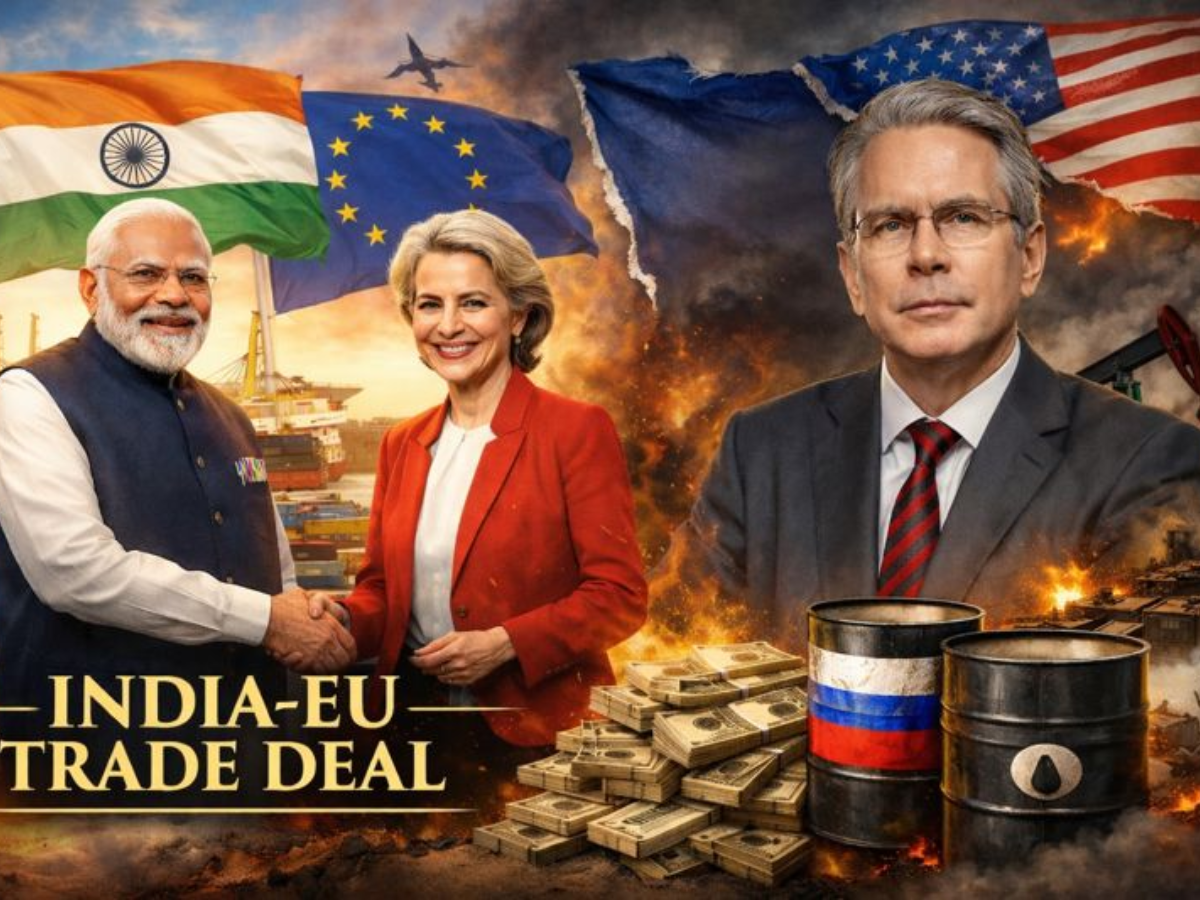

The long-awaited India-European Union trade deal which has been called as the “mother of all deals” has been successfully concluded, and it will be officially announced during the India-EU summit on Tuesday, Commerce Secretary Rajesh Agrawal said this weekend. The pact marks an important moment in global trade and comes at a time of heated economic tensions involving the United States, Europe, Russia, and India.
As per reports, Agrawal explained that negotiators have finished the main talks on the free-trade agreement (FTA) and now the text will go through legal scrubbing, which usually takes five to six months. Only after that will there be a formal signing ceremony, and the deal is expected to come into force sometime next year. He said the pact will be “balanced, forward-looking and help with better economic integration with EU,” and that it will boost trade and investment between the two sides.
Trump Aide Sparks Row, Says Europe Is ‘Financing War Against Itself’
While the deal is gaining support in many capitals, it has also drawn fire from the United States. According to reports, Scott Bessent, a top aide to US President Donald Trump, sharply criticised Europe’s economic behaviour in an interview on Sunday. Bessent said that European countries are “financing a war against themselves” by buying refined products made in India from Russian oil. He explained that Russian crude oil goes into Indian refineries, then the refined products like petrol and diesel are bought by Europeans. “They are financing the war against themselves,” he said, calling it an “act of irony and stupidity.”
Furthermore, Bessent also suggested that European governments chose not to impose tariffs on India for its Russian oil purchases because they wanted to protect the big trade deal with New Delhi. He said “virtue signalling European allies refused to do it because they wanted to sign this big trade deal with India,” showing how geopolitical and commercial interests are intertwined.
Trade Deal Aims to Boost Investment and Economic Integration
The comments show the complex geopolitical backdrop as India and the EU edge closer to finalising the FTA. European Commission President Ursula von der Leyen has described the agreement as one that would combine a market of 2 billion people and account for about 25% of global GDP, giving both sides huge economic reach.
Trump’s criticisms come as the US has also imposed 25% tariffs on India linked to its Russian oil imports, a move that strained ties between Washington and New Delhi. Bessent hinted that these tariffs might be eased if the situation changes and India cuts back on Russian oil purchases.
At the same time, the India-EU pact is meant to deepen economic cooperation and shows Europe’s willingness to work with India on trade, strategy, and shared global interests despite the ongoing debates over energy and sanctions.




