

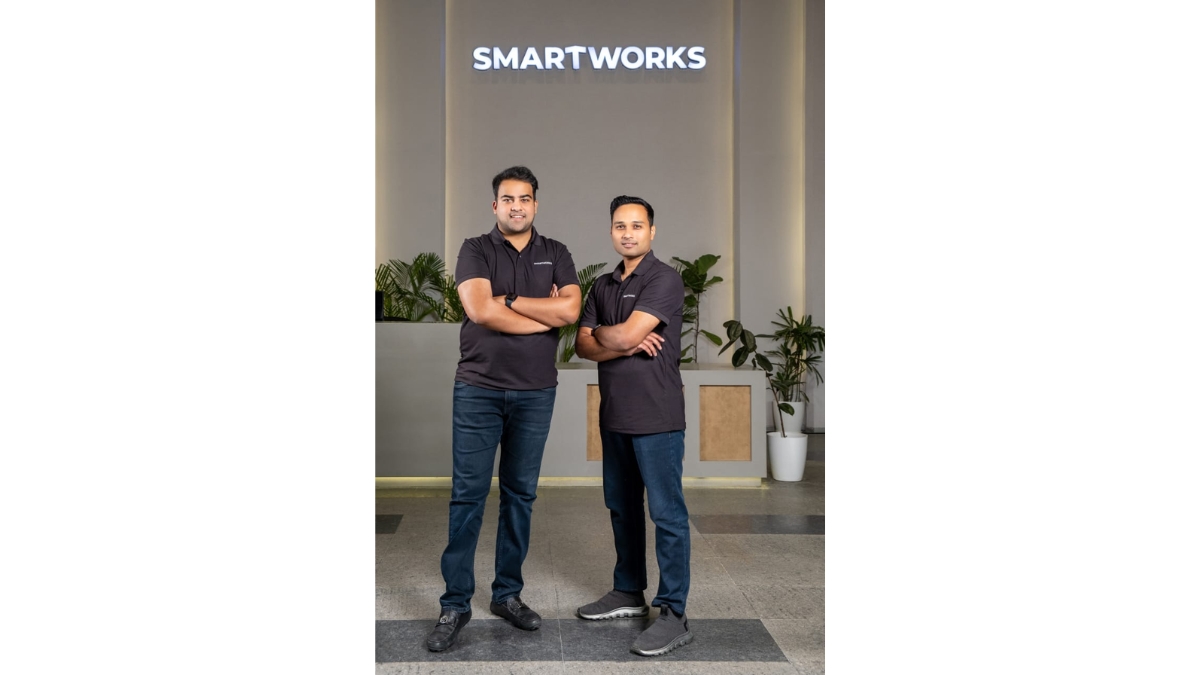
Image Description
Neetish Sarda & Harsh Binani, Smartworks
A look at how Smartworks, led by Neetish Sarda and Harsh Binani, built India’s most disciplined managed office model. While coworking chased buzzwords, Smartworks doubled down on fundamentals and let the numbers compound.
India’s office market loves its cycles. A new buzzword arrives, a few operators chase it, the music plays, then stops abruptly. For years, coworking space was that convenient hook. Pretty lounges. Bright lights. A little premium sprinkled onto rent. And somehow the sector kept insisting it was a revolution.
Except, it wasn’t.
The real pivot wasn’t happening in the glassy Instagram-ready corners of flex space. It was happening in something far less glamorous- whole buildings, long-tenure contracts, operational depth, and a cost structure that didn’t wobble every time global sentiment shifted. Neetish Sarda saw this early, almost uncomfortably early – long before profitability became fashionable again and long before India’s GCC wave grew into a macro force.
The industry often celebrates growth as a moral virtue. Doubling portfolios, splashing logos across new cities, chasing volume for bragging rights. But the real moat sits elsewhere. In the quiet arithmetic of capex, opex, and payback cycles – the foundation of any serious managed office model.
Smartworks’ cost of fit-out hovers around ₹1,350 per sq. ft., among the lowest in the industry, and opex stays in the ₹34–36 per sq. ft. range, a rare operational discipline not witnessed with any other player.
Where others chased aesthetics, the young duo chased unit economics. And today, those numbers tell their own story.
The impact of that frugality is visible in the way its large centres mature – payback in nearly 36 months, mature-centre occupancy at 88%, and revenue-to-rent multiples that behave more like REIT balance sheets than a flex-space experiment.
It helps that the demand tailwinds arrived right on cue. GCCs, which already occupy close to 200 million sq. ft. of Grade A stock across India, are projected to grow at a 7% CAGR over the next five years.
Most operators responded by tweaking designs, adding amenities, or offering shorter contracts. Smartworks responded by doing something harder – scaling an asset-light, enterprise-first model that actually holds its margins as it grows.
There’s also something counterintuitive about where Smartworks gets its cost edge. It doesn’t depend on institutional developers, at least not primarily. Nearly 76% of its portfolio comes from non-institutional landlords, primarily HNIs and family offices – who offer better terms, faster decisions, and fewer structural constraints.
This isn’t romantic storytelling; it’s strategy. A landlord mix that de-risks concentration, lowers effective rents, and lets the operator control the building as an integrated ecosystem.
That ecosystem now spans 14 cities, 61 centres, and over 3 lakh seats with committed occupancy at 88%. You don’t achieve those numbers by selling beanbags.
But the more interesting pivot may be the one no one saw coming. It was the rise of GCCs as India’s biggest flex occupiers and the way Smartworks metabolised this shift into SmartVantage, its consultative, partner-enabled GCC platform.
Over 30% of the company’s revenue comes from multi-city enterprise clients, a proof that enterprises are expanding, not experimenting.
GCCs contribute a meaningful share of revenue, and their requirements align almost perfectly with Smartworks’ campus model. The platform’s ability to deliver offices in 45–60 days transfers into what GCCs value most — certainty.
● Certainty of experience.
● Certainty of expansion.
● Certainty of cost.
In a market that loves selling flexibility, certainty may be the actual differentiator.
Smartworks’ trajectory over the past few years doesn’t read like a young flex operator stretching for scale. It reads like a company settling into its own discipline.
The company’s Q2 FY26 revenue stood at ₹4,248 Mn, EBITDA rising 46% year-on-year to ₹696 Mn, and annualised ROCE touching 14.3%, the highest in its history. Net debt has already turned negative, and operating cash flow sits at ₹614 Mn – numbers that behave less like a startup chasing relevance and more like an operator that has mastered its model and tightened its cadence.
The pattern is steady – disciplined growth, predictable numbers, and a model that holds firm through the cycle. Not dramatic, not loud – just durable.




