
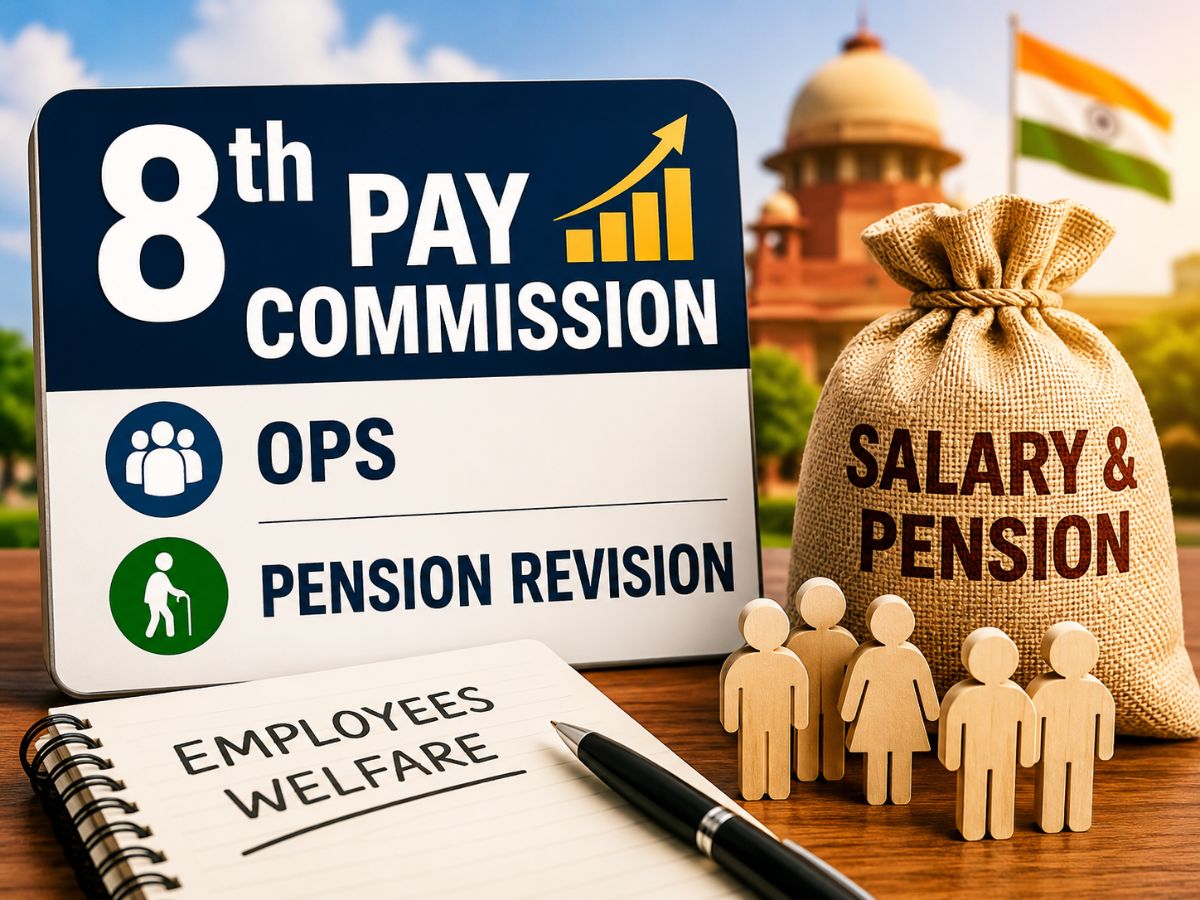
8th Pay Commission: The 49th meeting of the National Council JCM has once again brought central government employees’ concerns into focus, especially at a time when expectations around the 8th Pay Commission are steadily rising.
Employee representatives raised multiple unresolved issues linked to pension, promotions, staffing shortages, medical reimbursements and implementation gaps across departments.
The staff side also proposed a need for ongoing consultations with the employees’ unions when framing the report on the 8th CPC.
Here are the key takeaways from the meeting for central government employees and pensioners:
1. Submission of 8th Pay Commission Demand
The one major topic during the meeting was that of the 8th Pay Commission. The employees’ representatives revealed that they have already submitted the memorandum of demands, which includes:
– Minimum wage adjusted
– Fitting factor
– Yearly increase
– Processus promotionnel
– Pensions claims
Besides, the staff side also conveyed their wish to have regular interactions with the government during consultation and not a one-off affair. Many employees may consider this point important as their expectations of the 8th CPC recommendations could very much depend on salary revision and fitment factor-related demands.
2. OPS Restoration Demand Raised Again
The Old Pension Scheme (OPS) issue once again became a major topic of discussion.
Employee representatives requested the government to amend the Terms of Reference (ToR) of the 8th Pay Commission and formally include:
- Restoration of Old Pension Scheme
- Pension revision for existing pensioners
- Restoration of commuted pension
- Enhancement of pension benefits
The staff side also argued that employees recruited against vacancies sanctioned before December 22, 2003, should be considered under OPS, even if appointments happened later.
This could become an important issue for many post-2004 employees seeking pension relief.
3. Pension Issues May Be Sent To 8th Pay Commission
The Cabinet Secretary reportedly indicated that several pension-related issues may eventually be referred to the 8th Pay Commission.
This includes demands linked to:
- Existing pensioners’ revision
- Pension enhancement
- Commuted pension restoration
For pensioners, this means immediate relief may not come quickly, but the issues are now officially part of broader policy discussions.
4. Promotion Delays Come Under Scanner
During the meeting, there was a lot of concern expressed about delays related to promotions.
Employee representatives said that many departments are delaying Departmental Promotion Committees (DPCs), forcing employees to wait for years even after they become eligible.
Defence establishments and other departments expressed concerns, especially sincee a shortage of staff is already causing stress to the employees.
The cabinet secretary has reportedly asked the Department of Personnel and Training (DoPT) to issue strict directions for timely promotions.
5. Increment Rules Causing Employee Hardship
The staff side also flagged concerns regarding Rule 10 of CCS (RP) Rules 2016.
Under the current rule, employees need to complete six months after promotion to become eligible for the next increment.
Citing the “dies-non” clause, employee unions said that even a single such entry during the eligibility period can delay an employee’s increment, leading to financial hardship.
The demand now is to calculate eligibility based on 180 days instead of the stricter six-month interpretation.
6. Medical Reimbursement Issues Finally Get Attention
Healthcare reimbursement issues were another major focus area during the discussions.
Employee representatives demanded:
- Full reimbursement of medical treatment expenses
- Review of non-reimbursable medical items
- Revision in hearing aid reimbursement rates
- Inclusion of dental implant reimbursements
The reimbursement limit for hearing aids, employees argued, has not been revised for over a decade despite rising medical costs.
The cabinet secretary reportedly directed departments to examine these concerns and make a decision within three months.
7. Compassionate Appointment Rules May Be Reviewed
Compassionate appointments were also discussed extensively.
Employee representatives said the existing 5% ceiling is creating difficulties for families of deceased employees who depend on government support after a sudden loss of income.
Concerns were particularly raised about delays in defence establishments.
While no immediate decision was announced, the government reportedly agreed to examine department-specific concerns more closely.
8. AIIMS Employees Raise Issue of Spouse Posting
The staff side also drew attention to gaps in the implementation of government policies.
The employee representatives alleged that the AIIMS institutions were not properly following the DoPT policy for posting of spouses at the same station.
The unions said this has led to severe family hardship, especially for women employees, with some resigning, reportedly, under personal and family pressure.
The staff side had sought fresh instructions for uniform implementation across AIIMS institutions across the country.
9. Worries about outsourcing and staff shortages
Employee unions also warned of mounting workload pressure in various departments, especially in railways and defence establishments.
According to the staff side, projects and responsibilities are increasing, but recruitment is not happening at the same pace.
This, they argued, is leading to:
- Higher workload on existing employees
- Increased dependence on outsourcing
- Reduced efficiency in project execution
- Growing employee stress levels
Although no policy announcement was made, the issue was formally recorded during the meeting.
10. Defence Civilian Employees Receive Major Relief Signal
One of the biggest relief signals from the meeting came from employees of former ordnance factories that later became defence public sector units.
The Cabinet Secretary reportedly said the government has decided to recommend extending the deemed deputation of these employees until retirement while retaining their central government employee status, subject to approval from the empowered group of ministers.
For thousands of affected defence civilian employees, this decision could offer significant clarity and long-term job security.
JCM Meeting Frequency Itself Questioned
Interestingly, employee representatives also questioned why the JCM framework has held only 49 meetings in nearly 60 years.
As per the original scheme, three meetings are supposed to take place every year.
The cabinet secretary reportedly assured them that they would make efforts to hold meetings more regularly going forward.
Why this meeting is important for employees of the central government
The 49th JCM meeting is important, as it gives a clear indication of the priorities of employee unions before the 8th Pay Commission, though no final policy changes have been announced till now.
Several employee-centric issues have now been formally taken up for discussion at the highest administrative level, from pension revision and OPS demands to promotion delays and medical reimbursement issues.
For central government employees and pensioners, the immediate days ahead could be crucial as the government begins to lay the groundwork for the larger blueprint of the 8th Pay Commission and associated service reforms.
Priyanka Roshan is a business writer and chief sub-editor at the NewsX website who tracks everything from stock market swings and corporate earnings to personal finance trends and policy shifts. Known for turning fast-moving business developments into sharp, reader-friendly stories, she combines speed, accuracy, and a data-driven approach to break down complex financial news for everyday audiences.
With over 9.5 years of newsroom experience, Priyanka has worked with leading media organisations, including Moneycontrol, Times Now, and Ping Digital, covering diverse beats such as business, politics, technology, auto, travel, sports, and the world. From live breaking news desks to SEO-led digital storytelling, she specialises in creating engaging content that keeps readers informed without overwhelming them.





