

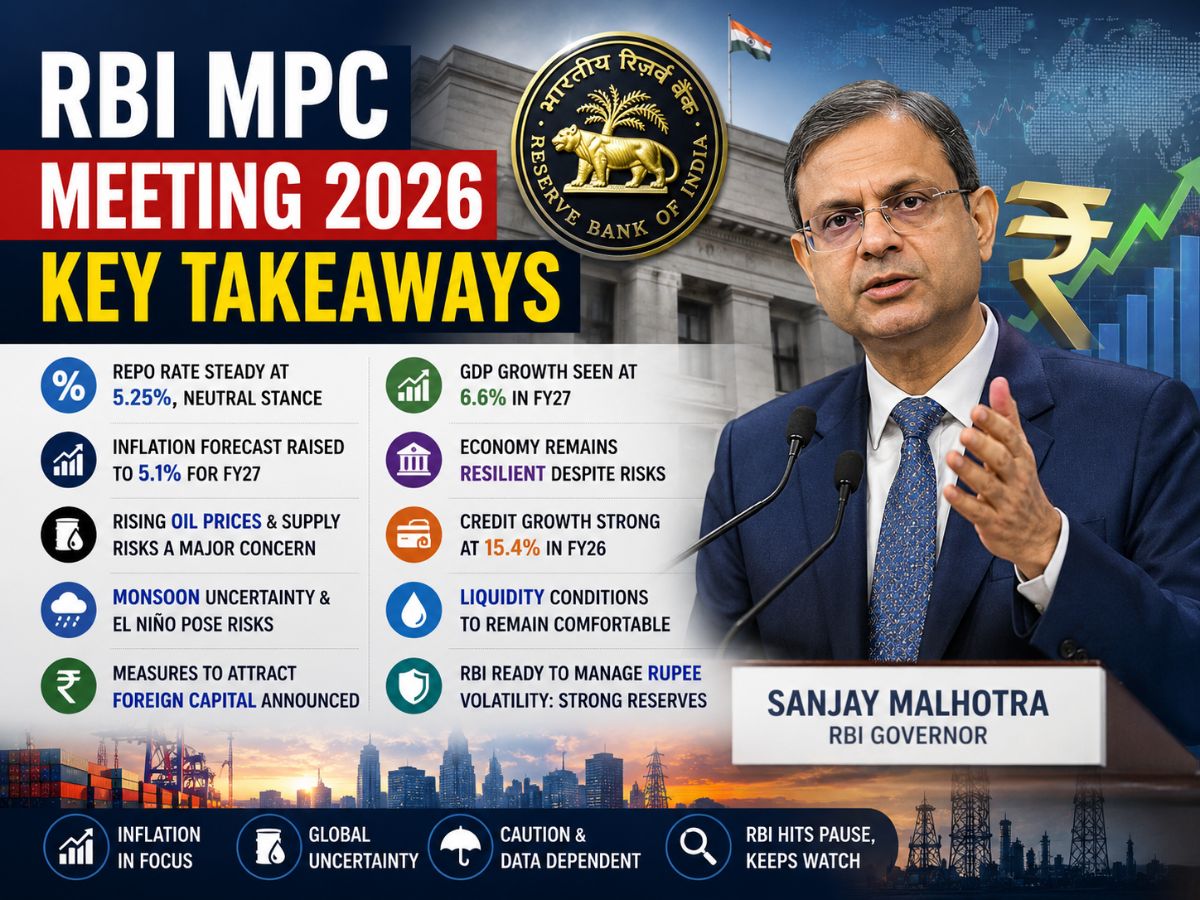
RBI MPC Meeting 2026: The Reserve Bank of India (RBI) has held the repo rate steady at 5.25%, as was largely predicted by economists. The decision of the three-day monetary policy meeting, which convened June 3 to June 5, was announced by the RBI Governor, Sanjay Malhotra. But if one reads the governor’s speech carefully, one will see what the RBI was really looking at: risks to the Indian economy that had begun to increase, driven by the escalation of conflict in West Asia, surging crude prices, and concerns about domestic weather. The RBI clearly signalled that the Indian economy, while growing stronger, is becoming riskier.
Here are the ten key takeaways from the RBI governor’s Monetary Policy Committee Meeting speech:
1. RBI waited to act rather than acting
The headline news was on the status quo as the Monetary Policy Committee decided by a unanimous vote to keep the repo rate at 5.25% and the monetary policy stance neutral. But the underlying message in the statement was why; risks to inflation had heightened, and the outlook for growth remained dim. Nevertheless, the RBI expressed its lack of visibility on the persistence of the geopolitical hostilities and its impact on crude prices and supply chains. In short, the RBI is taking the watch-and-wait stance.
2. Inflation back in focus
Inflation was the defining theme of Governor Malhotra’s speech. Crude oil prices have increased considerably and are expected to stay higher than the previous forecast, the central bank said. Also, prices of some industrial raw materials such as chemicals, plastics, rubber and metals have started to firm up. While overall inflation has been below the RBI’s target level of 4% in the recent past, policymakers now believe these cost pressures could spill over into the economy over time. The worries go beyond dearer fuel and extend to businesses eventually passing on these costs to consumers, thereby feeding higher inflation and expectations.
3. RBI now projects CPI inflation to touch 5.1%
It is in line with this belief that the RBI raised its CPI inflation forecast to 5.1% for FY27. The central bank expects price pressures to remain towards the higher end of its comfort band, especially in the second half of FY27 with inflation expected to peak in the third quarter. This would translate into higher costs of fuel, transport and everyday items for households and continued focus on managing prices for the central bank.
4. Growth outlook also takes a beating
The growth projections have also been pared down. The economy is now projected to grow by 6.6% in FY27 versus an estimated 7.6% growth in FY26. This downgrading of growth is mainly on account of the rise in oil prices and supply chain disturbances, compounded by the possibility of adverse weather patterns impacting agricultural output and rural demand over the next few months, especially if the monsoon turns out to be weaker than normal and El Niño conditions are a threat. However, the central bank avoided sounding too bearish on growth.
5. India’s economy still holding strong
Despite the growing challenges, the governor repeatedly highlighted resilience across various sectors in the economy. The manufacturing sector remains in the expansion zone. The services sector is doing very well. It looks as if consumer demand held up more than expected, and both private investment and credit growth are positive. Goods exports have been strong against increased freight and insurance costs. There is unlikely to be a dramatic fall overall, even if growth slows considerably.
6. No rate cuts in the near future
The central bank has given a strong message to borrowers looking for a cut in interest rates. The monetary policy was more worried about the risks of inflation than the growth prospects, and though it has not given any clear indication of its intention of raising rates, it has not even given any scope for a cut at this point. Rates are expected to remain high while inflation is high and global risks persist.
7. Liquidity conditions to remain comfortable
The RBI kept markets calm and reiterated its commitment to providing sufficient liquidity. Excess liquidity is abounding in the banking system, and the central bank stated it would continue pumping money to fuel growth, allowing the money markets to remain stable and banks to not experience constraints in lending due to a lack of liquidity.
8. Credit growth surprising on the upside
One of the more encouraging things about the statement was the continued healthy growth in lending activity. Credit of all types jumped 15.4% in FY26, reflecting robust borrowing by businesses and consumers who remain confident about the economy despite the higher cost of funds. This will continue to be a positive for banks, especially in contrast with the trend of weakening demand in global economies.
9. RBI announces mega plan to attract foreign capital
Beyond the rate policy, the central bank also launched a series of measures aimed at bringing in more overseas money. Foreign investor access to sovereign debt was enhanced; investment guidelines for foreign portfolio investors were eased; investment limits for NRIs and overseas individuals in the Indian stock market were increased; attractive options like foreign currency deposits and offshore borrowings for Indian companies were unveiled. All these are aimed at improving the country’s external account position amid capital outflows and rising import bills for energy.
10. A strong signal from RBI on the rupee
Governor Malhotra also expressed RBI’s stance on the Indian rupee and calmed the markets but denied targeting a particular level of the rupee. He reiterated that RBI stands ready to intervene in the market to check any extreme volatility. The central bank claimed to have enough reserves (which are around $682 billion plus) to counter any possible external shocks.
RBI hits pause as inflation risks rise and growth outlook softens
It’s not about a rate change as such. The June policy was about the RBI acknowledging the change in economic conditions since April with rising inflation risks stemming from higher oil prices, supply constraints, and weather factors. The economy will be able to cope with these risks. The RBI would maintain its wait-and-watch attitude, and the policy stance would be determined by the behaviour of oil prices, the inflation path, and global developments in the coming months.
Also Read: RBI MPC Meeting 2026: Repo Rate Unchanged At 5.25%; Will Fixed Deposit Rates Stay Elevated?
Priyanka Roshan is a business writer and assistant editor at the NewsX website who tracks everything from stock market swings and corporate earnings to personal finance trends and policy shifts. Known for turning fast-moving business developments into sharp, reader-friendly stories, she combines speed, accuracy, and a data-driven approach to break down complex financial news for everyday audiences.
With over 9.5 years of newsroom experience, Priyanka has worked with leading media organisations, including Moneycontrol, Times Now, and Ping Digital, covering diverse beats such as business, politics, technology, auto, travel, sports, and the world. From live breaking news desks to SEO-led digital storytelling, she specialises in creating engaging content that keeps readers informed without overwhelming them.





