
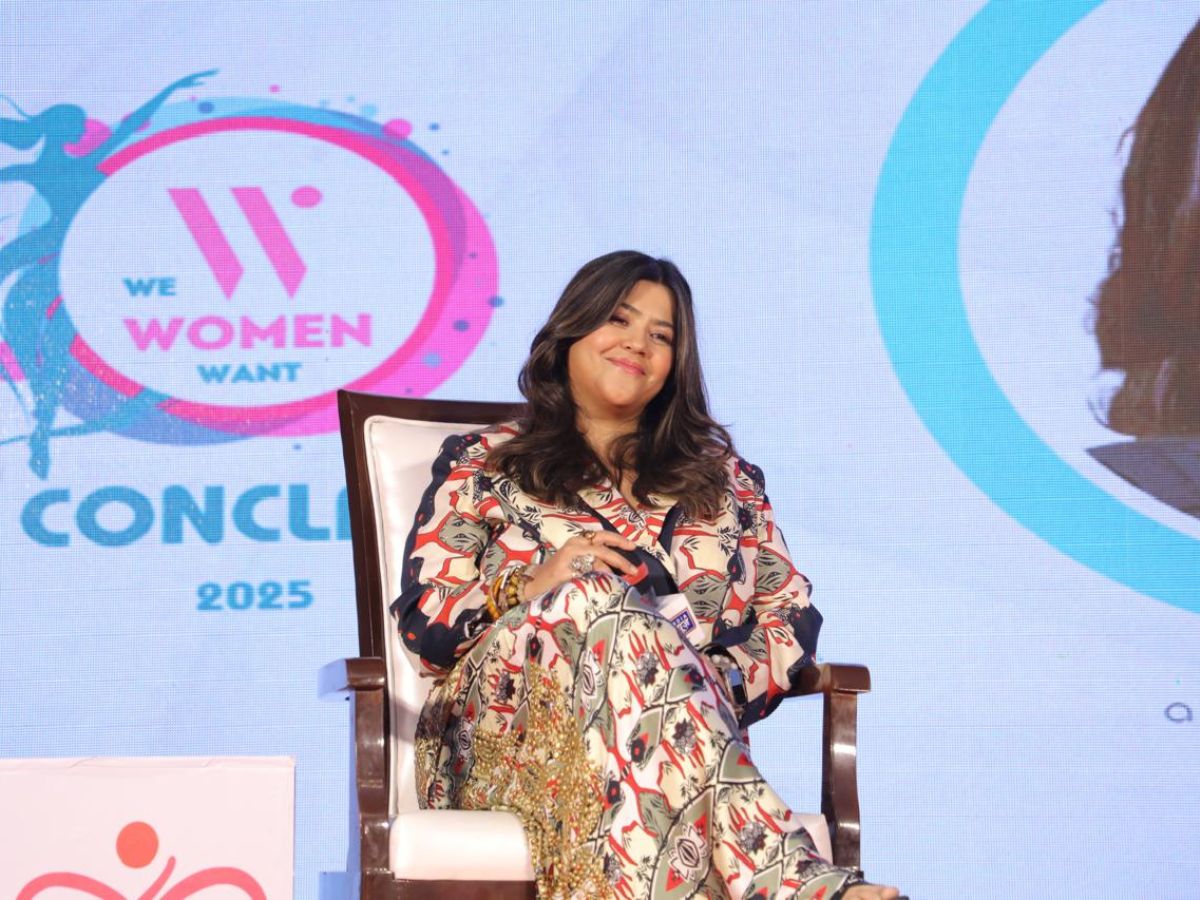

Twenty-five years after Kyunki Saas Bhi Kabhi Bahu Thi became a television phenomenon, its creator Ekta Kapoor is bringing the iconic show back, not for nostalgia, but to deliver what she calls “impact with entertainment.” Speaking at the NewsX We Women Want Conclave & Shakti Awards 2025 in Delhi, the founder and Joint Managing Director of Balaji Telefilms revealed that the revival will complete the 2,000-episode milestone left unfinished.
“Smriti and I said, ‘Let’s complete those 2,000 episodes, but let’s not do it for nostalgia. Let’s do it for impact,’” Kapoor said, adding that Tulsi’s new journey will address midlife realities.
The new Kyunki promises to be a bold exploration of a very different Tulsi, one confronting the realities of peri-menopause, hormonal battles, and the complexities of a modern woman juggling family and selfhood.
“We’re close to 50, peri-menopausal, dealing with hormones, kids, multitasking. She’s no longer fighting that battle and she’s losing it and dealing with it. It’s a thing,” Kapoor explained.
The Power of Entertainment with Impact
For Kapoor, entertainment has always been more than escapism. She defines Balaji Telefilms’ ethos as wanting to be “more felt and less understood,” bridging the spectrum from niche films like Lootera and Udta Punjab to mass television hits.

But she draws a clear line between preaching and storytelling. “If you make content only for impact, it’s like telling the woke to see woke content,” she said.
Her mantra is “impact with entertainment,” acknowledging that many viewers discover new perspectives only when wrapped in compelling narratives.
This duality, she argues, is what made Kyunki revolutionary in its time. A young viewer once told her that the show’s depiction of Tulsi as a decision-maker empowered his mother to assert herself at home, a threat to patriarchal norms.
“For the first time, she said, ‘If Tulsi can make decisions in the house, so will I,’” Kapoor recounted. “That was answering back. That was the moment TV broke the patriarchy in one home.”
Ekta Kapoor on The ‘K’ Factor
Behind the legendary Tulsi is Smriti Irani, who Kapoor remembers as a “soft, shy, scared” young woman at her first audition, a stark contrast to the confident leader and parliamentarian she is today.

“She’s become the woman she wanted to be,” Kapoor said. “Sometimes I wonder if it’s the same person I first met.”
Kapoor also touched on the oft-discussed ‘K’ in many Balaji titles. Starting with little more than instinct at age 18, she said the repeated success of these ‘K’ shows became a brand in itself.
“People said, ‘If it’s from K, it’s Balaji,’” she said. “It worked for me, part superstition, part identification.”
A New Era for Entertainment- OTT and Television Coexist
Kapoor remains optimistic about the evolving entertainment landscape. She dismisses the notion that OTT platforms threaten traditional television.

“Television still pulls in the maximum viewers, not a patch is any OTT to television,” she asserted. “TV is now consumed on linear, connected TV, and OTT platforms.”
For Kapoor, OTT is “a blessing” for all forms of content, allowing films like Laila Majnu to find new life and audiences through re-releases.
Lessons in Shakti and Resilience
On the topic of “Shakti” – Kapoor revealed a guiding lesson from Javed Akhtar – pick your battles wisely.

“Only take on wars where you know you will lose or it’ll hurt you. Never with someone you know will hurt them,” she shared. “That’s the difference between ego and self-respect.”
Her mother once urged her to temper her extremes, but Kapoor proudly quipped, “Good girls go to heaven, bad girls make history. Now, my bad girl got the Padma Shri.”
Breaking the Glass Ceiling with Gender-Agnostic Storytelling
Kapoor dismissed the notion that women-led projects are commercially unviable. She called herself “gender agnostic,” selecting roles based on talent, not gender.
“Crew broke box office numbers because there were three legit stars, it’s a disservice to call it a women’s film,” she said. “I’ve been honoured to work with great actors who just happened to be women.”
Ekta Kapoor Facing Critics Head-On
Criticism of TV as regressive, Kapoor says, often comes from those who haven’t truly engaged with its content.

“Those who say TV is regressive have never sat with empathy and seen lives beyond their own homes,” she said firmly. “Sometimes what is fiction for you is reality for someone else.”
Ekta Kapoor on Aamir Khan’s Bold Move
Kapoor lauded Aamir Khan’s unconventional choice to skip OTT for his latest film’s release.
“Only he can give up money for disruption. Succeed or not, he did what none of us could,” she said admiringly. “It takes a lot to stand out and say, ‘I’m going to do it my way.’”
Rapid Fire With Ekta Kapoor
In a rapid-fire round, the powerhouse producer confessed about various personal things.

Beaches or mountains?
“Mountains. I have a winter body.”
Social media?
“Waste of time.”
How do you deal with trolls?
“I’ve been told things since before social media existed. Now it’s like my alter ego, so I’m fine with it.”
Favourite cuisine?
“I love food — any cuisine.”
Last holiday?
“Recently, I went with my son to New York. As a parent, I’m not naturally easy. We’re both learning — me being a mother, him being a son.”
Superpower wish?
“I wish I could eat anything and never put on weight. That’s the only superpower I want.”
Zubair Amin is a Senior Journalist at NewsX with over seven years of experience in reporting and editorial work. He has written for leading national and international publications, including Foreign Policy Magazine, Al Jazeera, The Economic Times, The Indian Express, The Wire, Article 14, Mongabay, News9, among others. His primary focus is on international affairs, with a strong interest in US politics and policy. He also writes on West Asia, Indian polity, and constitutional issues. Zubair tweets at zubaiyr.amin




