
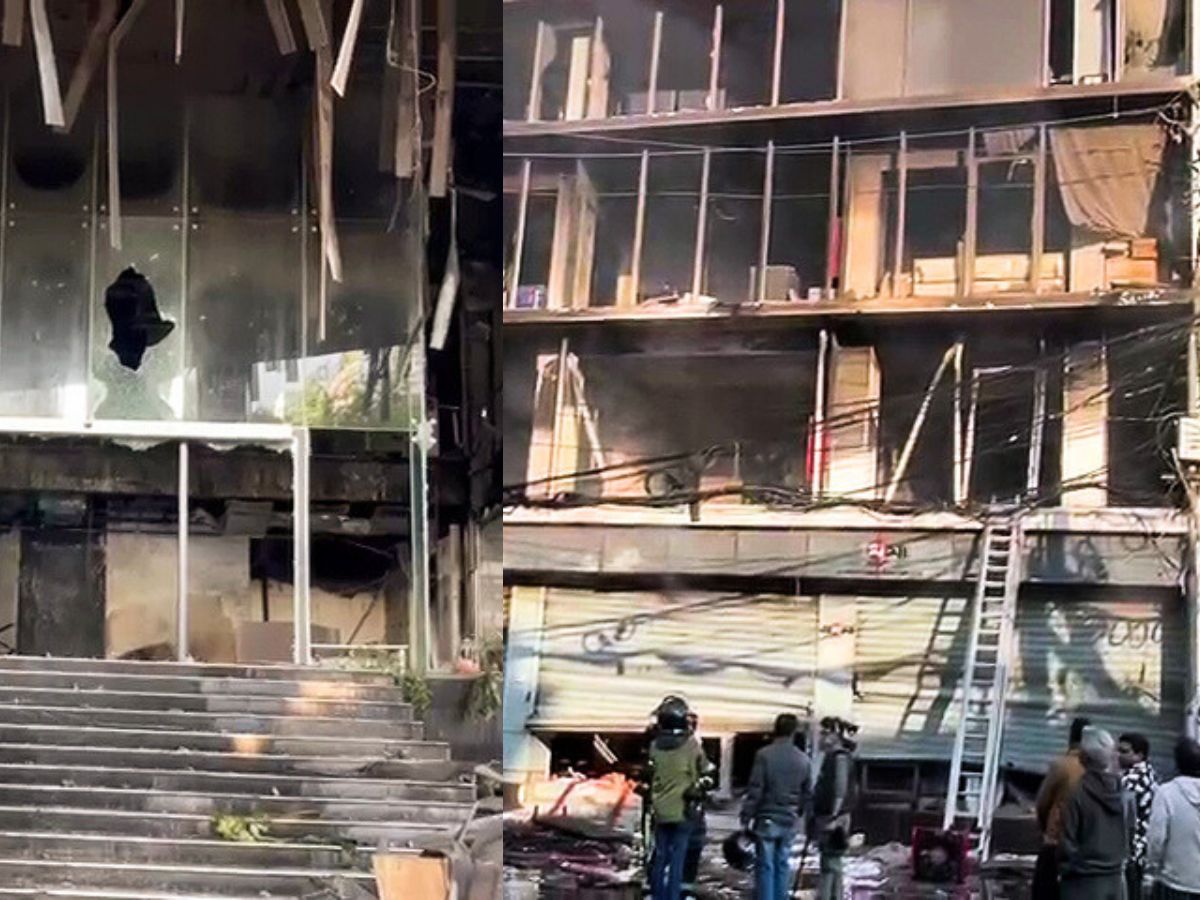

The country has been going through one of the most difficult periods in Bangladeshi history, what with protests turning violent, an increased anti-Indian backlash, assaults on news organizations, and a Hindu man lynched in the wake of highly significant national polling.
This came after the death of Sharif Osman Hadi, a youth leader and a controversial political figure whose death has occasioned widespread violence that has revealed fault lines in the political transition in Bangladesh.
The developments have caused concern for the New Delhi establishment, which has warned that the new political landscape in Dhaka constitutes the “greatest strategic challenge to India since the Liberation War of 1971.” The Standing Committee on External Affairs of the Indian Parliament has expressed this concern.
Who Was Sharif Osman Hadi and What Made His Death a Flashpoint?
Sharif Osman Hadi, 32, made a reputation as a major player in revolts brought upon Bangladesh by students during July-August 2024, leading to the ouster of prime minister Sheikh Hasina, who had been wielding power since 2009 for a cumulative 15-year tenure. Hadi, a media spokesperson and ideologue of Inquilab Mancha, a revolutionary political ideology, quickly made a reputation as a major youth mobilizer and nationalist with a penchant to criticize India and prime minister Sheikh Hasina.
Recently, the Inquilab Mancha has evolved from a protest site into a large political force by capitalising on people’s anger towards the previous ruling party.
Hadi had declared his intention of running in the upcoming parliamentary election scheduled for February 12 as an independent candidate in Dhaka’s Bijoynagar constituency, linking his election campaign with the uprising’s ambitions.
Hadi was gunned down on December 12, just a day after the election schedule was announced by the Election Commission, in the heart of Dhaka by masked attackers. He was flown to Singapore for better medical care, but he died from a bullet injury to the head on December 18. This triggered violent protests throughout Bangladesh.
Dhaka Unravelled by Violent Demonstrations
News of Hadi’s death soon spread like wildfire, bringing thousands of protesters out onto the streets of Dhaka and other major cities. What began as protests demanding justice soon escalated into violent clashes and looting.
A number of buildings were also set on fire in the capital, including office spaces that house two of the most popular Bangladeshi dailies: Prothom Alo and The Daily Star. Reporters were also trapped in the smoke-filled offices late into the night before being rescued. Both publications later suspended their printing and website operations for a while due to concerns over security.
Incidents of violence were reported from Chittagong, Rajshahi, and several other districts, with the demonstrations attacking the Awami League headquarters, cultural organizations, and historical landmarks linked to Sheikh Mujibur Rahman and the Hasina family. In certain places, major roads were also blocked. The army and paramilitary were deployed in certain areas of Dhaka.
Anti-India Anger Takes Centre Stage
“As the unrest escalated, the protests became increasingly anti-Indian, with the protesters blaming the government in New Delhi for protection given to Hadi’s attackers and for meddling with the internal affairs of Bangladesh,” said a “Banglapedia” news report. The anti-Indian protest slogans were raised outside the Indian Assistant High Commission in Chittagong.
Political outfits like the National Citizen Party alleged that the attackers were already hiding in India and demanded that they be handed over immediately. Some of the leaders also threatened to close down the Indian High Commission office in Dhaka until this was achieved.
This rhetoric heightened tensions between these two neighbouring countries.
In response, the Indian government summoned the High Commissioner of Bangladesh in New Delhi and repudiated what it called a “false and malicious narrative” being propagated by such extremist groups. The Indian High Commission in Dhaka also advisedIndian citizens there to restrict their movements because of the tense security environment.
Hindu Man Lynched Amid Protests, Minority Safety In Spotlight
In the midst of all this political instability, a very disturbing incident highlighted once again the safety of religious minorities in Bangladesh. A Hindu was lynched in Bhaluka Upazila of Mymensingh district on charges of defaming Islam. Dipu Chandra Das was 30 years old.
According to a report by the Bangladeshi media, Das was accused of using disparaging comments during an event that took place within his workplace, which was a garment factory, where he was an employee. The news spread like wildfire, and soon, the local people were angry enough that they beat him to death, hung his body from a tree, and then lit it on fire, thereby disrupting traffic flow along the Dhaka-Mymensingh Highway.
This came as protests with regard to Hadi’s death were underway, with concerns that communal riots may further go out of control.
Yunus-Led Interim Government Response
The country’s temporary prime minister, Mohammad Yunus, came out against the lynching and the violence in general, saying that there was no need for such incidents in the new state of “new Bangladesh”. In a live press conference following Hadi’s murder, Mohammad Yunus called it an irreparable loss for the country’s political and democratic development.
An official day of state mourning was called, during which the national flag was to be flown at half-mast, and special prayers were to be held across the country. Yunus explained that the assassination of Hadi was a carefully plotted action aimed at sabotaging the elections, but those responsible would definitely suffer the punishment of their actions.
Nevertheless, it has been argued that radical sectors have felt encouraged throughout the transitional period, with the police struggling to control radical sectors.
Parliamentary Standing Committee
There is also a Parliamentary Standing Committee on External Affairs, led by Congress MP Shashi Tharoor, which has noted: “The current evolving political situation in Bangladesh is India’s most consequential strategic challenge since 1971.” The main reasons given for this are “the rise again of Islamist forces, loss of institutional control, loss of public confidence, and youth nationalism.”
Although it seems that, according to the panel, there is no current existential threat to India, they warned that any prolonged period of instability and strategic readjustment among the Bengali regime may have a profound impact on India’s strategic environment.
The Shadow of China-Pak Influence on Bangladesh
The committee also identified “the increasing presence of China and Pakistan in Bangladesh as a major point of worry.” “China has emerged as its largest arms supplier, as well as a big development partner, with huge investments in infrastructure, port development, and power projects through BRI,” said an expert.
Though Beijing maintains a policy of non-intervention, it is observed that economic and strategic necessities dictate that political stability in Bangladesh is essential to it, and Pakistan, reeling from a surge in anti-India sentiment, is attempting to re-establish itself, though it is internal politics that trends towards instability.
Bangladesh Elections
Bangladesh is scheduled to hold a national election on the 12th of February under the interim government that came into power when Sheikh Hasina shut down the country and flew to India. The Awami League has been banned and dissolved to further divide the polarized political environment.
Given the levels of violence being witnessed, the minorities being threatened, the freedom of the press being attacked, as well as the deteriorating ties with the Indian government, the death of Sharif Osman Hadi has become the catalyst for broader political, societal, and geopolitical tensions.
Within the midst of such an uncertain transition, the coming days will prove to be quite pivotal, not only in the future of Bangladesh in terms of its democracy, but also in the stability of the entire region of South Asia and, by association, the Indian neighborhood.
Sofia Babu Chacko is a journalist with over five years of experience covering Indian politics, crime, human rights, gender issues, and stories about marginalized communities. She believes that every voice matters, and journalism has a vital role to play in amplifying those voices. Sofia is committed to creating impact and shedding light on stories that truly matter. Beyond her work in the newsroom, she is also a music enthusiast who enjoys singing.




