
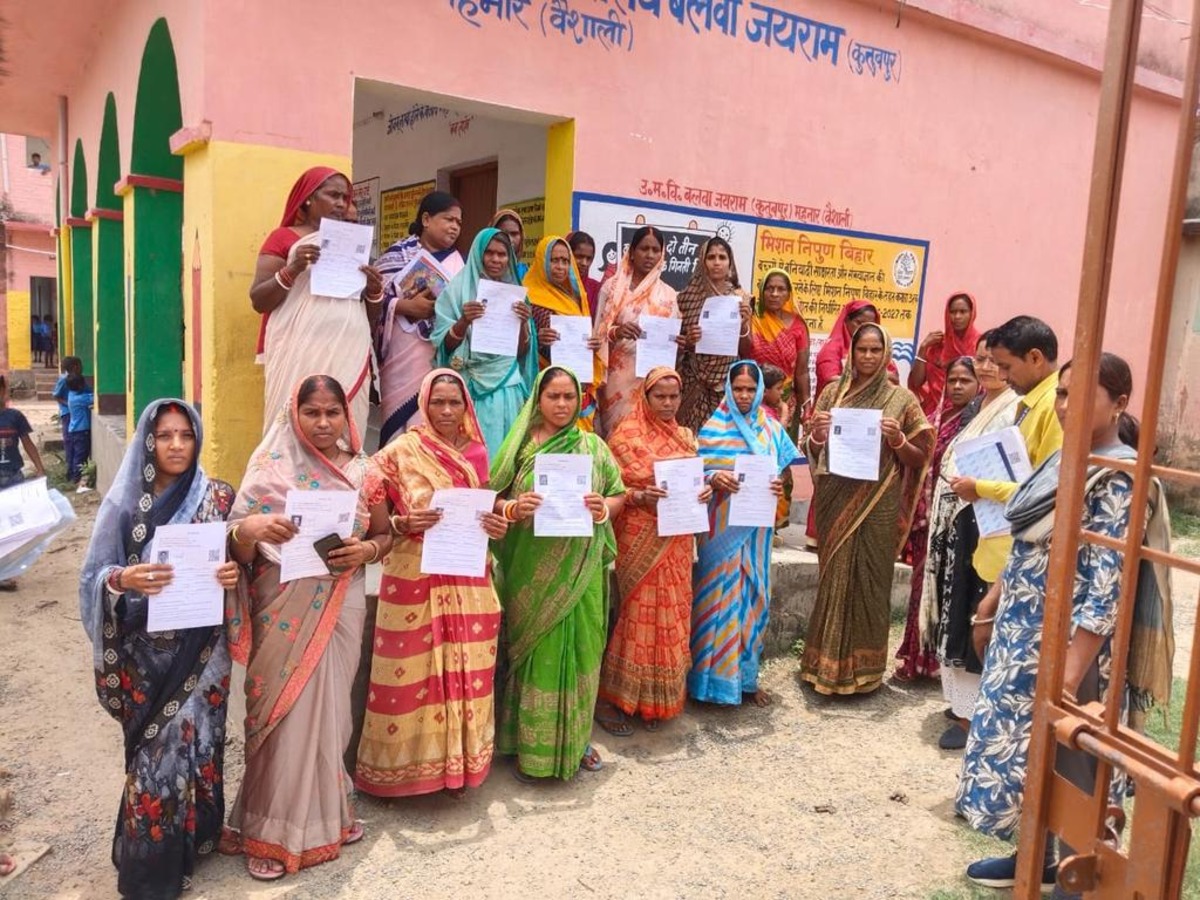

The Election Commission of India has stated to the Supreme Court that Aadhaar, voter ID cards, or ration cards can’t be a proof of voter eligibility.
It defended its special intensive revision (SIR) of electoral rolls in Bihar and noted that constitution has granted rights to the ECI to ask for proof of citizenship before registering a person’s name in the voter list.
The ECI said that under Article 324 of the Constitution, it is responsible to supervise and manage all parts of elections, including preparing voter rolls.
Earlier, several opposition leaders and civil society groups filed a petition in the Supreme Court and questioned about the timing and method of the SIR.
Earlier, Supreme Court Had Asked ECI To Halt Their Process
MPs like Manoj Jha, KC Venugopal, and Mahua Moitra were the main petitioners in the case.
The court had then asked the ECI to withhold the process and also urged it to accept Aadhar, voter ID, and ration cards as eligibility proof.
In response, the ECI submitted its answer to the Supreme Court.
It also added that “Aadhaar” is just a “proof of identity” and it doesn’t “help in screening the eligibility under Article 326.”
The ECI added that due to “widespread existence of fake ration cards,” it can’t be used as a reliable proof.
However, in specific cases, Electoral Registration Officers (EROs) can accept them.
ECI Defends Its Decision In The Supreme Court
Regarding the voter cards, the ECI noted that it cannot “substitute the verification process mandated for fresh preparation.”
Similarly, the ECI said that any claim which says central government can decide who could be an Indian citizen is “patently erroneous.”
It noted that only “ECI is fully competent to require a person claiming citizenship by birth to produce relevant documents for inclusion in the electoral roll.”
The ECI also said that if someone has failed to prove citizenship for voter registration, it does not mean their citizenship stands cancelled.
“Determination of non-eligibility under Article 326 will not lead to cancellation of citizenship.”
The next hearing of the case will be done by the Supreme Court on July 28.
Also Read: Union Minister Giriraj Singh Defends Bihar Electoral Revision, Hits Back At Opposition




