
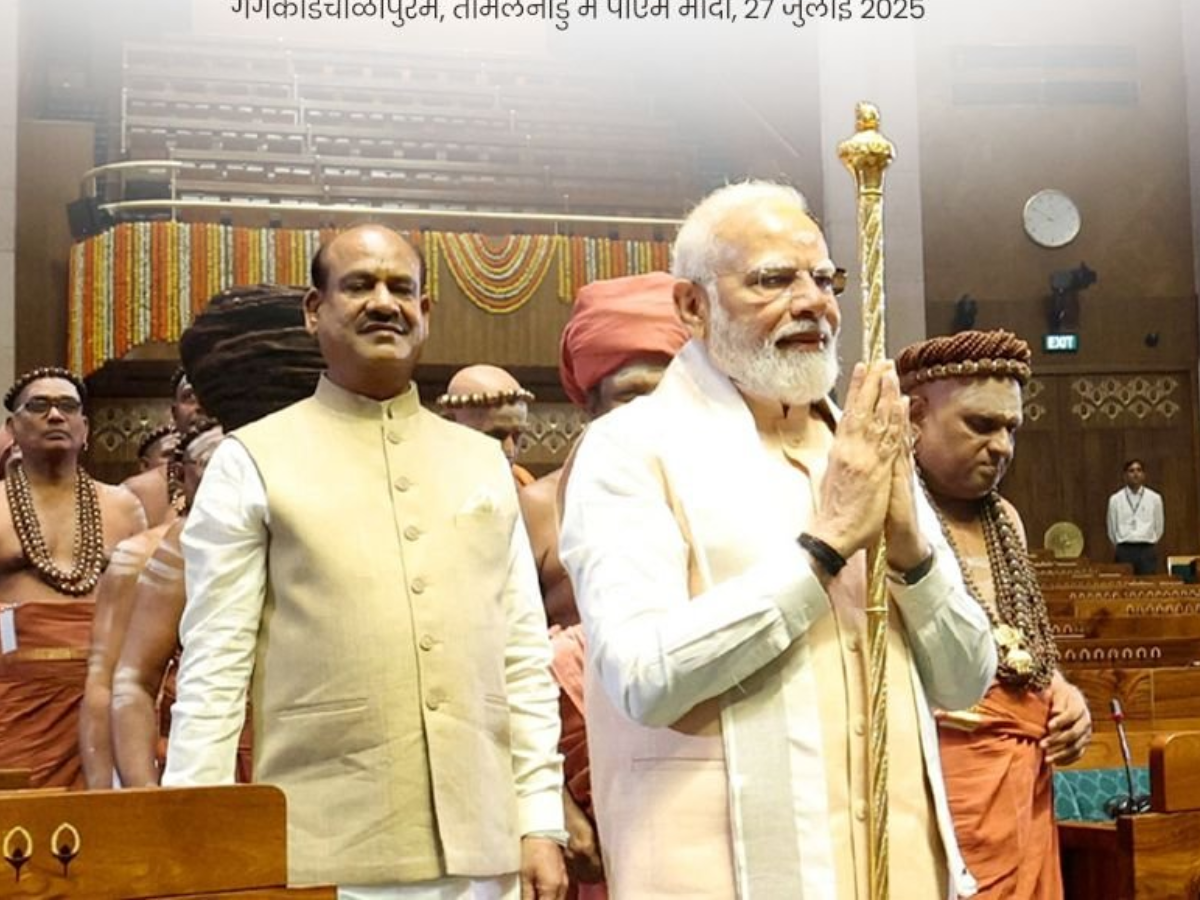

Prime Minister Narendra Modi on Sunday offered prayers at the Gangaikonda Cholapuram temple in Tamil Nadu’s Ariyalur. He participated in a commemorative programme organised as part of the birth anniversary of the Chola emperor, Rajendra Chola I.
PM Modi also attended the Aadi Thiruvathirai festival, which celebrates the rich Tamil Shaiva Bhakti tradition, fervently supported by the Cholas and immortalised by the 63 Nayanmars–the saint-poets of Tamil Shaivism.
While attending the festival, PM Modi wore traditional attire — a white Veshti (dhoti), a white shirt, and an Angavasthram wrapping around the neck while attending the festival. He was welcomed by local pandits.
Chola Empire Expanded Its Influence Across South and Southeast Asia, Says PM
At the event, Prime Minister Narendra Modi paid rich tributes to Rajendra Chola I (1014-44 CE), saying he was one of the most powerful and visionary rulers in Indian history. “Under his leadership, the Chola Empire expanded its influence across South and Southeast Asia, “he added.
Praising the Chola empire, the Prime Minister said India reached economic and military heights during the Chola era, adding that Rajaraja Chola built a powerful navy, which Rajendra Chola further strengthened.
The economic and military heights India reached during the Chola era continue to inspire us even today.
Rajaraja Chola built a powerful navy, which Rajendra Chola further strengthened. pic.twitter.com/acdUWLHTdO
— PMO India (@PMOIndia) July 27, 2025
In a post on ‘X’, PMO said, citing the Prime Minister, “Rajaraja Chola and Rajendra Chola symbolise India’s identity and pride.”
The PMO, in another post, further stated, “The Chola era was one of the golden periods of Indian history, which was distinguished by its formidable military strength.”
Who Was Rajendra Chola?
Rajendra Chola I was a Chola emperor who ruled between 1014 and 1044 CE. He succeeded his father, Rajaraja I, in 1014 CE. During his reign, he extended the influence of the Chola empire to the banks of the river Ganges in the north and across the ocean.
To commemorate his victory on the River Ganges, he assumed the title of ‘Gangaikondachola’ and built a temple dedicated to Lord Shiva. He followed Shaivism (a branch of Hinduism). However, he also welcomed Buddhism and built many stupas (Buddhist shrines) in South-East Asia and South India.
What PM Modi Said
PM Modi said, the Gangaikonda Cholapuram temple, stands as a UNESCO World Heritage Site, renowned for its intricate sculptures, Chola bronzes, and ancient inscriptions. He added that our government is carrying forward the same vision of the Chola era through initiatives like the Kashi-Tamil Sangamam and the Saurashtra-Tamil Sangamam, and we are strengthening these centuries-old bonds of unity.
“When the new Parliament building was inaugurated, the saints from our Shaivite Adheenams led the ceremony spiritually. The sacred Sengol, deeply rooted in Tamil culture, has been ceremoniously installed in the new Parliament, “he added.
He further said, “Our Shaivite tradition has played a vital role in shaping India’s cultural identity. The Chola emperors were key architects of this legacy. Rajaraja Chola built a powerful navy, which Rajendra Chola further strengthened.”
ALSO READ: Who Was Rajendra Chola I And Why Is Modi Honouring Him Now? Inside PM’s Tamil Nadu Push




