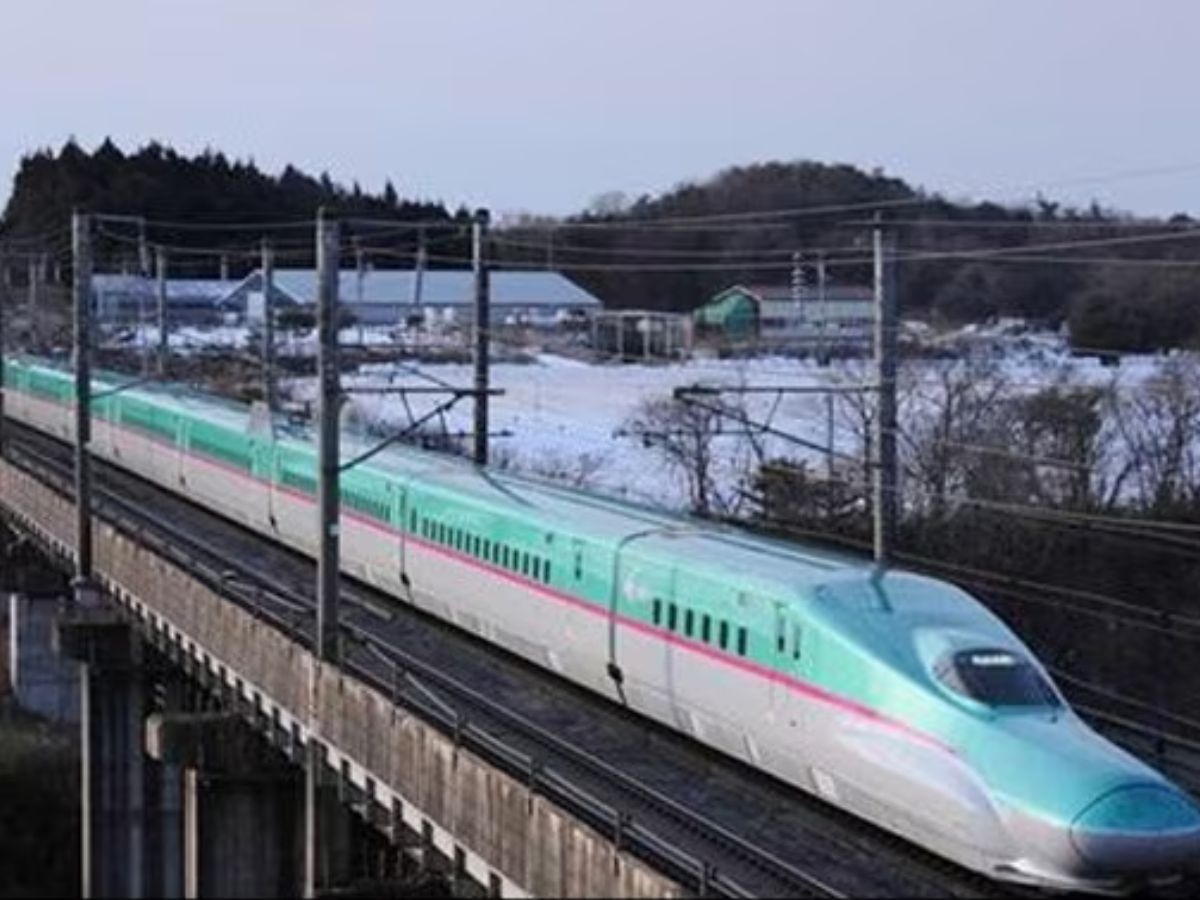

A development has been reported in the Mumbai-Ahmedabad bullet train project. State-of-the-art stations have been designed for ensuring the speed, comfort, and sustainability of the Mumbai-Ahmedabad bullet train project. These stations will feature modern architecture, regionally inspired aesthetics, solar power and rainwater harvesting. It will also ensure seamless integration with rail, metro, and road networks. The passengers will also get to experience a world-class, environmentally conscious travel experience at the Ahmedabad, Surat, and Vadodara stations.
Photo Credit- x.com/@PTI_News
PHOTO | The Mumbai-Ahmedabad bullet train project is reshaping India’s transport landscape with state-of-the-art stations designed for speed, comfort, and sustainability. Featuring modern architecture, regionally inspired aesthetics, solar power, rainwater harvesting, and… pic.twitter.com/IvRlr36l9g
— Press Trust of India (@PTI_News) August 27, 2025
Mumbai-Ahmedabad bullet train project: the first section undersea tunnel opened in July
Another development related to the Mumbai-Ahmedabad bullet train project was reported in July 2025. The first section undersea tunnel of 21 kilometres was opened between Ghansoli in Navi Mumbai And Shilphata in Thane. It was confirmed by the Ministry of Railways in a press release on the Press Information Bureau. The bullet train project has accomplished a significant milestone by completing 310 km of viaduct construction. A viaduct is a long bridge-like structure.
This structure typically comprises a series of arches or spans that are designed to carry a road or railway over a valley, low-lying ground, or other obstacles.
According to the Ministry of Railways press release, the track laying, construction of overhead electrical wires, stations, and bridges is also progressing at a rapid speed. It was mentioned in the press release that the construction work in Maharashtra has also picked up pace.
The tunnel will be a part of the high-speed rail corridor
In an interaction with the PTI, National High Speed Rail Corporation Limited said that the 21-kilometre-long tunnel will be a part of the high speed rail corridor. According to the NHSRCL, the Tunnel Boring Machines will be used for the construction of 16 kilometre of the tunnel. The NHSRCL added that remaining 5 km of the tunnel, especially between the Shilphata and Ghansoli, is being built using the New Austrian Tunnelling Method. Also, the NHSRCL mentioned that the tunnel also features a 7 km undersea section beneath the Thane Creek.