

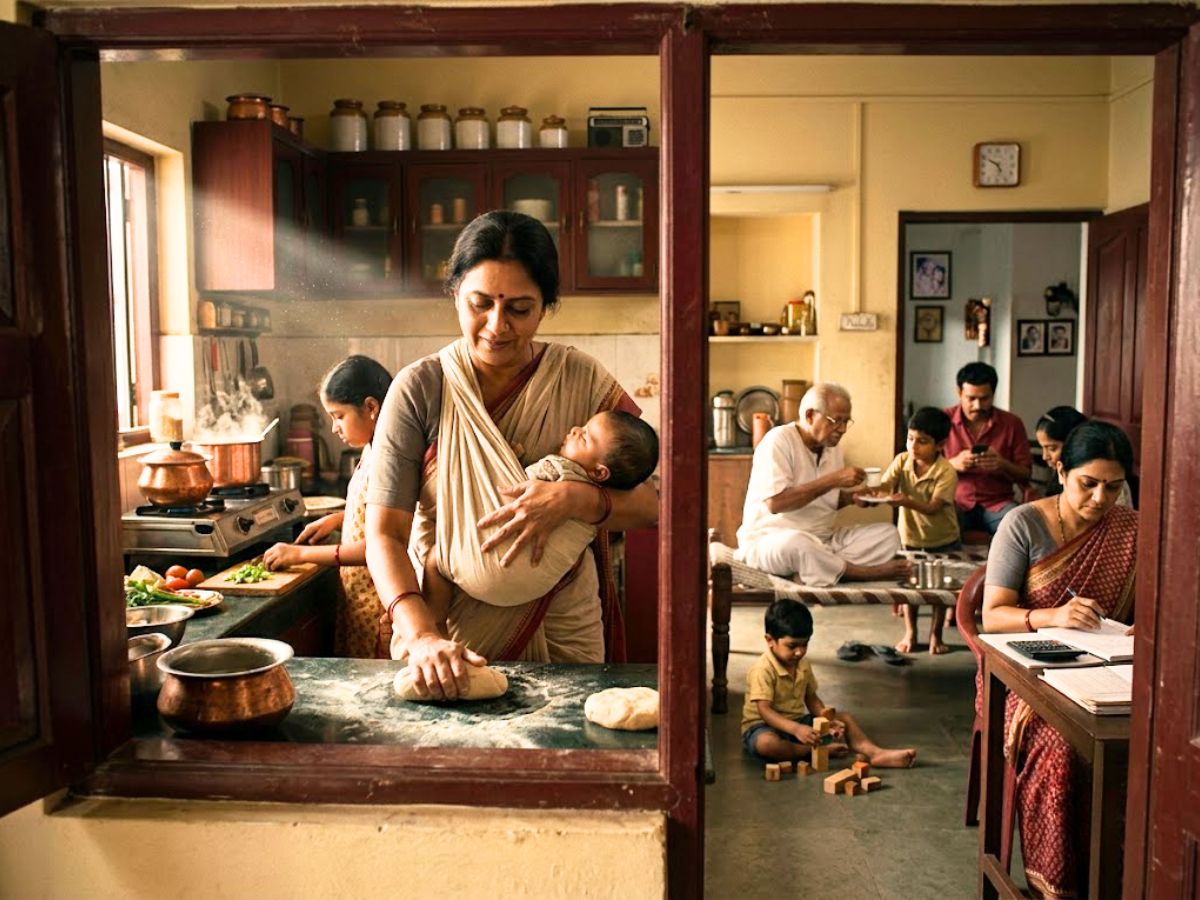
For centuries, Indian homes have run on the invisible labour of women cooking meals, raising children, caring for the elderly, and holding families together, all without a salary or social recognition. On June 11, the Supreme Court finally acknowledged this reality, calling homemakers “nation builders” and assigning their labour a value of ₹30,000 a month. The judgment is historic because it acknowledges what society has long ignored. But it also forces us to ask: can care, sacrifice and emotional labour ever truly be reduced to a price tag?
At first, this ruling feels like progress and it is. For decades, domestic labour has been excluded from economic frameworks. By assigning a monetary value, Court has attempted to correct that invisibility.
But the question still feels uncomfortable: can a fixed figure ever capture the value of a homemaker’s life work?
Because what is being measured here is not a job with fixed hours. It is an entire ecosystem of care cooking, cleaning, childcare, elder care, emotional support, crisis management, and the invisible work of holding a family together.
Different life realities tell another story
This is where the difficulty begins. Every woman’s experience of homemaking is different.
Some live in nuclear families where they carry the entire burden alone. Others live in large joint families where responsibilities stretch across 15 or 20 people. The intensity, emotional load, and physical exhaustion vary widely.
In such a reality, can one uniform number ₹30,000 truly reflect the depth of this labour? Or does it flatten deeply personal experiences into an average that does not fit anyone fully?
In fact, big screen Cinema has long captured what economics struggles to define in reality.
In English Vinglish, Shashi’s family fails to notice her daily labour until she steps outside the home and is forced to prove her worth in a language the world respects. Her story is not about English alone, it is about recognition.
Supreme Court’s ruling feels like a “Shashi moment” for the law: acknowledgement of invisible work. But it still defines that recognition through numbers.
In The Great Indian Kitchen movie, domestic labour is shown differently, repetitive, exhausting, and endless. There is no applause, no break, no valuation. Just repetition. The film reminds us that care work is not just service, it is structure and expectation.
Even in KGF, the emotional line “Is duniya mein sabse badi yoddha Maa hoti hai”celebrates sacrifice. But it also raises a question: when women are constantly framed as warriors of sacrifice, does society end up normalising their burden instead of questioning it?
Who has the privilege?
Supreme Court’s recognition of homemakers’ unpaid labour is undoubtedly a progressive step, but it also brings out a crucial layer that cannot be ignored: differences of privilege and marginalisation among women.
Not all homemakers live the same reality. For some women in relatively privileged households, domestic work is supported by financial stability, shared responsibilities, or even hired help, which can reduce the physical and emotional burden of care work.
However, many women from marginalised or economically weaker backgrounds carry the double weight of unpaid domestic labour along with financial insecurity, limited agency, and in some cases, rigid social structures that restrict their choices. Their work is not just invisible, it is often rooted in inequality.
In such a context, a uniform valuation like ₹30,000 may acknowledge the existence of domestic labour, but it cannot fully reveal the deep social and economic disparities that shape how that labour is experienced.
The real issue is not valuation, but invisibility
Supreme Court’s judgment is undoubtedly progressive. It forces society to confront a truth: unpaid domestic work has real economic value. But monetisation alone cannot solve the deeper issue. A number can acknowledge labour, but it cannot capture dignity, inequality, emotional strain, or social expectation. The danger lies in believing that once something is priced, the problem is solved.
What can we do?
The conversation must move beyond compensation alone.
First, we need to recognise domestic work not just in courts, but in everyday social thinking as real labour, not “help” or “duty.”
Second, care work must be redistributed. Men must share domestic responsibilities more equally, consistently.
Third, policies must go beyond accident compensation. Social security for homemakers, access to financial independence, and recognition in economic planning are essential steps.
Finally, families themselves must change the way they value care not after loss, not after crisis, but every single day.
Because the question is not just whether ₹30,000 is enough. The real question is whether we are ready to see homemakers not as invisible supporters of life but as equal participants in it.
Sofia Babu Chacko is a journalist with over five years of experience reporting on Indian politics, crime, human rights, gender issues, and stories about marginalized communities. She believes journalism plays a crucial role in amplifying unheard voices and bringing attention to issues that truly matter. Sofia has contributed articles to The New Indian Express, Youth Ki Awaaz, and Maktoob Media. She is also a recipient of the 2025 Laadli Media Awards for gender sensitivity. Beyond the newsroom, she is a music enthusiast who enjoys singing. Connect with Sofia on X: https://x.com/SBCism





