

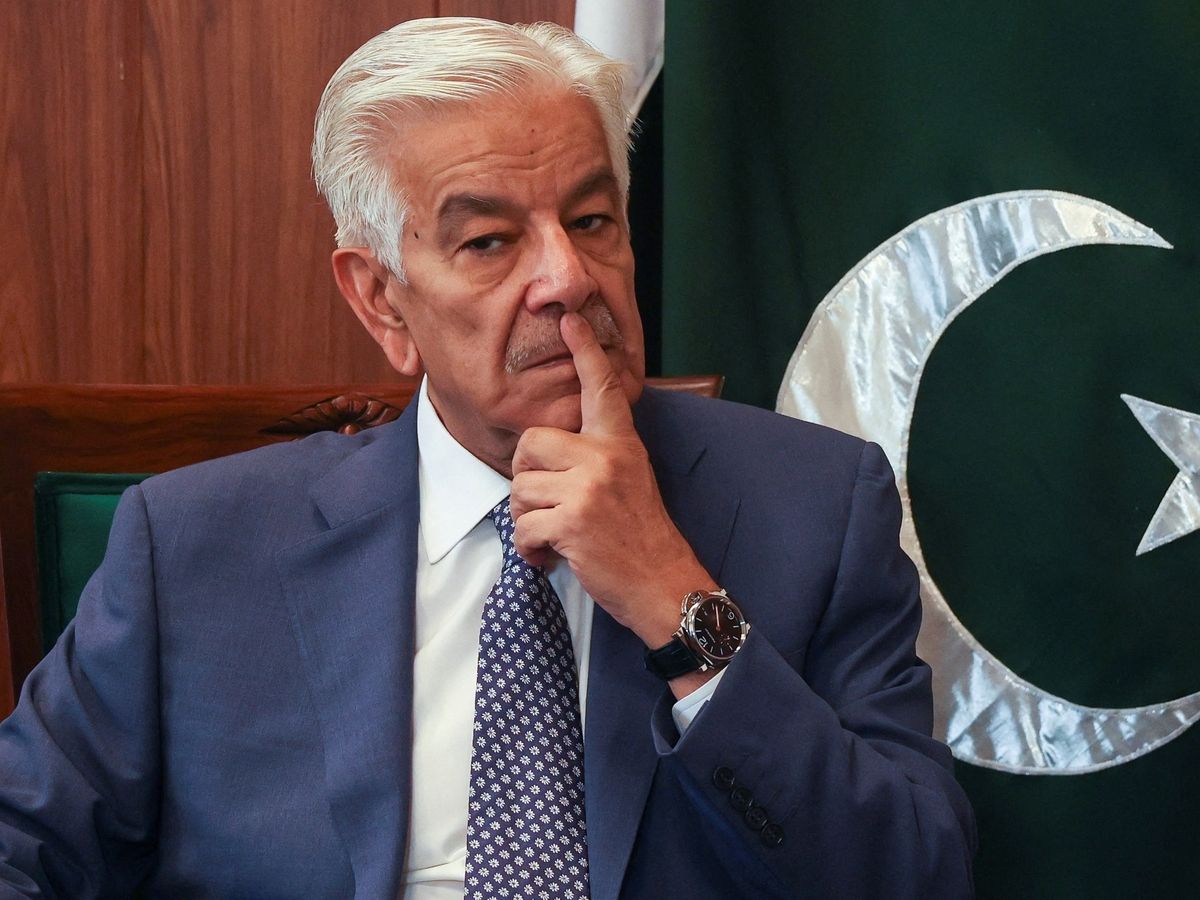
Pakistan Defence Minister Khawaja Asif has found himself at the centre of a storm after a social media post on the unrest in Pakistan-occupied Kashmir (PoK) raised uncomfortable questions about the government’s use of religion in politics. At a time when protests, deaths and allegations of state repression are dominating headlines from PoK, Asif chose not only to invoke Pakistan’s Constitution but also one of the Quran’s most severe verses while addressing demonstrators. The move has triggered a wider debate: Is the Defence Minister merely defending the state, or is he attempting to equate opposition to the Pakistani state with opposition to Allah and His Messenger?
The controversy erupted after Asif posted on X on Saturday night, writing, “Dialogue begins with loyalty and complete obedience to the state.” He then added, “Some misguided brothers in Azad Kashmir, who these days appear to be following a certain agenda, should read Article 5 of Pakistan’s constitution that requires unwavering loyalty to the state.” The remarks came as supporters of the banned Joint Awami Action Committee (JAAC) continued protests across PoK, demanding political, economic and governance reforms.
Questions emerge over linking the state with divine authority
What has drawn the strongest criticism is not the reference to the Constitution but what followed. In the same post, Asif cited Surah Al-Ma’idah, Verse 33 of the Quran, which states: “Those who wage war against Allah and His Messenger and strive to spread corruption in the land, their punishment is that they be killed or crucified, or have their hands and feet cut off from opposite sides, or be banished from the land. That is a disgrace for them in this world, and in the Hereafter, they will suffer a tremendous punishment.”
As per reports, the use of this verse has sparked a fierce debate among critics, activists and religious observers. Many have questioned whether Asif was effectively placing protesters in PoK in the category of people who are described in the Quran as waging war against Allah and His Messenger. If loyalty to the state is being presented alongside such a verse, critics ask whether the government is implying that challenging state policies is equivalent to challenging religion itself.
Quran should not be used to defend political failures
The backlash has been particularly sharp because the protests in PoK are centred on political representation, governance and rights rather than religious issues. Religious scholars critical of the remarks described the episode as a new low, arguing that sacred scripture should not be used as a political tool against citizens demanding reforms.
It should also be noted how ironic the situation is, taking into account the verse being referred to which talks about corrupting others. The critics say that Pakistani governments have faced charges of corruption, bad governance, and political manipulation of the region of PoK by opposition activists. Considering that context, they maintain that using the religion card to support the government’s stance may seem more like protecting political power rather than making a plea for unity in the face of opposition.
Violence in PoK continues to escalate
The controversy comes as the situation on the ground in PoK continues to deteriorate. According to AFP, clashes between police and supporters of the banned JAAC have left 20 people dead. Earlier reports had put the toll at seven, but subsequent figures released by local authorities showed a much higher number.
According to the Associated Press, the latest unrest was triggered by a ruling of the Supreme Court of Pakistan-administered Kashmir, which held that 12 legislative seats reserved for Kashmiri refugees living in Pakistan are constitutionally protected and cannot be removed without a constitutional amendment. The JAAC, formed in 2003, has been demanding greater political rights for residents of PoK and the abolition of those seats, arguing that they give excessive influence to people who do not live in the territory. As protests intensify and the death toll rises, Asif’s remarks have added another layer of controversy to an already volatile PoK crisis.
Khalid Qasid is a media enthusiast with a strong interest in documentary filmmaking. He holds a Master’s degree in Convergent Journalism from AJK MCRC. He has also written extensively on esports at Sportsdunia. Currently, he covers world and general news at NewsX Digital.





