
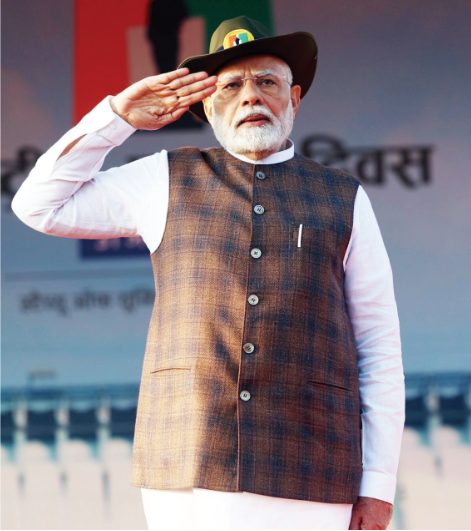

“Dheergha Ayushman Bhava, Modiji,”—like your respected Ma and Bharat Mata. You have accepted us as your parivar and dedicated yourself to providing a swachh, swasth aur ayush life through your yeoman service during COVID-19 and, over the past decade, via Ayushman Bharat, Ayushman Arogya Mandirs, Jan Aushadhi Kendras, AYUSH (integrated medical care) and the Ayushman Bharat Digital Mission—each under the National Health Mission (NHM)—true to the maxim “Arogyam paramam dhanam.”
Modiji Leads by Example
Less than three months after Prime Minister Narendra Damodardas Modi proposed the idea, the UN General Assembly on 10 December 2014 adopted an India-led resolution declaring 21 June—the summer solstice—as the International Day of Yoga, recognising that yoga provides a holistic approach to health and well-being and promotes health, harmony and peace, both within individuals and across the world. It is now celebrated globally, with PM Modi performing yoga with fellow Indians each year.
PM Modi was among the rare world leaders to act early and decisively against COVID-19, while the presidents of the USA and Brazil, and the prime minister of the UK, initially dismissed the coronavirus as “just a flu.” He managed the world’s largest nationwide lockdown on short notice in March 2020, communicating clearly and organising effectively. On 28 November 2020, he visited three vaccine manufacturers—Serum Institute of India (Pune), Bharat Biotech (Hyderabad) and Zydus (Ahmedabad)—to review vaccine development and manufacturing. Rapid mobilisation of health and frontline workers, emergency networking of software, apps, laboratories, health facilities, telecom and logistics helped democratic India prevail against the odds under a responsive, hands-on leader who removed roadblocks.
COVID Vaccines for All
Visionary leadership and close government–industry collaboration compressed what is usually a decade-long cycle into about a year—genome sequencing, development, testing and rollout of multiple vaccines compatible with existing cold-chain logistics. On 16 January 2021, India launched the world’s largest (and free) vaccination drive. On 1 March 2021, PM Modi publicly took a dose of Indian Covaxin to endorse its safety and efficacy. Strong communication—by healthcare experts, media and telecom networks—and behaviour-change campaigns helped overcome hesitancy without compulsion; India recorded among the lowest vaccine hesitancy levels globally.
CoWIN (COVID Vaccine Intelligence Network), a scalable cloud-based IT platform, enabled real-time stock tracking at national, state and district levels; beneficiary registration in 12 regional languages; anywhere appointment booking; and digitally verifiable certificates compliant with WHO guidelines to facilitate international travel. Vaccine Maitri (“Vaccine Friendship”), launched on 20 January 2021, supplied vaccines worldwide on humanitarian, commercial and COVAX bases. By February 2022, India had supplied ~162.9 million doses to 96 countries (14.3 million gifted; the rest commercially or via COVAX), while some foreign vaccines faced efficacy questions and high costs.
Healthcare to the Doorstep
India’s vaccination scale speaks for itself: a vast geography and population, R&D and logistics hurdles, and free access—even at doorsteps in remote locations. Drones delivered vaccines; health workers reached by bicycle, boat and camel. The Har Ghar Dastak (door-to-door) campaign covered missed or dropped-out beneficiaries. Unprecedented milestones followed: over 100 crore doses in <9 months; 2.51 crore doses in a single day; and 90% of eligible beneficiaries fully vaccinated. Confirmed COVID-19 cases during the pandemic included ~0.10 billion in the US (~33% of ~0.3 billion people), ~0.09 billion in China (~6.4% of ~1.4 billion) and ~0.04 billion in India (~2.85%).
The Ayushman Bharat Digital Mission is knitting together the healthcare ecosystem through digital highways. Expansion of motorable roads, highways, railways, telecom, new airports and village health centres—and robust logistics—has pushed care into India’s remotest corners. Home delivery of essentials and tele-health at scale have been enabled by advances in telecom, transport, drones, e-commerce, digital payments, automation, AI and allied technologies.
Healthcare Supply Chain
India was largely self-reliant in APIs (Active Pharmaceutical Ingredients) and intermediates until the 1990s; subsequent cheap imports led to domestic shutdowns. After initial shortages of masks, PPE and diagnostic kits during COVID-19, local manufacturing scaled rapidly—covering disposables (masks, gloves, syringes, sutures, catheters, IV cannulas, etc.), equipment (surgical instruments, implants, ventilators, defibrillators, incubators, fibre-optic endoscopes, electromedical devices), lab supplies, oxygen systems, drugs and vaccines—often at one-fourth to one-third of typical imported prices.
India exported life-saving medicines and equipment to 150+ countries during the pandemic’s initial phase. The 2020 Production-Linked Incentive (PLI) scheme is reducing import dependence (Atmanirbhar Bharat) on Key Starting Materials (KSMs), Drug Intermediates and APIs—rewarding domestic production, innovation, diversification and scale in pharma and medical devices. Parallel support is boosting local manufacture of semiconductors and other critical components for medical devices, many rooted in aerospace, defence, nuclear, electronics and telecom R&D—showing how strategic industry support strengthens health security.
Preventive Healthcare
Pradhan Mantri Surakshit Matritva Abhiyan (PMSMA) provides free, comprehensive, quality antenatal care to detect and prevent high-risk pregnancies, reducing maternal and infant mortality. Delivery and post-natal care are covered through JSY (Janani Suraksha Yojana) and JSSK (Janani Shishu Suraksha Karyakaram). MAA (Mother’s Absolute Affection) supports breastfeeding through counselling.
Beyond the Universal Immunisation Programme (UIP), Mission Indradhanush (2014) targets left-out and unreached children. New vaccines added to UIP include inactivated polio, adult Japanese Encephalitis, rotavirus, measles-rubella and pneumococcal conjugate vaccines. Intensified Diarrhoea Control Fortnight (IDCF) distributes ORS and counselling to reduce child mortality; National Deworming Day (NDD) provides albendazole to crores of children to curb anaemia due to worm infestation.
The Swachh Bharat Mission–Grameen (2014)—a historic behaviour-change movement—made India Open-Defecation-Free (ODF), cut groundwater contamination and reduced diarrhoeal and parasitic disease. WHO reported ~300,000 fewer diarrhoeal deaths in 2019 vs 2014, directly attributable to improved sanitation. Families in ODF villages saved, on average, ~₹50,000 annually in health costs.
Targeted Healthcare
The National Programme for Prevention and Control of Cancer, Diabetes, Cardiovascular Diseases and Stroke (NPCDCS) and the Pradhan Mantri National Dialysis Programme expand NCD care—setting up 356 District NCD Clinics, 103 Cardiac Care Units, 71 Day-Care Centres and 1,871 CHC-NCD Clinics—alongside a mass awareness drive, Chalo Banayein Swasth Bharat.
Affordable Healthcare
To advance Universal Health Coverage, Ayushman Bharat moves from a fragmented, sectoral approach to comprehensive, primary-care-led services via two linked components: (1) creation of 1.5 lakh Health & Wellness Centres (Ayushman Arogya Mandirs) with free essential drugs and diagnostics; and (2) PM-JAY, the world’s largest health assurance scheme, providing ₹5 lakh per family per year for secondary/tertiary hospitalisation to ~12 crore poor and vulnerable families (~55 crore beneficiaries). PM-JAY offers cashless, paperless care at public and empanelled private hospitals, covering pre-existing diseases, diagnostics and post-hospitalisation care, with no cap on family size or age. All senior citizens aged 70+ are now covered regardless of income under the scheme.
More Healthcare Personnel
India has expanded medical education dramatically: medical colleges rose from 387 (pre-2014) to 731 (mid-2024); MBBS seats grew 118% (51,348 → 1,12,112+); PG seats 133% (31,185 → 72,627+). New AIIMS and medical colleges, Competency-Based Medical Education (CBME), digital/virtual learning tools and Workplace-Based Assessments (WPBA) are sharpening practical skills, ethics, communication and patient-centred care while improving the doctor-population ratio.
Hospitals increased from ~43,500 (2019) to ~54,000 (2024); total beds reached ~1.3 million by 2024, amid a 27% expansion in private hospitals. Medical tourism is spurring expansion and modernisation, especially in metros.
Health as Soft Power
On 26 June 2025, PM Modi posted on X: “Indian culture offers numerous ways to stay fit and healthy. In #MannKiBaat, we’ve showcased such initiatives, including a startup that beautifully integrates tradition with modernity.” Indian pharmaceuticals—and Indian doctors, nurses, technicians and health workers—underpin national health services worldwide. This soft power, plus India’s ability to deliver medical and disaster relief across the globe, strengthens logistics reach and geopolitical heft.
Healthcare also supports athletes, pilots, astronauts, police and defence personnel in harsh conditions—pushing the frontiers of human performance. Medical tourism yields multiple benefits: scalable facilities and workforce for emergencies; hospitality and leisure infrastructure; foreign-exchange earnings; exports of Indian drugs; diversified financial returns; goodwill among nations; and invaluable clinical experience and research data across populations. Its applications extend far beyond the obvious—conferring strategic, geopolitical and soft-power advantages.
—Dr. P. S. Venkatesh Rao is a Consultant Surgeon, former faculty at CMC (Vellore) and AIIMS (New Delhi), and a polymath based in Bengaluru.




