
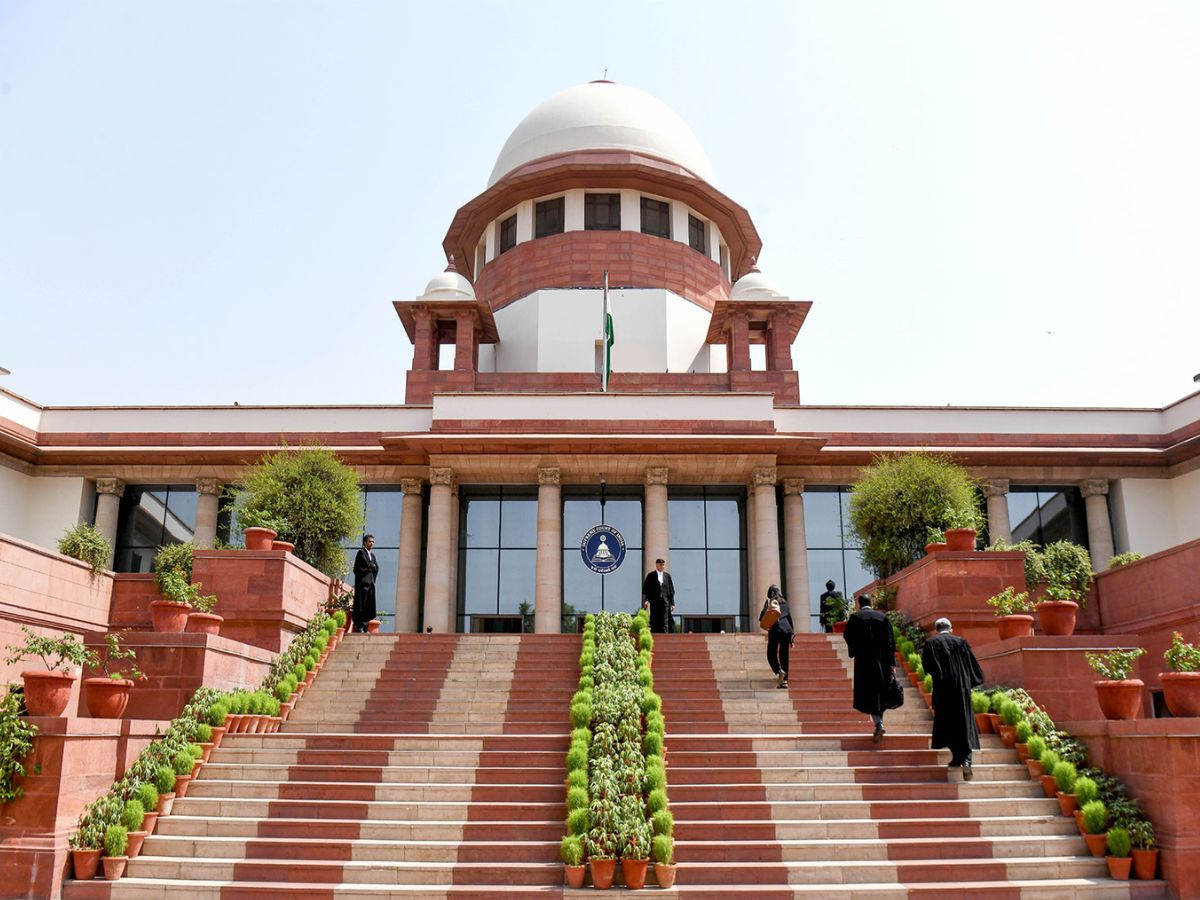

On Monday, the Supreme Court declared that it would deal with cyber frauds with an “iron hand” and demanded strict and severe measures to combat them, especially digital arrest schemes.
A panel of Justices Surya Kant and Joymalya Bagchi expressed surprise upon learning that these schemes have extorted people out of close to Rs 3,000 crore. The fact that about Rs 3,000 crore has been collected from victims and that’s only in our nation is startling. If we don’t issue strict and severe directives, the issue will worsen. Justice Kant said, “We will handle this with iron hands.” A sealed cover report from the CBI and the Ministry of Home Affairs (MHA) was presented to the bench. According to Solicitor General Tushar Mehta, the matter was being handled by a different MHA section, and various actions were being taken. Following a brief hearing, the Supreme Court posted the case for hearing on November 10 and declared that the proper instructions will be issued. Regarding instances of digital arrest scams nationwide, the top court sent letters to all states and Union Territories last week. It had requested that each state provide information about cyber arrest cases that were still being looked at.
Additionally, it had considered turning the probe over to the Central Bureau of probe (CBI) and asked if the CBI had the capacity to handle all cases involving these schemes nationwide. The Supreme Court previously took suo motu cognisance of cases involving digital arrest schemes, in which con artists pose as judicial or law enforcement officials in order to extract money from people, especially elderly people.
In a prior hearing, the Supreme court had noted that the creation of judicial orders with fake judge signatures undermines both the rule of law and public confidence in the legal system. It had claimed that the action was a “direct assault” on the institution’s honour. “In addition to the rule of law, the creation of judicial orders with fake judge signatures undermines the public’s faith in the legal system. The institution’s dignity was directly attacked by such an action. According to the bench, “such a serious criminal act cannot be treated as an ordinary or routine offence of cheating or cyber crime.”
According to the Supreme Court, in order to uncover the entire scope of the operation involving the fabrication of court documents, extortion, and the robbery of innocent people most significantly, elderly citizens, coordinated efforts between the federal and state police are necessary.
A senior citizen couple who were cheated of their life savings through a digital arrest scam last week filed a complaint with the supreme court, and the bench took suo motu cognisance of the case. The 73-year-old Ambala woman said that fraudsters had imprisoned her in a digital arrest and demanded more than Rs. 1 crore by using fake Supreme Court orders. She asserted that a fictitious order allegedly issued by the Supreme Court judge was generated by the scammers. Through the Secretary of the Ministry of Home Affairs, the Director of the CBI, the Principal Secretary of the Department of Home, and SP Cyber Crime in Ambala, the Supreme Court had sent notice to the Union of India. Additionally, it requested that the Haryana government and SP Cybercrime Ambala submit a progress report on the investigation’s current state. On the matter, the bench had also asked the Attorney General for India for help.
(With Inputs From ANI)




