
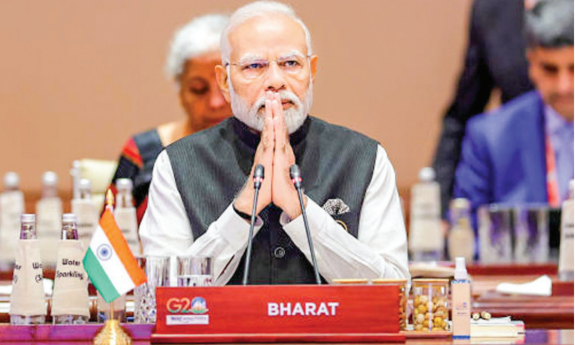

Deepak VohraIn 2025, I began wearing a collar pin that proclaims: “I am a nationalist”. I had never done this before.
I am 74 years young with 52 years in diplomacy and counting. I wish I had served Prime Minister Narendra Modi as one of his ambassadors. He has given an entirely new dimension to Bharat’s foreign policy, ably supported by his outstanding Minister for External Affairs, Dr. S. Jaishankar.
Narendra Modi says what he means and he means what he says. Bharat’s interest is paramount for him. Antagonists are learning this to their horror.
For three decades of my career, I would defend India’s position on Kashmir, refuting Pakistan’s claims about so-called United Nations resolutions. No one was really interested in what happened to Kashmir. Foreigners used it as a pressure point on India. And then Narendra Modi mainstreamed Jammu and Kashmir into the great Indian body politic, abolishing its “special status”. Overnight the narrative shifted. The Kashmir “issue” became Pakistan Occupied Kashmir. We tell those who ask us to persuade Pakistan to vacate its aggression. Our Pakistani counterparts are lost, confused, disoriented.
He has taught his diplomats not to be diffident or submissive, not to punch below their weight. Don’t lower your eyes when talking to foreigners, he has counselled us. Do not look up. Look your interlocutors straight in the eyes. He stands conventional logic on its head and questions every shibboleth.
Thrice in the past few years he asked why our waters from the Indus River system were flowing into the country that has adopted terrorism as state policy, even as our farmers in northern India were struggling to irrigate their crops. Indian officials would mutter some excuses about a 1960 Indus Waters Treaty. And then, one fine day in May 2025, as part of a slew of measures to punish the sponsors of terror, we suspended the Treaty. Bharat reclaimed its waters. Terroristan threatened Armageddon, then floundered for a response.
This is Narendra Modi.
I call the Prime Minister Jaamvant, the bear who, in the Ramayana, reminded Hanuman of his enormous strength. Tasked to locate Sita Ma, Hanuman and his acolytes scoured every part of Bharat but could not find her. When one of his supporters found out about the island where she was being held captive by her abductor, Hanuman lapsed into depression, wondering how he would travel 300 kilometres across the ocean. He was terrified about confessing his failure to Lord Rama. And then Jaamvant appeared.
Hanuman, he said, remember your great power, your unmatched strength. Rise, and with self-confidence, leap across the seas. Inspired and rejuvenated, Hanuman did just that, found Sita Ma, and then burnt the kidnapper’s palace.
In the modern era, indecisive India has become Bharat Bahadur, reminded of its great strength by its modern Jaamvant, Prime Minister Narendra Modi.
When he declared war on terror, and said that India would lead the fight against international terror, going it alone, if necessary. We put away the voluminous dossiers that we had built on terror attacks in India which we would distribute to all and sundry, especially the big boys, seeking their support and sympathy. They, of course, did nothing, with many suggesting that cross-border terrorism that was bleeding India was a law-and-order issue. Our modern Jaamvant said enough is enough.
To prove our resolve and determination, we eliminated several terror camps in Pakistan and Myanmar, using our special forces, fighter planes, missiles and drones, earning Bharat global respect and admiration. Yet we remain down to earth. In diplomacy there is no place for arrogance.
Despite the United States denying him a visa for a decade, Prime Minister Narendra Modi went there soon after being elected Prime Minister of Bharat. He said let the past be the past. This is pragmatic diplomacy or realist diplomacy.
In diplomacy, if your hands are tied behind your back and shackled to the past, you cannot hug the future.
In 2025, with strategic resolve born of our magnificent history Bharat has navigated President Dollar Trump’s tariff terrorism, Pakistan’s military terrorism, China’s economic terrorism. Respect among nations is always earned and commanded, not demanded or self-proclaimed.
We are a rival to developed nations in terms of technology, size, and intellectual quotient. We are fast becoming an industrial, technological, and military force to reckon with. Two decades of steady and sustained progress is critical to our emerging as an economic giant without poverty, a nuclear power, a tech powerhouse, a global talent engine. That is what our neighbours and the big powers want to stymie. But they have to deal with the solid Mount Meru that defends Bharat’s interests. Mount Meru is a central axis of the world and the abode of gods.
Narendra Modi has given back to Bharat its self-respect, its self-confidence, its self-esteem. The world did not owe India respect—we have earned it, strategically. Narendra Modi says this bluntly, clearly, and without delusion.
China does not get global respect because it is fair—it gets it because it is feared. Israel does not get unwavering Western support because it is loved. It gets it because it is useful.
Bharat is a civilizational state, a functioning democracy of 1.4 billion people. A culture that has survived every invasion, every collapse, and still thrives. And yet—when we are attacked, slandered, or sabotaged—the world rarely rushes to our side. Whether it is cross-border terrorism, global media bias, or international institutions treating us like we are still in the 1970s—we do not get the backing we believe we have earned. Why?
There is no point in seeking moral validation in a world that only respects power. Under Narendra Modi’s leadership, Bharat projects its huge power whenever and wherever required. Pirates in the Red Sea and off the Somali coast flee when the Indian navy approaches. Bharat Mata reaches out to bring home her children and others from trouble spots; other nations ask us to evacuate their citizens.
We are not seeking applause for being the world’s biggest democracy. The bitter truth is that the world does not care who is right. It cares who is strong, who is useful, and who is unavoidable.
We do not need sympathy. We have our strategy defined and lived by our Jaamvant. Bharat does not cry for approval from Trump or Putin or Macron or MBS. They will back us when we make ourselves economically indispensable, technologically non-substitutable, and geopolitically pivotal. We are the world’s data trust and the pharmacy of the Global South. We are the cultural superpower whose ideas, not just yoga and movies, reshape global values.
Narendra Modi has proved that we do not need to be liked, we need to be needed. Because in geopolitics, being irreplaceable is more powerful than being virtuous.
India’s path to civilizational dominance will be lonely, complex, and uphill. Bharat has always walked alone—and changed the world anyway.
In January 2025, India’s Defence Research and Development Organization (DRDO), successfully tested an endothermic fuel powered long duration Scramjet engine—India has mastered hypersonic missile technology.
An American analyst claimed in late 2024 that India held the best geopolitical position globally, with a leadership role in the global south, improving relations with China, strong relations across G-7, friendly with Russia without backlash from the West, with no other major economy close to being friends with pretty much everyone.
There are some hiccups, but we have dealt with them. Prophylactics, antidotes, therapeutics, and therapies are many: the basic question is how we optimize them. Easier said than done!
Malcolm X, the African American revolutionary, Muslim minister and human rights activist who was a prominent figure during the civil rights movement until his assassination in 1965, had said: “The media is the most powerful entity on earth. They have the power to make the innocent guilty and to make the guilty innocent, and that’s power…Because they control the minds of the masses.” Modi has taught us how to handle the media—counter it when necessary, ignore it when other issues demand our attention.
We have given up writing assessments of current events with limited shelf lives and have started imagining the future.
In college in the 1960s, I adored Bob Dylan, especially his classic for the rich world, that I quote:
“…don’t criticize
What you can’t understand…
Your old road is rapidly agin’
Please get out of the new one
If you can’t lend your hand
For the times they are a-changin’.”
Its motto of one world, one family, one future appeals to everyone.
Sri Aurobindo said 115 years ago that Bharat was rising to share the eternal light entrusted to her… Bharat has always existed for humanity and not for herself.
We proved our credentials with our global leadership in supplying vaccines to combat the Chinese virus even when we were ourselves short of them, being the first responder in natural crises, giving food aid when needed, offering medical treatment, sharing our Digital Public Infrastructure with whoever was interested etc. Bhutan’s Prime Minister called India a role model for the world. I can confirm that most African nations would agree. I am Special Advisor in three of them and at least two have asked for Shri Narendra Modi on wet lease for a few years to develop their countries!
Bharat works quietly, the duck syndrome. On the surface the duck appears calm and gentle, beneath the surface it paddles furiously to stay afloat.
In 1944, international relations professor William Fox of Columbia University wrote a book called Superpower, in which he listed three Superpowers: USA, USSR and Britain. The USSR had boarded Yamraj’s train, Britain waits on the platform boarding pass in hand, only the USA survives as a Great Power.
The attributes that Fox listed for a Great Power—Bharat has them all and more. By all parameters of Great Power status, Bharat is right there. The global interest in Bharatiya skill and talent is growing by the day. It is difficult to get an elephant to run, but once it starts charging it is impossible to stop it. The combination of a large, young, aspirational population with a taste for democracy means that difficult thing called public opinion matters.
When Narendra Modi, as Head of G-20, hosted a virtual Voice of the Global South Summit for 125 developing nations in January 2023 on the theme “Unity of Voice, Unity of Purpose”, more than one of my principals in Africa called to say that they had chosen Bharat as their role model. I replied: Yehi hai right choice, Baby!
170 years ago, Victor Hugo said that no power on earth could stop an idea whose time has come. At some point, every nation, every civilization, undergoes a renaissance that marks its rise. The Bharati renaissance is galloping ahead.
Ek Bharat Shresht Bharat is our reality. Bharat’s time has come.
Thank you, Prime Minister Narendra Modi.
— Deepak Vohra, Former Indian Ambassador
Manisha Chauhan is a passionate journalist with 3 years of experience in the media industry, covering everything from trending entertainment buzz and celebrity spotlights to thought-provoking book reviews and practical health tips. Known for blending fresh perspectives with reader-friendly writing, she creates content that informs, entertains, and inspires. When she’s not chasing the next viral story, you’ll find her diving into a good book or exploring new wellness trends.




