
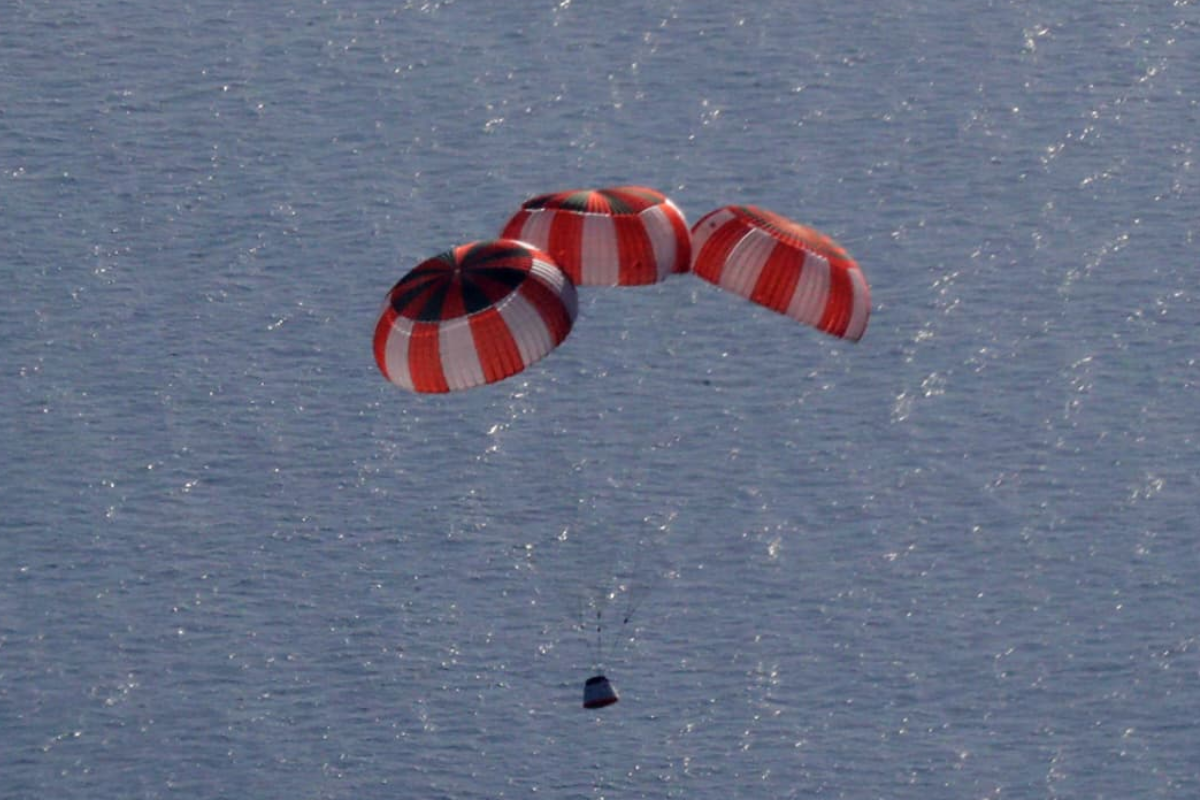

The Indian Space Research Organisation (ISRO) on Saturday has successfully conducted a series of Key qualification tests for drogue parachutes. This test carried out to develop a deceleration system for the Gaganyaan Crew Module.
The union minister for science and technology, Jitendra Singh said that “ISRO successfully completed the Drogue Parachute Deployment Qualification Tests for the Gaganyaan Crew Module at the RTRS facility of TBRL, Chandigarh, during 18–19 December 2025.”
Heartening to note that India has moved one more step closer to its first Human Space mission #Gaganyaan.
ISRO successfully completed the Drogue Parachute Deployment Qualification Tests for the Gaganyaan Crew Module at the RTRS facility of TBRL, Chandigarh, during 18–19 December… pic.twitter.com/ci47TQDaoA
— Dr Jitendra Singh (@DrJitendraSingh) December 20, 2025
Union minister further said “performance and reliability” of drogue parachutes under varying flight conditions, adding that this was an “important step” in qualifying the parachute system for India’s human spaceflight mission. “Heartening to note that India has moved one more step closer to its first Human Space mission #Gaganyaan,” minister said.
As per the ISRO, the deceleration system of the crew module of the Gaganyaan mission had a total of 10 parachutes of 4 types. The space agency further explained the descent sequence of the module. The agency said that “begins with two apex cover separation parachutes that remove the protective cover of the parachute compartment, followed by two drogue parachutes that stabilize and decelerate the module.”
ISRO said that once these drogues are released, three pilot parachutes are deployed to extract three main parachutes, which will further slowdown the crew into the module to ensure a safe touchdown.
The organisation said that the drogue parachutes are a crucial component in that they assist in stabilizing the crew module by reducing its velocity to a safe level during re-entry.
Regarding the objective of this particular series of tests, ISRO stated that they were conducted to evaluate the performance and reliability of drogue parachutes in extreme conditions.
The ISRO further said that “The successful completion of these tests marks another significant step toward qualifying the parachute system for human spaceflight, with active support and participation from the Vikram Sarabhai Space Centre (VSSC), ISRO, Aerial Delivery Research and Development Establishment (ADRDE), DRDO and Terminal Ballistic Research Laboratory (TBRL), DRDO,”
Syed Ziyauddin is a media and international relations enthusiast with a strong academic and professional foundation. He holds a Bachelor’s degree in Mass Media from Jamia Millia Islamia and a Master’s in International Relations (West Asia) from the same institution.
He has work with organizations like ANN Media, TV9 Bharatvarsh, NDTV and Centre for Discourse, Fusion, and Analysis (CDFA) his core interest includes Tech, Auto and global affairs.
Tweets @ZiyaIbnHameed




