

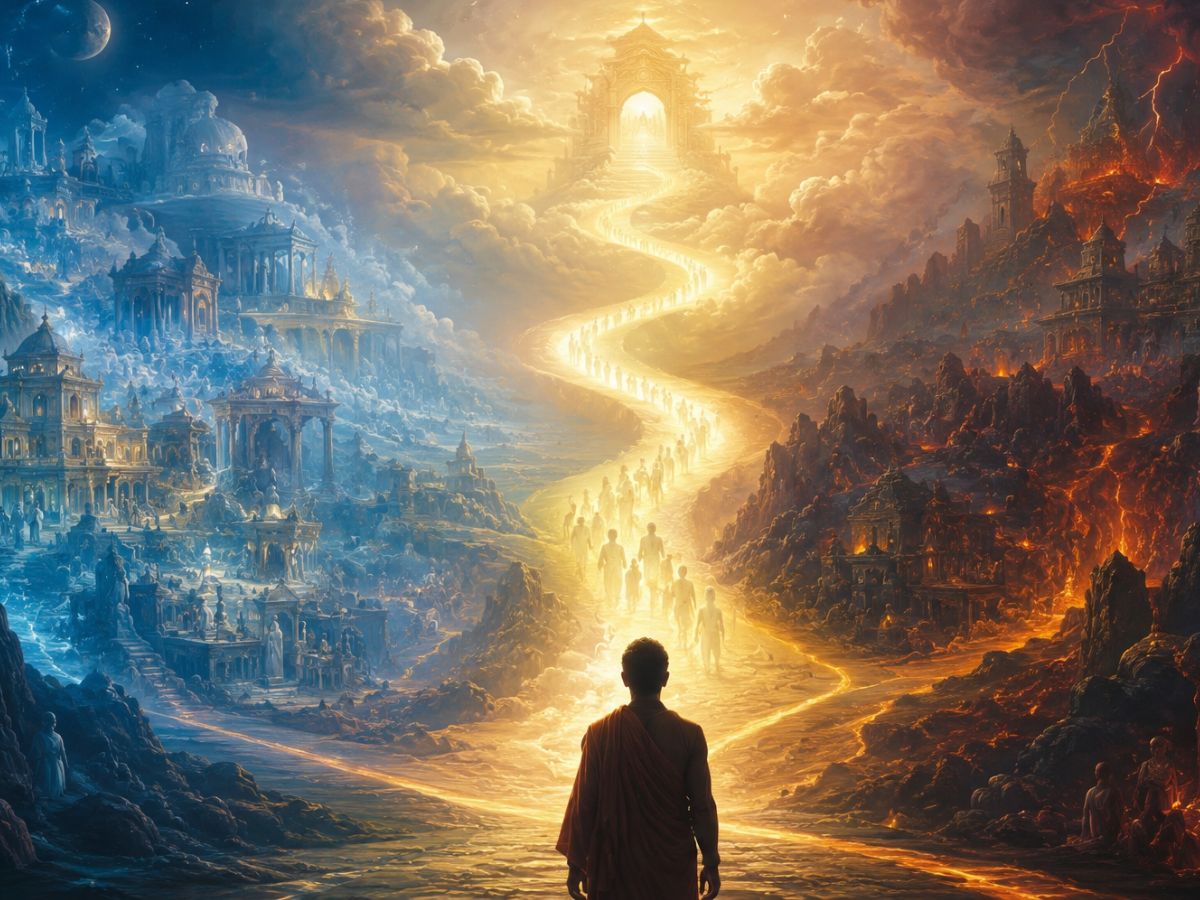
For thousands of years, Hindu philosophy has offered a unique perspective on what happens after death. Rather than viewing death as the end of existence, Hinduism describes it as a transition in an eternal journey guided by karma, spiritual growth, and rebirth. At the heart of this belief lies the concept of the 14 Lokas, or realms of existence, which together form a vast cosmic structure where souls continue their journey after leaving the physical body. Ancient texts such as the Puranas and Upanishads describe these Lokas as different planes of existence inhabited by gods, sages, humans, celestial beings, and other life forms.
What Are The 14 Lokas?
The Sanskrit word “Loka” means world, realm, or plane of existence. Hindu cosmology divides the universe into 14 Lokas arranged in different levels. These are not merely physical places but spiritual dimensions connected to consciousness and karma.
The 14 Lokas are broadly divided into:
- Seven Higher Worlds (Urdhva Lokas)
- Bhuloka (Earth), the human realm
- Seven Lower Worlds (Adho Lokas)
According to Hindu teachings, Earth occupies a special position because it is considered the realm where human beings create karma through their actions, which ultimately influences their future journey after death.
The Seven Higher Lokas
Satyaloka (Brahmaloka)
Regarded as the highest realm, Satyaloka is associated with Lord Brahma and ultimate truth. Souls reaching this level are believed to have attained the highest spiritual realization and are liberated from the cycle of rebirth.
Tapoloka
This realm is inhabited by great sages and ascetics engaged in deep meditation and spiritual discipline. It symbolizes intense devotion and penance.
Janaloka
Known as the abode of enlightened seers and rishis, Janaloka represents wisdom, contemplation, and spiritual knowledge.
Maharloka
A transitional realm between mortal and divine worlds, Maharloka is believed to be inhabited by highly evolved sages.
Svargaloka
Often compared to heaven, Svargaloka is ruled by Lord Indra. Souls who accumulate positive karma are believed to enjoy temporary rewards, happiness, and pleasures here before continuing their spiritual journey.
Bhuvarloka
Located between Earth and the higher celestial realms, Bhuvarloka is associated with celestial beings, spirits, and semi-divine entities.
Bhuloka
The earthly realm where humans live. Hindu scriptures describe it as the most important loka because it offers the opportunity to perform actions that determine one’s future destiny.
The Seven Lower Lokas
The lower realms are often misunderstood as hell-like worlds. Hindu texts, however, describe them as planes of existence where souls experience different forms of material attachment, desires, and karmic consequences rather than eternal punishment.
Atala
Associated with pleasure, illusion, and worldly temptations.
Vitala
A realm connected to powerful energies and mystical forces.
Sutala
The kingdom granted to the legendary King Bali by Lord Vishnu after the Vamana incarnation.
Talatala
Known as the domain of Maya, the master architect of the Asuras.
Mahatala
Home to serpent beings known as Nagas and often linked to hidden wisdom and subconscious energies.
Rasatala
Associated with powerful Asuras and material strength.
Patala
The lowest of the seven realms, often described as magnificent and wealthy despite its position in the cosmic hierarchy. It is traditionally associated with serpent kings and immense hidden power.
What Happens To The Soul After Death?
The soul, or Atman, is immortal. Hindu philosophy states that after the physical body dies, the soul sets out on the path of its karmic impressions. Depending on thoughts and actions, the soul goes to somewhere before re-entering birth again.
Many Hindu traditions believe that the soul may go to a higher or lower place than planets, such as an ancestral realm like Pitru Loka before rebirth. Liberation, or Moksha, is achieved when the soul goes free from the cycle of birth and death.
More Than A Cosmic Map
However, many teachers and scholars believe that the 14 Lokas are symbolic, representing the various aspects of human consciousness. The higher realms are spiritual wisdom and compassion, while the lower realms represent ignorance, attachment, desire and ego.
Each human being goes through these places within their thoughts, actions and spiritual growth, and so the Lokas are destinations after death and also markers of one’s current state.
A Vision Of Endless Spiritual Growth
Thus, the concept of Lokas creates a world in which every action has purpose and every soul can grow. Rather than a token system of punishments and rewards, Hinduism stresses the possibility of growth, spiritual learning and release.
For those that believe, the Lokas are simply omnipresent reminders that in life, we are bound to go on our way, making choices from atonement to rebirth and beyond.
ALSO READ: Benefits of Taking Collagen Supplements: Why More People Are Adding Them to Their Daily Routine





