

1I/‘Oumuamua became the very first interstellar interloper to pass through our Solar System. Detected on October 19, 2017, by a Canadian astronomer, Robert Weryk, using the Pan-STARRS telescope in Hawaii, it was sighted nearly 40 days after actually coming closest to the Sun. This greatly mystified scientists as to its unusual elongated shape and motion.
An Exo-Pluto Fragment
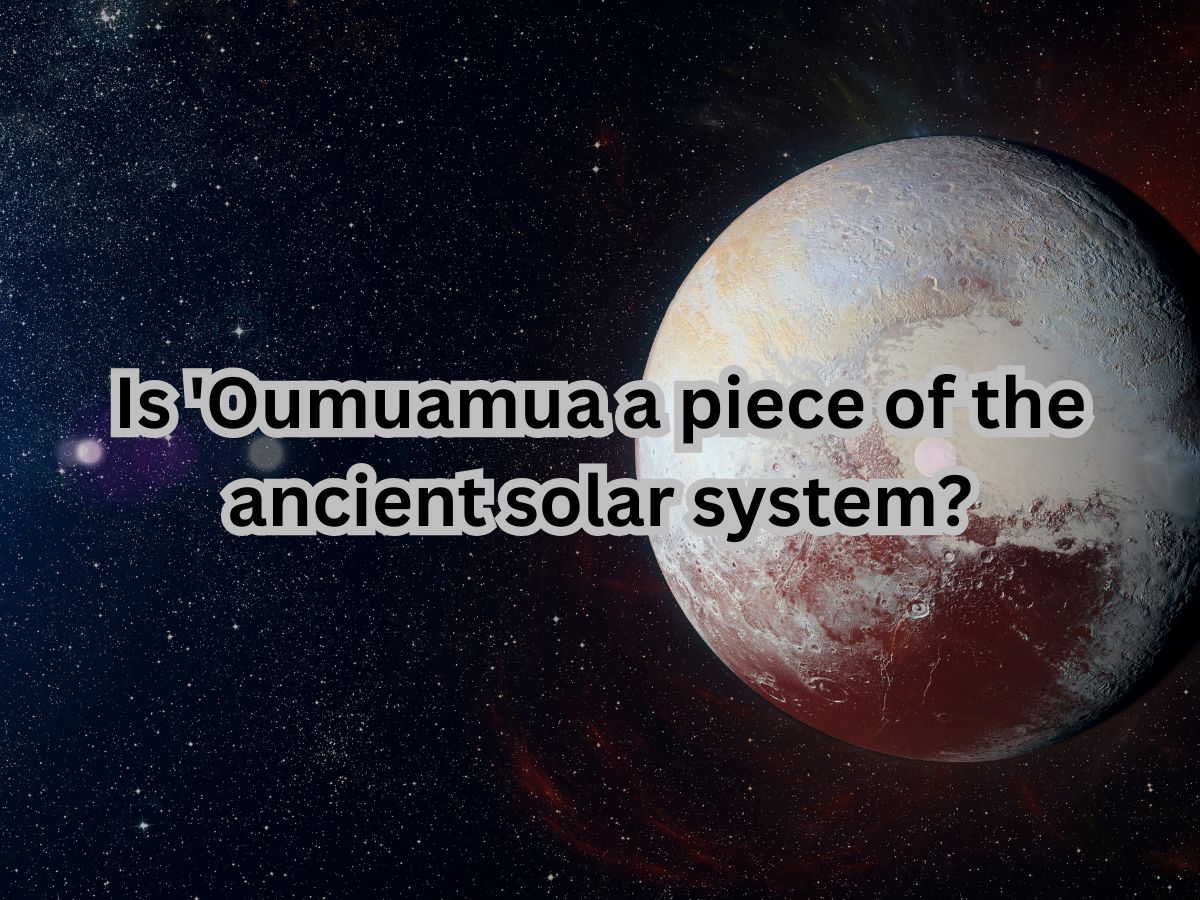
Recent studies establish that ‘Oumuamua is not a comet but instead a fragment of an icy exoplanet or an “exo-Pluto”, basically formed of nitrogen ice. Thus, it lies well into an entirely new group of space objects.
Pluto-Nitrogen Ice Connection
Back in 2015, NASA’s New Horizons mission established that Pluto’s surface was covered with nitrogen ice. By the same token, ‘Oumuamua’s bright surface, its makeup, and its perplexing acceleration are all what one would expect from a fragment of nitrogen ice.
Different from Other Interstellar Comets
Comets such as 2I/Borisov and 3I/ATLAS had water ice and dust, but this was not characteristic of ‘Oumuamua. The unusual shape and pure nitrogen composition made it something really special.
From the Kuiper Belt to Interstellar Space
Billions of years ago, violent collisions in the early solar system likely scraped nitrogen ice from Pluto-like worlds in the Kuiper Belt. Many fragments were then flung into interstellar space by Jupiter’s gravity. Scientists believe ‘Oumuamua is one such shard.
Why ‘Oumuamua isn’t a Comet?
Instead of a comet, ‘Oumuamua is best interpreted as a unique foreign intruder from beyond the stars-a leftover from the chaotic origin of planetary systems.
Shubhi is a seasoned content writer with 6 years of experience in digital media. Specializing in news, lifestyle, health, sports, space, optical illusions, and trending topics, she crafts engaging, SEO-friendly content that informs and captivates readers. Passionate about storytelling, Shubhi blends accuracy with creativity to deliver impactful articles across diverse domains.




