
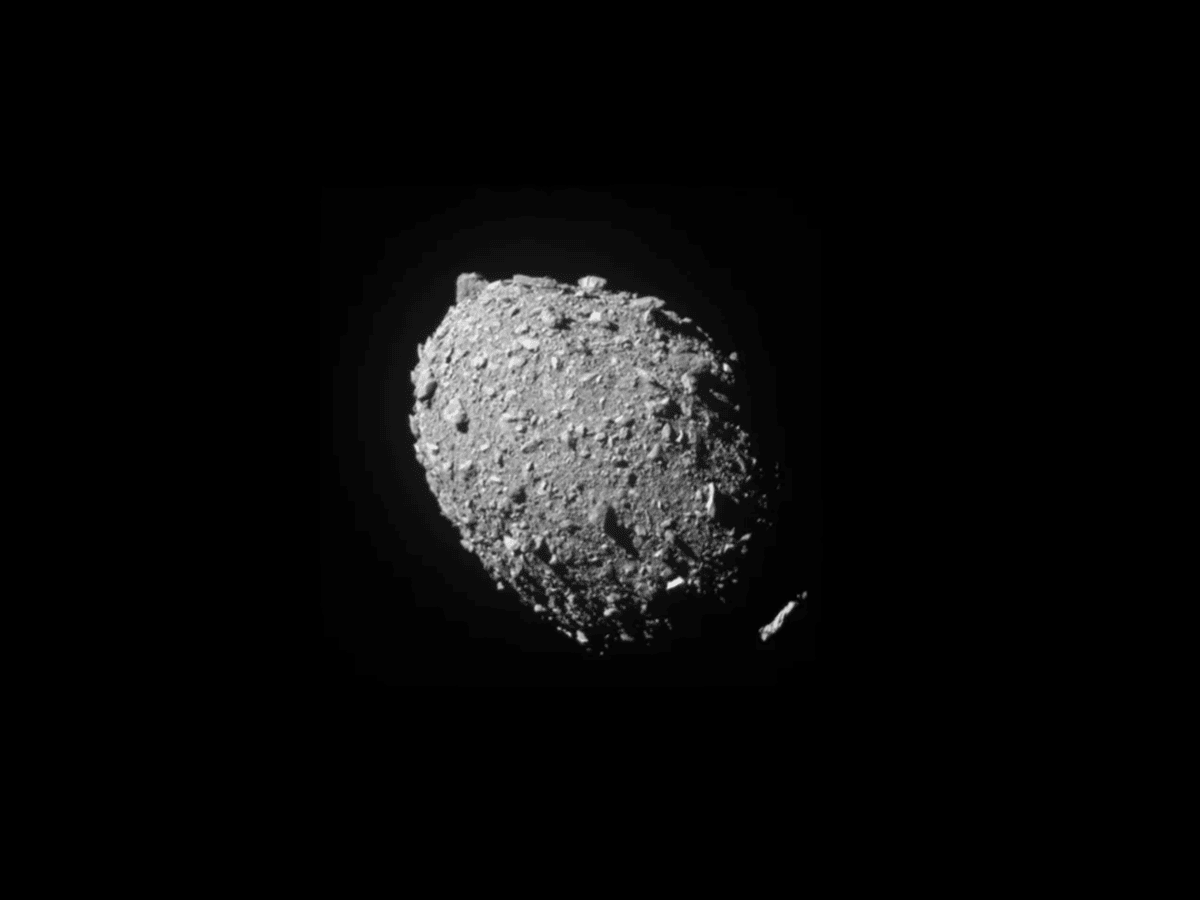

NASA has announced that a large asteroid named 2025 FA22 will pass close to Earth on September 18, 2025. The space rock was first spotted earlier this year by the Pan-STARRS 2 Survey in Hawaii and is being carefully tracked by NASA’s Centre for Near-Earth Object Studies and the Jet Propulsion Laboratory.
Scientists estimate that the asteroid is between 120 and 280 metres wide. For comparison, Delhi’s Qutub Minar is 73 metres tall, making the asteroid almost two to four times larger.
Asteroid’s Distance From Earth
According to NASA, FA22 will come as close as 842,000 kilometres from Earth. Experts noted that the distance is slightly more than twice as far as the moon. They also said that asteroid will safely pass through and will not collide with the Earth, during this event or even in the future.
The asteroid was discovered on March 29, 2025. It moves at a speed of about 24,127 miles per hour and follows a slightly tilted, stretched-out orbit. It takes about 1.85 years to complete one trip around the Sun.
It is expected to reach 13th magnitude in brightness and can be seen with medium telescopes.
Dangerous For Earth?
Although it is classified as a potentially hazardous asteroid because of its size and orbit there is no risk of impact.
Observation campaigns are planned with NASA’s Goldstone radar and telescopes in Europe, Japan and Australia between September 18 and 22.
The asteroid was briefly rated 1 on the Torino Scale but this was later revised to zero risk.
The close pass has triggered a worldwide observation campaign under the International Asteroid Warning Network.
NASA’s Goldstone radar will capture high-resolution images while facilities in Europe, Japan and Australia will contribute to detailed tracking.
Will Experts Study the Asteroid?
Experts say that studying the asteroid’s orbit, composition and surface features is very valuable for improving planetary defence and refining impact prediction models.
Researchers from the International Asteroid Warning Network said this is the closest approach in 2025 by an object of this size and it provides a chance to refine models test radar imaging techniques and study asteroid composition in detail.
Asteroid 2025 FA22 reminds us why constant sky monitoring is important and shows the dynamic nature of the solar system and that every flyby increases knowledge and preparedness for near-Earth objects.
Also Read: NASA’s TESS Mission Finds Two Rocky Earth-Sized Planets Orbiting a Nearby Star




