
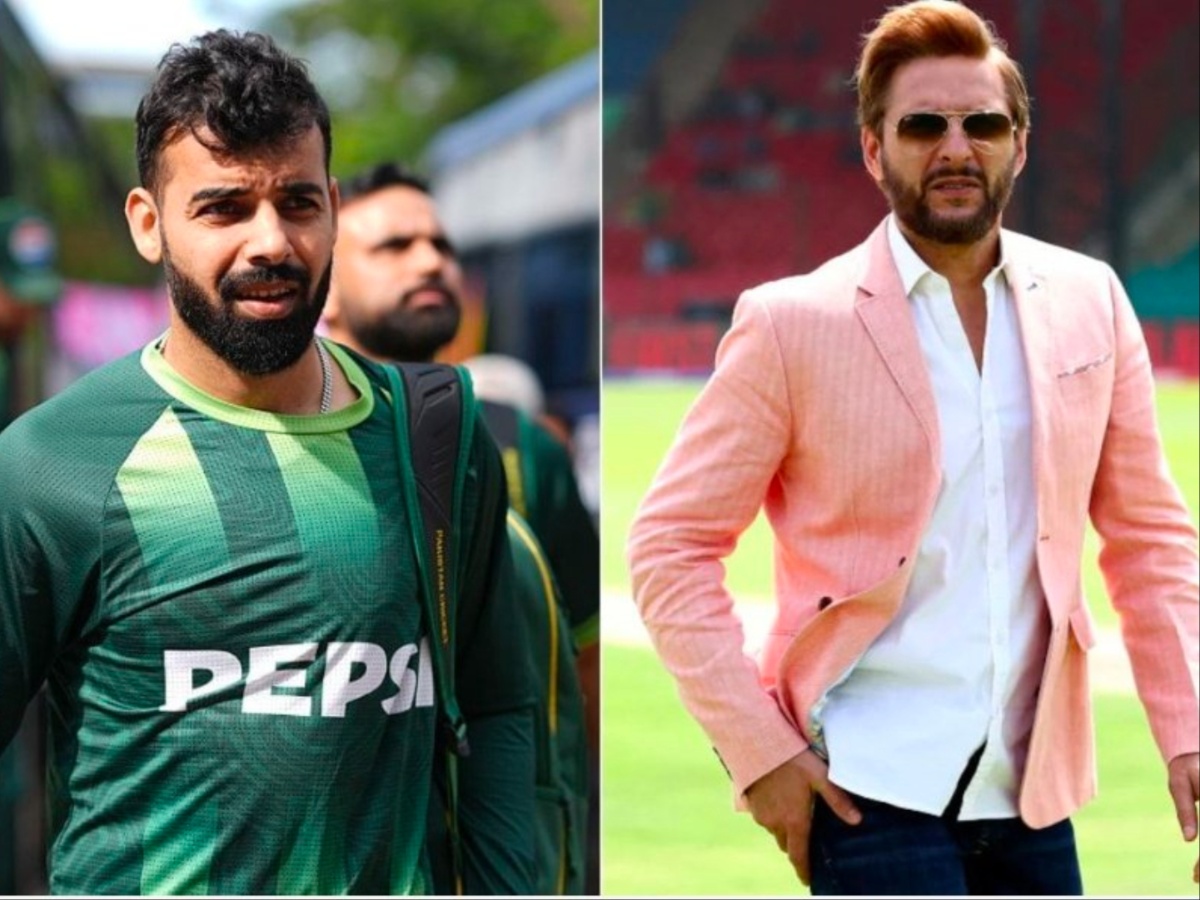

The aftermath of Pakistan’s disappointing exit from the ICC Men’s T20 World Cup 2026 has ignited a fierce debate over the team’s leadership. After failing to secure a semi-final berth, current skipper Salman Ali Agha is reportedly on the verge of losing his job following heavy criticism of his on-field decision-making. While rumors suggest that former vice-captain Shadab Khan is the frontrunner to take over, legendary all-rounder Shahid Afridi has voiced a scathing dissent.
Speaking to Samaa TV, Afridi didn’t pull any punches regarding Shadab’s current form. The former captain argued that Shadab’s recent performances don’t even justify a spot in the playing XI, let alone the captaincy.
Afridi Slams Shadab’s “Preferential” Treatment
Afridi pointed toward a perceived bias from head coach Mike Hesson, citing their shared history at Islamabad United in the PSL. “The head coach is giving Shadab chance after chance. That’s why I said Shadab can become the next Pakistan captain. But looking at his recent performance, he doesn’t even deserve a place in the playing XI,” Afridi remarked. He went as far as to say that, based on the World Cup showing, he wouldn’t even keep Shadab in the squad.
The Case for Fakhar Zaman
Instead, Afridi has thrown his full support behind 35-year-old left-handed explosive batter Fakhar Zaman. For “Lala,” the requirement for the next era of Pakistan cricket is simple: raw aggression.
“Looking at the current situation, I would go with Fakhar Zaman. I want an aggressive captain. Right now, only one player fits the bill, and that is Fakhar,” Afridi stated.
Fakhar recently proved he still possesses that “big-match” spark. In Pakistan’s final Super 8s clash against Sri Lanka in Pallekele, he blazed 84 runs off just 42 balls. While the 212-run total helped Pakistan win the match, it wasn’t enough to save their tournament. However, for Afridi, that display of fearless intent is exactly what the captaincy needs to galvanize a demoralized side.
As the PCB prepares for a leadership overhaul, the choice between the “safe” tactical route of Shadab and the “aggressive” frontline approach of Fakhar Zaman will define Pakistan’s trajectory toward the 2028 cycle.




