
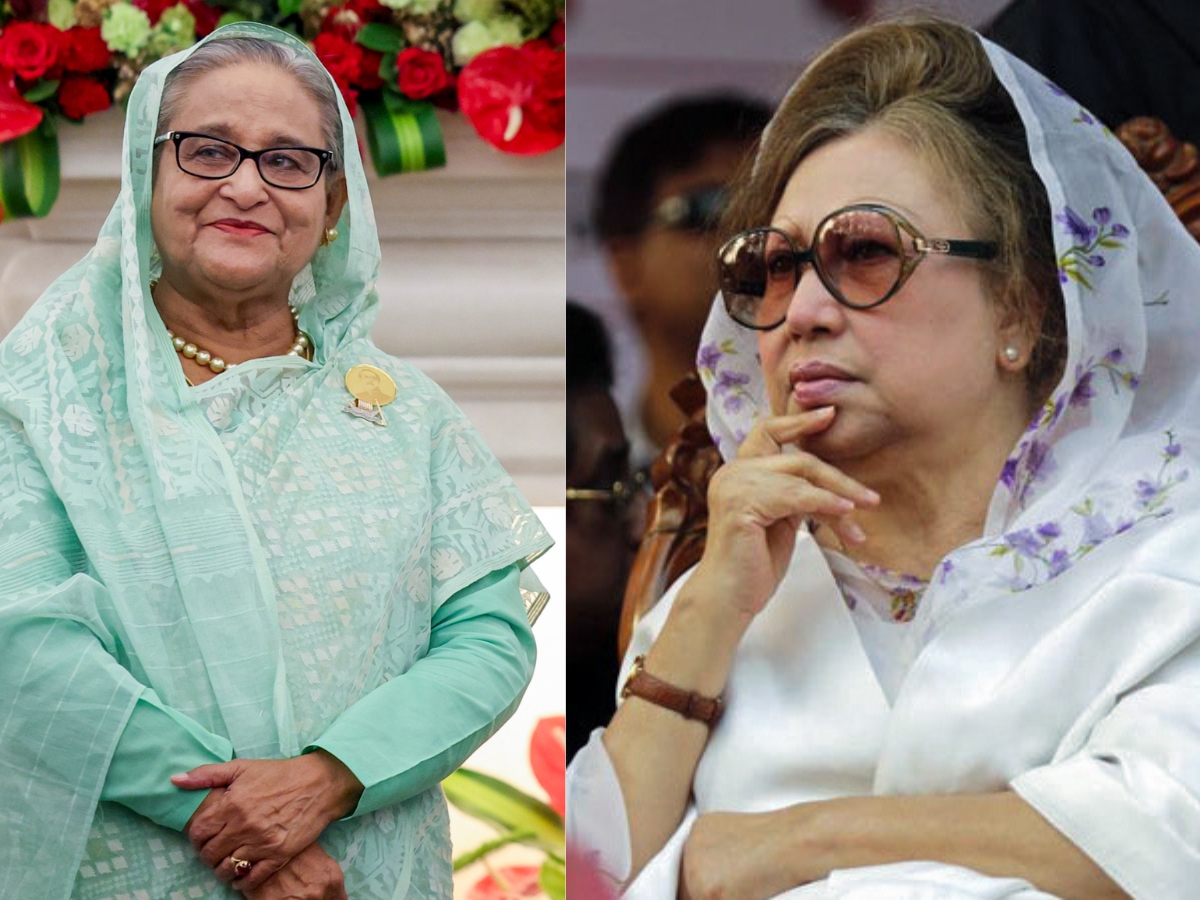

Khaleda Zia, Bangladesh’s first female prime minister and a towering figure in the country’s turbulent political history, died on Tuesday at the age of 80 following a prolonged illness, her party, the Bangladesh Nationalist Party (BNP), confirmed on social media.
According to her medical team, Zia had been suffering from advanced liver cirrhosis, arthritis, diabetes, and complications related to her chest and heart.
“Khaleda Zia passed away at around 6:00am, just after Fajr prayer,” the BNP said in a post on its official Facebook page. “We pray for the forgiveness of her soul and request everyone to offer prayers for her departed soul.”
Khaleda Zia: Release From House Arrest After Sheikh Hasina’s Ouster
Zia’s death comes months after she was released from years of house arrest following the dramatic ouster of her long-time political rival, Sheikh Hasina. Hasina fled the country after protesters stormed her official residence, ending her tenure as prime minister.
The bitter rivalry between Khaleda Zia and Sheikh Hasina, often described as personal, political, and deeply rooted in history, has shaped Bangladesh’s politics for decades.
The ‘Battle of Begums’ That Defined Bangladesh
The hostility between the two leaders is popularly known as the “Battle of Begums,” with “begum” being a South Asian Muslim honorific for women of stature. Their feud, marked by imprisonment, street protests, and alternating terms in power, came to symbolise Bangladesh’s deeply polarised political culture.
The roots of this rivalry lie in the violent upheavals of the 1970s. In 1975, Sheikh Hasina’s father, Sheikh Mujibur Rahman, Bangladesh’s founding leader, was assassinated along with her mother, three brothers, and several other family members during a military coup.
At the time, Khaleda Zia’s husband, Ziaur Rahman, was the deputy chief of the army. He effectively assumed power three months later and began steering Bangladesh toward economic recovery through privatisation after years of poverty and instability.
Ziaur Rahman was himself assassinated in another military coup in 1981.
Following his death, leadership of the Bangladesh Nationalist Party passed to his widow. Then just 35 years old and a mother of two young sons, Khaleda Zia was dismissed by critics as a politically inexperienced housewife.
Bitter-Sweet Relationship Between Khaleda Zia And Sheikh Hasina
Zia soon emerged as a formidable political force, leading opposition to military ruler Hussain Muhammad Ershad. She boycotted what she described as sham elections in 1986 and mobilised street protests against the regime.
In a rare alliance, Zia and Hasina joined forces to lead a popular movement that forced Ershad from power in 1990. The following year, Bangladesh held what was widely hailed as its first free and fair election.
In the 1991 polls, Khaleda Zia scored a surprise victory over Sheikh Hasina, securing support from Islamic political allies. With that win, she became Bangladesh’s first female prime minister/
During her first term from 1991 to 1996, Zia replaced the presidential system with a parliamentary form of government, concentrating executive power in the prime minister’s office. She lifted restrictions on foreign investment and made primary education compulsory and free.
The Deepening Hostility Between Khaleda Zia And Sheikh Hasina
Zia lost the 1996 election to Hasina but returned to power in 2001, beginning her second term that lasted until 2006. That period was marked by the rise of Islamist militant groups and mounting allegations of corruption against her administration.
In 2004, a grenade attack targeted a rally addressed by Sheikh Hasina. Although Hasina survived, more than 20 people were killed and over 500 injured. Khaleda Zia’s government and its Islamic allies were widely blamed for the attack.
Years later, Zia’s eldest son was tried in absentia and sentenced to life imprisonment for his role in the attack. The BNP maintained that the charges were politically motivated and fabricated.
Although Zia later took steps to clamp down on Islamist radical groups, her second term ended in 2006 amid political turmoil, street violence, and instability. An army-backed interim government assumed power, declaring emergency rule.
Both Khaleda Zia and Sheikh Hasina were jailed on charges of corruption and abuse of power and remained detained for about a year. They were released ahead of the December 2008 general election.
When Sheikh Hasina Returned As Bangladesh’s PM, And Khaleda Zia’s Conviction
Sheikh Hasina won the 2008 election by a landslide and went on to rule uninterrupted for years. Her government tightened its grip on power, detaining tens of thousands of BNP members, while hundreds of people reportedly disappeared.
In 2018, Khaleda Zia, her eldest son and several aides were convicted of embezzling around $250,000 in foreign donations received by an orphanage trust established during her time in office. Zia said the case was part of a deliberate effort to keep her and her family out of politics.
She was sentenced to 17 years in prison on graft charges, convictions the BNP rejected as politically motivated.
As her health deteriorated, Zia was released from prison into house arrest in March 2020 on humanitarian grounds. The conditions barred her from engaging in politics or travelling abroad for medical treatment.
Though she never returned to power after 2006 and the BNP boycotted the 2008 election, her rivalry with Sheikh Hasina continued to dominate Bangladesh’s political landscape.
(With inputs from agencies)
Zubair Amin is a Senior Journalist at NewsX with over seven years of experience in reporting and editorial work. He has written for leading national and international publications, including Foreign Policy Magazine, Al Jazeera, The Economic Times, The Indian Express, The Wire, Article 14, Mongabay, News9, among others. His primary focus is on international affairs, with a strong interest in US politics and policy. He also writes on West Asia, Indian polity, and constitutional issues. Zubair tweets at zubaiyr.amin




