
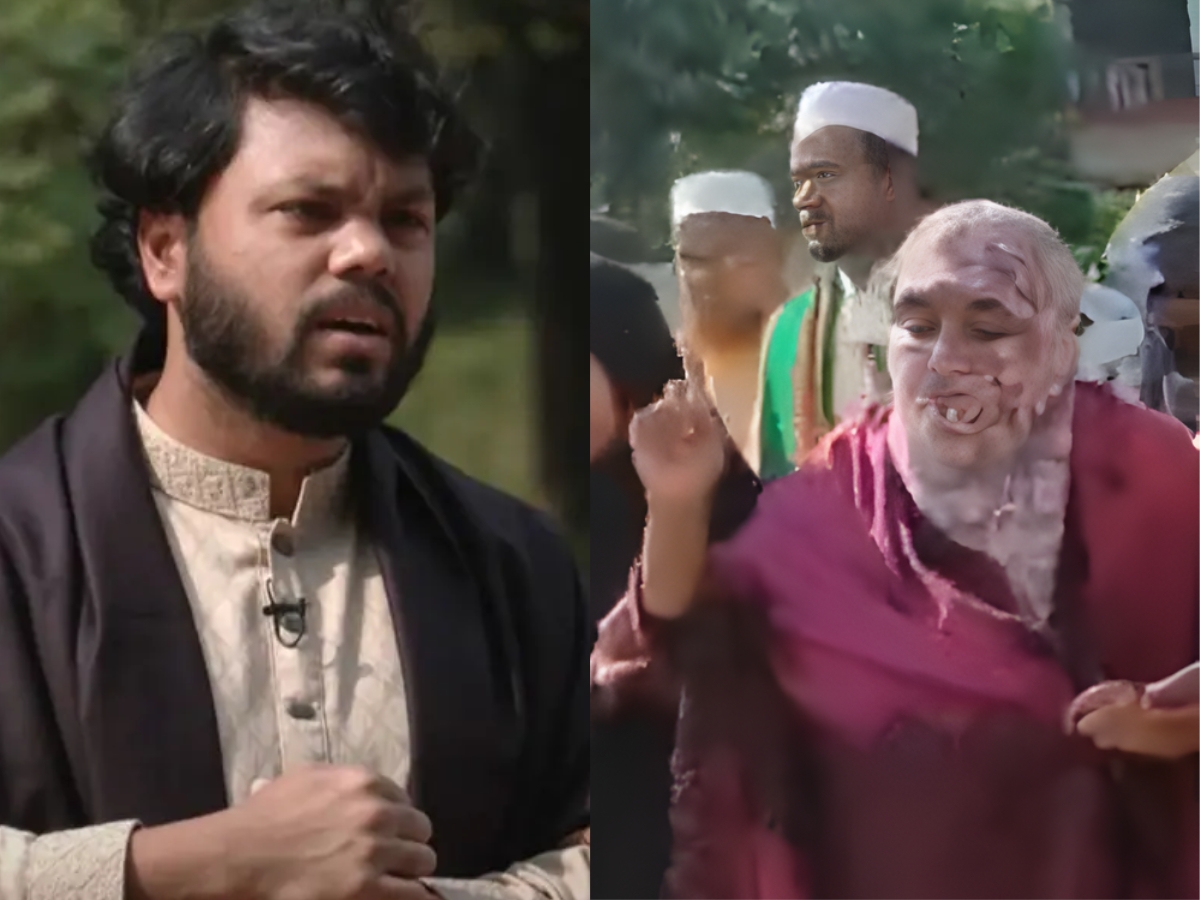

Violent protesters hit the streets across Bangladesh after the death of prominent youth leader Sharif Osman Hadi, who passed away at Singapore’s General Hospital last week. Hadi, 32, succumbed to gunshot injuries sustained during an assassination attempt in Dhaka last week.
Hadi was a leading figure in Bangladesh’s 2024 student-led uprising and served as the spokesperson for Inquilab Mancha, or “Platform for Revolution.” He had also announced plans to contest the Dhaka-8 parliamentary seat in the Bijoynagar area during the upcoming elections expected in February 2026.
Osman Hadi’s Sister Makes Anti-India Remarks
Hadi’s sister has now made anti-India remarks that have gone viral on social media. She called for jihadi training in every home, regardless of gender, including children, to fight India.
“We should give training (Jihadi) to everyone in every home irrespective of gender including children to fight India. I did not see Khudiram Bose or Azad but I have seen Osman Hadi. Hadi is a revolutionary leader,” she said.
She also threatened India directly, claiming, “We Bangladeshis will not rest until Indian dogs are completely wiped out. This war began 200 years ago.”
BIG NEWS 🚨 Sister of radical Osman Hadi threatens India.
She said “This war began 200 years ago”
Same India helped Bangladesh achieve Independence in 1971.
pic.twitter.com/82SRo4TvFy— News Algebra (@NewsAlgebraIND) December 21, 2025
These statements are part of a growing anti-India wave in Bangladesh, a sentiment analysts say has been fueled by the China-Pakistan nexus.
Sections of Bangladesh’s political leaders have also alleged that Hadi’s attackers fled to India and are being sheltered by New Delhi. These unverified claims have intensified anti-India sentiment.
China-Pakistan Nexus Behind Bangladesh’s Anti-India Wave
Bangladesh, over the last year, has grown closer to China and Pakistan. China has expanded its economic and political footprint in Dhaka, while Pakistan’s ISI reportedly leverages anti-India narratives to influence domestic politics.
According to experts in New Delhi, the current situation mirrors Pakistan’s strategy of using civilian unrest and extremist rhetoric to apply pressure without overt state action.
India’s Parliamentary Standing Committee on External Affairs recently warned that the evolving political situation in Bangladesh could constitute India’s most serious strategic challenge since the 1971 war. The assessment reflects concerns over political instability, the resurgence of Islamist forces, and increasing influence of China and Pakistan in India’s immediate neighborhood.
Zubair Amin is a Senior Journalist at NewsX with over seven years of experience in reporting and editorial work. He has written for leading national and international publications, including Foreign Policy Magazine, Al Jazeera, The Economic Times, The Indian Express, The Wire, Article 14, Mongabay, News9, among others. His primary focus is on international affairs, with a strong interest in US politics and policy. He also writes on West Asia, Indian polity, and constitutional issues. Zubair tweets at zubaiyr.amin




