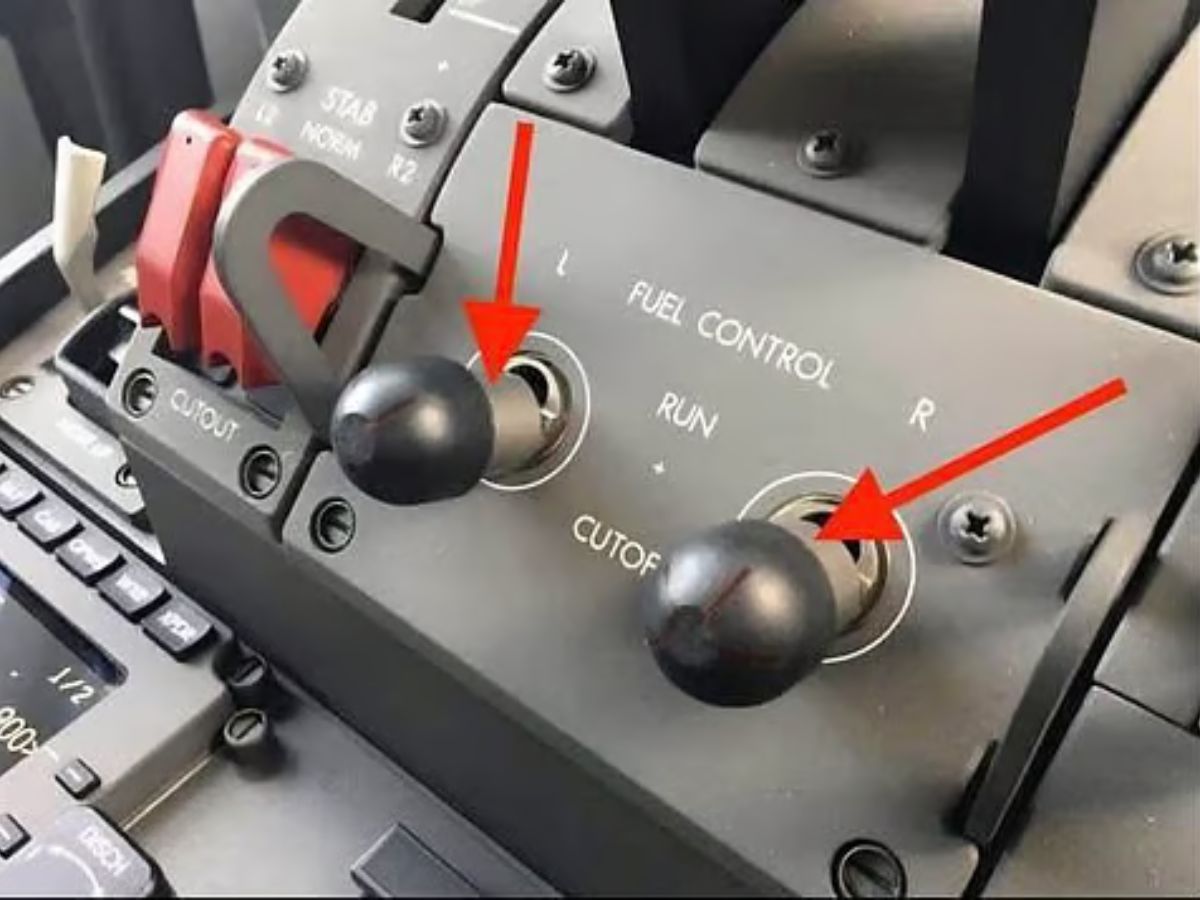

The safety of Boeing aircraft fuel cutoff switches has come under global scrutiny after last month’s Air India crash that killed 260 people.
Boeing Crash Report Raises Questions Over Fuel Switch Locks
A preliminary crash report revealed that shortly after takeoff, the fuel control switches on the Air India jet flipped almost simultaneously from the run position to cutoff. The cockpit voice recorder captured one pilot asking the other, “why did you cut off the fuel?” The second pilot reportedly responded, “I did not do so,” according to the report.
The report also referred to a 2018 advisory from the US Federal Aviation Administration (FAA). In that advisory, the FAA recommended, but did not mandate, operators of several Boeing models, including the 787, to inspect the locking mechanisms of fuel cutoff switches to ensure they could not be moved accidentally.
India Orders Inspections of Boeing Aircraft Fuel Switches
Following the Air India crash, India’s Directorate General of Civil Aviation (DGCA) has ordered an investigation into the locking mechanisms of fuel switches on Boeing aircraft, including 787s and 737s. Several Indian and international airlines have also begun inspecting their fleets.
India is currently the world’s third-largest and fastest-growing aviation market. Three of the country’s four largest airlines operate Boeing aircraft.
Airlines Worldwide Conduct Precautionary Checks of Boeing Aircraft Fuel Switches
Many airlines around the world have confirmed they have been checking the fuel switch locks since 2018 in response to the FAA’s advisory.
Among them, Australia’s Qantas Airways and Japan’s ANA said they have performed regular checks since the FAA issued its guidance.
Other carriers began additional inspections after the preliminary findings from the Air India crash were made public.
Singapore Airlines, along with its low-cost subsidiary Scoot, said on Tuesday that precautionary checks on its Boeing 787 fleet confirmed the fuel switches were functioning properly.
In South Korea, a transport ministry spokesperson said inspections would follow the FAA’s 2018 advisory, but did not provide a timeline.
Korean Air Lines said on Tuesday it had already begun proactively inspecting the fuel control switches on its fleet and would comply with any additional requirements from the transport ministry.
Japan Airlines also confirmed that it is conducting inspections in line with the FAA’s earlier recommendation.
Air India Begins Checking Boeing Aircraft Fuel Switches
The Air India Group began inspecting the fuel switch locking mechanisms of its Boeing 787 and 737 fleets over the weekend.
According to the reports, about half of Air India’s 787s and nearly all of its 737s have already been inspected, with the remaining checks expected to finish within a day or two.
The preliminary crash report noted that Air India had not conducted the FAA’s recommended checks on the switches because the FAA advisory was not mandatory.
However, the airline’s maintenance records showed that the throttle control module, which houses the fuel switches, had been replaced in 2019 and again in 2023 on the aircraft involved in the crash.
In an internal memo on Monday, Air India CEO Campbell Wilson stated that the preliminary report found no mechanical or maintenance faults with the aircraft. According to Wilson, all required maintenance procedures had been properly carried out.
Also Read: Interim Report Finds No Mechanical Faults Found In The AI 171 Crash: Air India CEO
Zubair Amin is a Senior Journalist at NewsX with over seven years of experience in reporting and editorial work. He has written for leading national and international publications, including Foreign Policy Magazine, Al Jazeera, The Economic Times, The Indian Express, The Wire, Article 14, Mongabay, News9, among others. His primary focus is on international affairs, with a strong interest in US politics and policy. He also writes on West Asia, Indian polity, and constitutional issues. Zubair tweets at zubaiyr.amin