
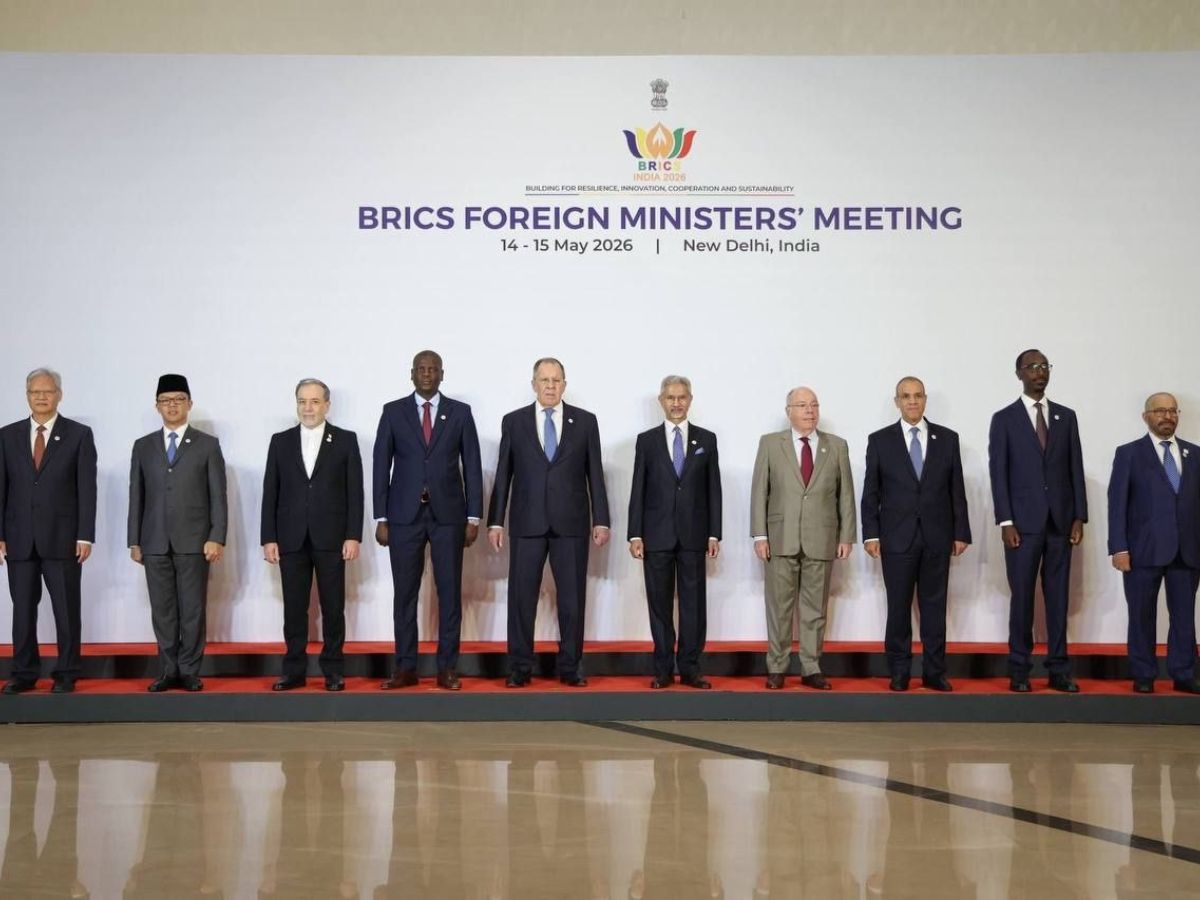
A high-level meeting of BRICS foreign minister started in the New Delhi, India on Thursday 14th April 2026. Foreign ministers of Iran and Russia met in New Delhi, where India warned of “considerable flux” with conflict driving economic uncertainty and energy insecurity. The key discussion in the BRICS 2026 is around Iran-US war and fuel crisis are dominating discussion in the two-day high-level gathering.
What is BRICS?
BRICS is a group of major developing economics seeking to co-ordinate on policies regarding security and economy to amplify the demand of the Global South within International organisations and on issues where the US and European countries has traditionally dominated economically and as well as politically.
The BRICS stand for Brazil, Russia, India, China, and South Africa. Initaially the organisation was called BRIC but when in 2010 when South Africa joined it it becomes BRICS.
In 2023 the organisation extended invitations to Egypt, Ethiopia, Iran, Saudi Arabia, and the United Arab Emirates after these countries applied for membership. Saudi Arabia has yet to join formally. The organisation also extended to Argentina, but they denied as President Javier Milei elected in December 2023 has campaigned on the promise of bolstering ties with western powers.
This week’s meeting in New Delhi will bring together the foreign ministers of BRICS countries on a single platform, who are likely to discuss economic cooperation, and their positions on key global issues.
Why the BRICS Foreign Ministers Meeting 2026 in New Delhi Is Drawing Global Attention
India holds the BRICS chair this year, was hosting the foreign ministers from the expanded BRICS bloc, which now consists of Islamic Republic of Iran, Kingdom of Saudi Arabia, and the United Arab Emirates, countries at odds over the conflict started by the United States and Israel on 28th February 2026. India’s foreign affair minister S Jaishankar said in his opening speech that “We meet at a time of considerable flux in international relations.” Among the foreign ministers attending were Iran’s Abbas Araghchi and Russia’s Sergei Lavrov.
Jaishankar further said “Ongoing conflicts, economic uncertainties, and challenges in trade, technology, and climate are shaping the global landscape.There is a growing expectation, particularly from emerging markets and developing countries, that BRICS will play a constructive and stabilising role.”
The conflict in West Asia has disrupted Gulf shipping routes and the Strait of Hormuz continue to drive volatility in oil and gas markets, increasing pressure on energy-importing states, including India.
How Iran Tensions and West Asia Conflicts Are Dominating BRICS Discussions
The ongoing BRICS meeting in New Delhi is being heavily dominated by the ongoing tension in West Aisa, particularly in Iran. The attendance of Iranian Foreign Minister Abbas Araghchi marks Tehran’s first major diplomatic outreach since the conflict has started, with Iran urging India to play an “independent role” in brokering peace.
A major conflict in the BRICS bloc is the Iran-UAE rivalry, which has already derailed consensus at a previous April meeting, leaving it without a joint statement. Iran’s deputy FM has blamed the UAE for blocking BRICS agreement on the conflict.
Which Countries Are Attending the BRICS 2026 Meeting and What Are Their Positions?
The countries which are attending the BRICS 2026 in New Delhi are as follows:
| Category | Countries | Position & Priority |
| Founding Members | India (Host) | Advocates for “Reformed Multilateralism“ and a more inclusive UN Security Council. Priorities include digital health, MSME cooperation, and counterterrorism. |
|
| China | Focuses on global infrastructure (Belt and Road synergy) and high-level economic integration, despite ongoing border sensitivities with the host. |
|
| Russia | Priorities include strengthening intra-bloc trade to bypass Western financial systems and solidifying security ties within the Global South. |
|
| Brazil | Championing climate finance and global governance reform, building on the “Rio Declaration” legacy. |
|
| South Africa | Emphasizes African regional stability and inclusive economic growth within the continent. |
| Expanded Members | Iran | Seeking strategic realignment and closer security cooperation with Eastern powers to counter diplomatic isolation. |
|
| UAE | Focuses on energy security, financial technology, and leveraging its role as a global logistics hub. |
|
| Egypt | Priorities center on public health, specifically tuberculosis research, and securing food supply chains. |
|
| Ethiopia | Aiming sovereign development and infrastructure support to stabilize its domestic economy. |
|
| Indonesia | Focuses on maritime cooperation and acting as a bridge between ASEAN and the BRICS+ framework. |
India’s Role as BRICS Chair 2026: Can New Delhi Build Consensus Among Members?
India is hosting BRICS for the fourth time. However, this is the most complex diplomatic test yet. The bloc expanded its membership and now it consists of Egypt, Ethiopia, Indonesia, Iran and the UAE, alongside the core members. The extended members don’t have friendly relations with each other, Iran and UAE are not having good diplomatic relations these days and on other hand Egypt and Ethiopia have a fraught relationship, and Saudi Arabia is a bitter rival of Iran.
India has also invited French President Macron to use India’s BRICS leadership to foster formal coordination between BRICS and G7, making India as key factor to prevent global fragmentation.
What the BRICS 2026 Talks Could Mean for Global Economy, Oil Prices and World Politics
The BRICS Foreign Ministers’ meeting in New Delhi is taking place at a crusial time when Iran-US conflict has disrupted global energy supplies and increased the fuel prices globally. The BRICS members collectively contribute for over 40 per cent of global GDP and around 55 per cent of the world’s population.
On Energy, PM Modi will be flying to UAE after the BRICS to secure India’s oil supply which portrays how closely the BRICS 2026 is interconnected to global fuel prices. While on the economy and trade, BRICS nations are gearing to shared grain exchange that could control nearly half of the world’s wheat trade and a new payment method has been introduced called mBridge that would let countries trade without using US dollars.
On a geopolitical end, the association is pushing for a bigger say for developing nations in global institutions. US President Trump has threatened massive 100 per cent tariffs on BRICS countries if they try to replace the dollar.
BRICS 2025 vs BRICS 2026: Major Shifts of Agenda
| Category | BRICS 2025 (Brazil) | BRICS 2026 (India) |
| Host Country | Brazil | India |
| Summit Location | Rio de Janeiro | New Delhi |
| Theme | “Strengthening Global South Cooperation for a More Inclusive and Sustainable Governance” | “Building for Resilience, Innovation, Cooperation and Sustainability” |
| Overall Tone | Cooperative, idealistic, development-focused | Crisis-driven, pragmatic, geopolitically charged |
| Top Priority | Global South solidarity & expansion | Managing internal divisions & energy security |
| Geopolitics | Mild — no condemnation of Israel or US; de-dollarisation not mentioned | Dominated by Iran war, UAE–Iran rivalry, West Asia conflict |
| Climate Agenda | Strong — BRICS Climate Leadership Agenda, COP30-linked goals | Sidelined by conflict and energy crisis |
| Finance Focus | Local currency trade, financial market reform | Economic resilience, supply chain stability, de-dollarisation pressure from US tariff threats |
| Technology | AI governance, digital cooperation | Digital Public Infrastructure (DPI), ethical AI frameworks |
| Health | Major priority — medicines, vaccines, disease elimination | Minor focus |
| Membership | Indonesia added; 11 new partner countries welcomed | Focus on managing tensions from expansion, not adding members |
| Key Challenge | Institutionalising membership process | Preventing bloc from fracturing over Iran–UAE fault line |
| US Factor | Trump tariff threats in background | Tariff threats front and centre; 100% tariff warning on BRICS nations |
| China’s Role | Xi Jinping absent; attended via deputy | Wang Yi absent due to Trump–Xi Beijing summit |
| Expected Outcome | Rio Declaration adopted | Risk of vague, watered-down joint statement |
Also Read: Xi Jinping’s Big Warning To Trump: Taiwan Issue Can Bring US-China To Clashes
Syed Ziyauddin is a media and international relations enthusiast with a strong academic and professional foundation. He holds a Bachelor’s degree in Mass Media from Jamia Millia Islamia and a Master’s in International Relations (West Asia) from the same institution.
He has work with organizations like ANN Media, TV9 Bharatvarsh, NDTV and Centre for Discourse, Fusion, and Analysis (CDFA) his core interest includes Tech, Auto and global affairs.
Tweets @ZiyaIbnHameed





