
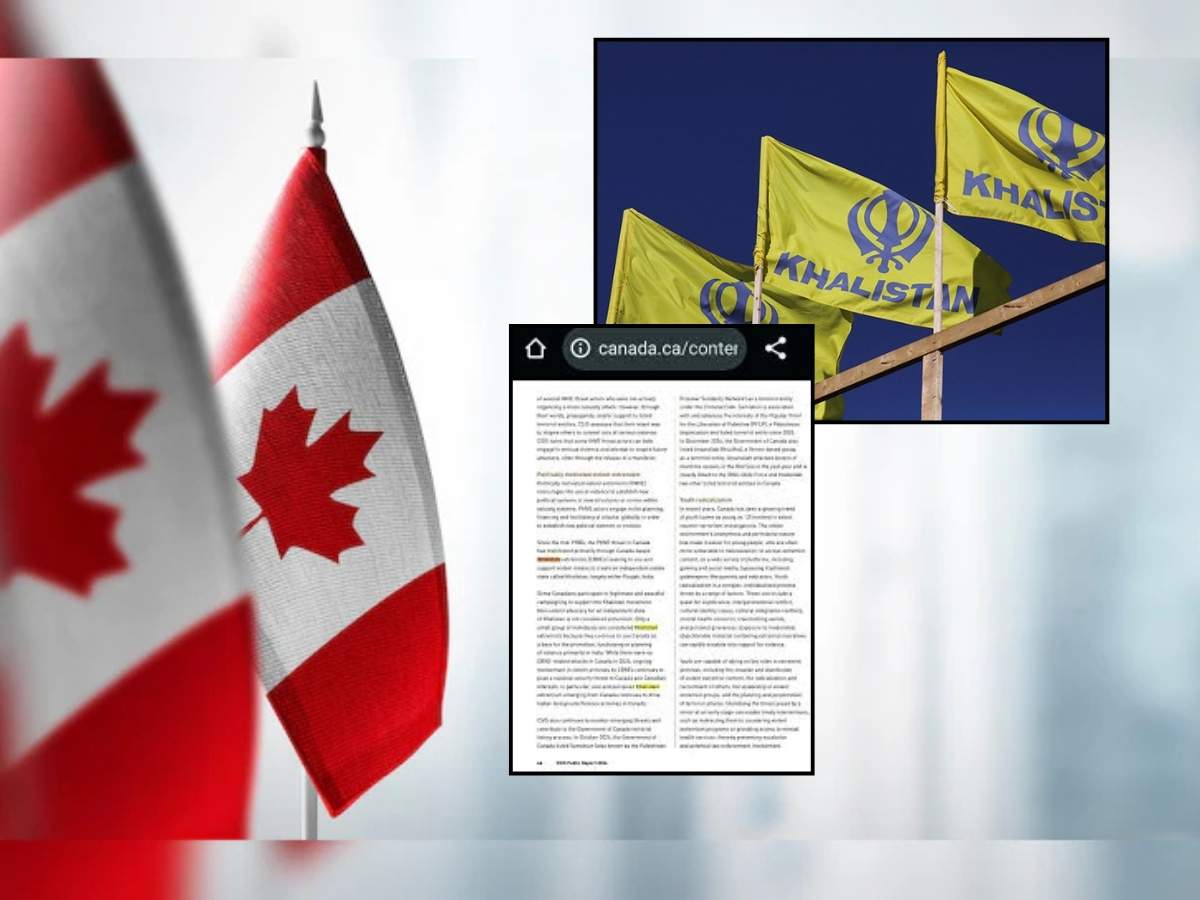

Canadian Security Intelligence Service (CSIS) has officially acknowledged in its latest annual report that Khalistani extremists continue to use Canada as a base for promoting, fundraising, and planning acts of violence, primarily in India.
Released on Wednesday, the CSIS report marks the first time that the Canadian intelligence agency has explicitly referred to these groups as “extremists,” giving weight to India’s repeated warnings over the past several years. “A small group of individuals are considered Khalistani extremists because they continue to use Canada as a base for the promotion, fundraising or planning of violence primarily in India,” the report stated.
The acknowledgment comes at a sensitive time when diplomatic ties between Canada and India have been strained. However, a glimmer of restoration emerged this week after Indian Prime Minister Narendra Modi and Canadian Prime Minister Mark Carney met at the G7 Leaders’ Summit in Kananaskis, Alberta. Both leaders agreed to take “calibrated steps” to restore diplomatic stability, including appointing new High Commissioners to each other’s capitals, according to a statement from the Prime Minister’s Office of Canada.
The CSIS report underlined that the Politically Motivated Violent Extremism (PMVE) threat in Canada has mainly emerged from Canada-based Khalistani extremists (CBKEs). These groups continue their push for a separate nation-state Khalistan largely carved out of India’s Punjab region. “Since the mid-1980s, the PMVE threat in Canada has manifested primarily through CBKEs,” CSIS noted.
While India has repeatedly raised concerns about these activities, Canada had previously been accused of ignoring the issue. The report now confirms New Delhi’s stance that Canada has become a “safe haven for anti-India elements.”
Furthermore, the CSIS report warned of Indian foreign interference activities in Canada that are allegedly driven by both real and perceived Khalistani extremism. “These activities attempt to steer Canada’s positions into alignment with India’s interests on key issues, particularly with respect to how the Indian government perceives Canada-based supporters of an independent homeland that they call Khalistan,” the report emphasized.
The timing of this report is especially notable, as it follows diplomatic fallout from last year’s assassination of Khalistani terrorist Hardeep Singh Nijjar, who was gunned down outside a gurdwara in Surrey, British Columbia on June 18, 2023. Former Canadian Prime Minister Justin Trudeau had alleged that India was involved in the killing, describing it as a “credible allegation.” India strongly denied the accusation, calling it “absurd” and “politically motivated.”
In response to the allegations, India withdrew six of its diplomats from Canada after they were declared “persons of interest” by Canadian investigators probing Nijjar’s murder. According to Wednesday’s CSIS report, the killing and its aftermath marked a significant escalation in India’s measures against the Khalistan movement. “Links between the Government of India and the Nijjar murder signals a significant escalation in India’s repression efforts against the Khalistan movement and a clear intent to target individuals in North America,” the report claimed.
The CSIS report also brought up rising worries about foreign meddling, which affects Canada’s national security. The document noted that ongoing surveillance remains crucial against extremist money networks and outside efforts to sway Canada’s home and foreign policy.
In the middle of the uproar, Prime Minister Carney got pushback from Sikh advocacy groups and even his own party members for asking Prime Minister Modi to the G7 Summit. Critics raised doubts about the look of working with India during such a tense time. Carney though, stood by his choice pointing out India’s key role on the world stage. “India has the world’s fourth-biggest economy and the most people. We need India to solve global problems,” Carney said.
Even with the ongoing tensions, both countries seem to be taking careful steps to rebuild diplomatic ties. However, the CSIS confirmation will make the relationship more complicated. Canada’s recognition that it serves as a base for Khalistani extremist activities and faces Indian foreign meddling has started a crucial discussion. This debate centers on how Canada deals with extremism and outside influence within its borders.
This CSIS report marks a turning point in the conversation around Khalistani extremism in Canada, showing that Ottawa is beginning to officially recognize threats that India has been flagging for decades.




