
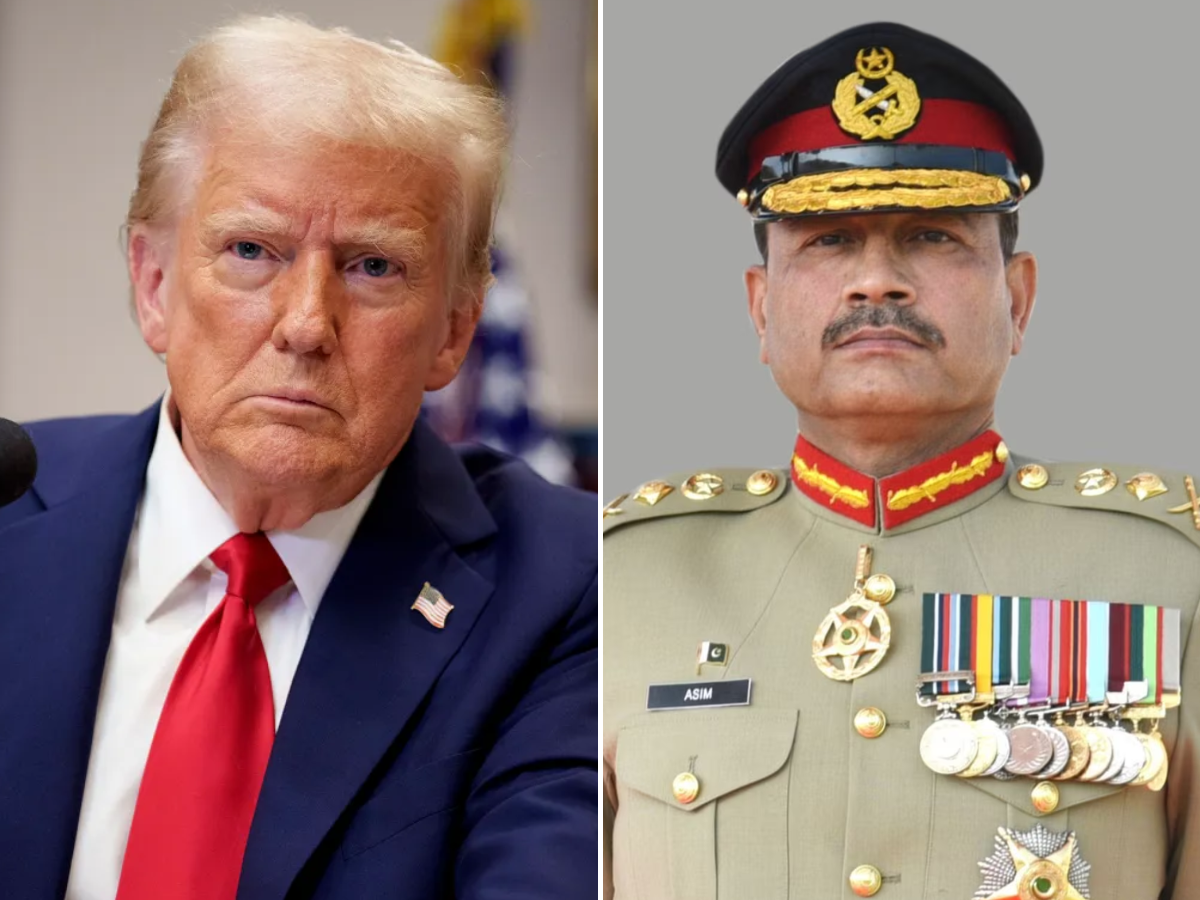

On Wednesday, June 18, U.S. President Donald Trump said he was “honoured” to meet Pakistan’s Army Chief General Asim Munir at the White House.
Trump thanked Munir for choosing not to enter a military conflict with India and praised both countries for showing restraint.
Trump Applauds India and Pakistan for Avoiding Nuclear Conflict
Trump acknowledged the recent visit of Indian Prime Minister Narendra Modi and said both nations are working on trade deals with the United States.
Trupm revealed the real reason why he invited Asim Munir to The White House saying, “The reason I had him here was I wanted to thank him for not going into the war and ending the war. Prime Minister Modi just left a little while ago, and we are working a trade deal with India,”
“Two smart people, two very smart people decided not to continue with the war. Those are two big nuclear powers,” he said. “I was honoured to meet him today.”
#WATCH | Washington, DC | On his meeting with Pakistan Army Chief Asim Munir, US President Donald Trump says, “… Reason I had him here was I wanted to thank him for not going into the war and ending it… Prime Minister Modi just left a little while ago and we are working a… pic.twitter.com/PN2kfIJvrm
— ANI (@ANI) June 18, 2025
Historic White House Lunch Meeting with Asim Munir
The meeting marked the first time a U.S. President formally hosted a Pakistan Army chief for lunch at the White House without any senior civilian officials in attendance. The closed-door engagement highlighted the strategic military ties between the two nations.
Trump also disclosed that he discussed Iran during his meeting with General Munir. “They know Iran very well, better than most,” Trump said. “They’re not happy about anything, and he agreed with me,” he added, without offering specifics on their conversation.
Pakistan’s Foreign Minister Says Iran Open to Peace Talks
Meanwhile, Pakistan’s Foreign Minister Ishaq Dar told the national parliament that Iran is willing to resume peace negotiations—on the condition that Israel halts further military actions.
Dar emphasized Pakistan’s longstanding diplomatic goal of encouraging dialogue between the U.S. and Iran.
Iran and Pakistan’s nuclear cooperation has historically drawn global scrutiny. International watchdogs have long accused Pakistani scientist Abdul Qadeer Khan of sharing nuclear technology, including centrifuge designs, with Iran and other nations.
Prime Minister Shehbaz Sharif recently spoke with Iran’s president, expressing support in the wake of what he described as “Israel’s unprovoked aggression.” At a cabinet meeting on Wednesday, Sharif urged the international community to take immediate action to end the ongoing conflict.
ALSO READ: Trump Leaves Italy’s Juventus Soccer Club Stunned With A Transphobic Question, Nervous Stare Follows




