
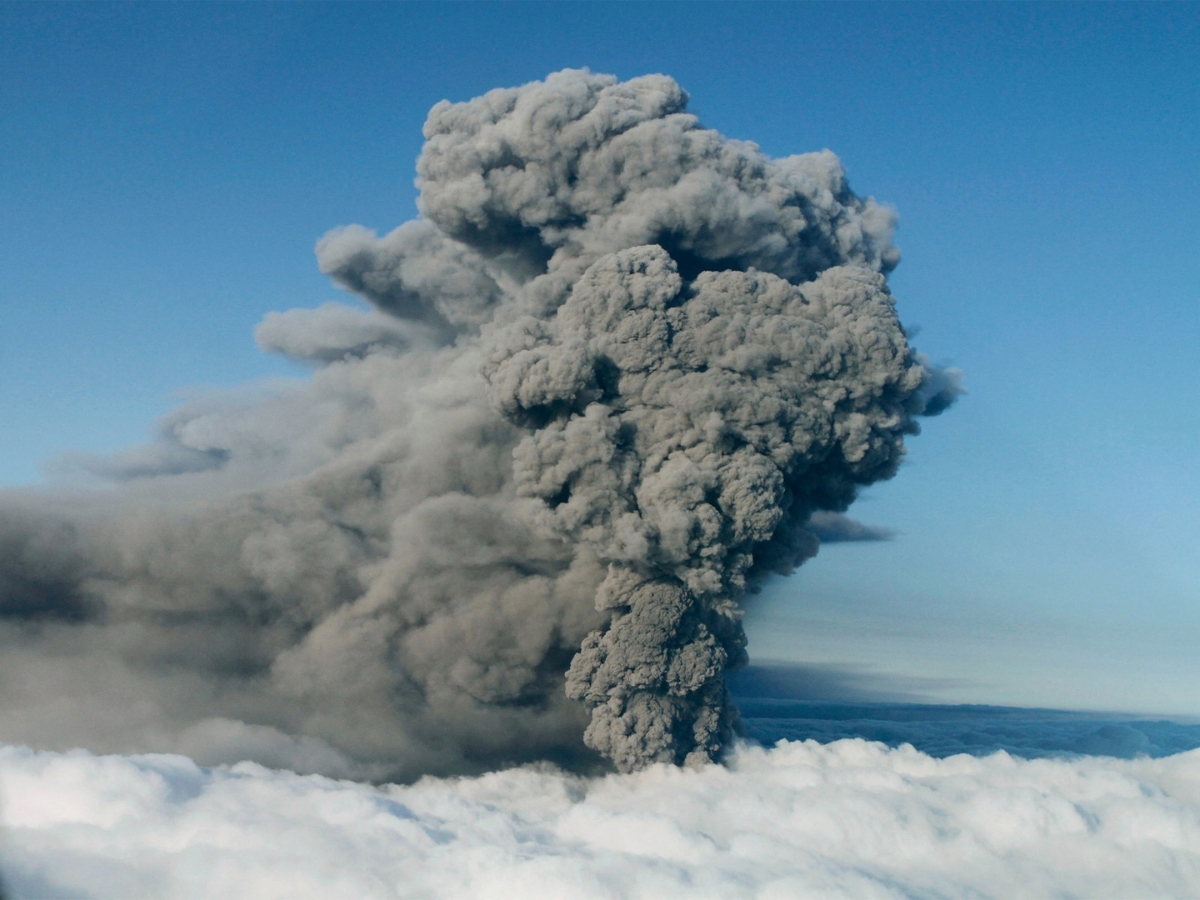

Ethiopia Volcanic Eruption: A volcano in northern Ethiopia erupted on Sunday for the first time in almost 12,000 years, with high-velocity winds travelling at 100–120 km/h pushing massive ash plumes across several countries, including India. The Hayli Gubbi volcano in Ethiopia’s Afar region began erupting on Sunday morning, and by late Monday night, the drifting ash had reached Delhi, where already hazardous air conditions and flight operations were further affected.
Ash Plume Reaches Indian Skies: Which Cities Are Affected?
By Monday night, the ash cloud had crossed large parts of northwest India, passing over Gujarat, Maharashtra, Rajasthan, Delhi-NCR, Haryana and Punjab. Some areas reported reduced visibility as the plume travelled east.
According to the India Meteorological Department (IMD), the plume is moving in the direction of China and is expected to clear Indian airspace by 7:30 pm on Tuesday.
“High-level winds carried the ash cloud from Ethiopia across the Red Sea to Yemen and Oman and further over the Arabian Sea towards western and northern India,” the IMD said in a statement.
Ethiopia Volcano Eruption: DGCA Issues Advisory to Airlines As Volcano Ash Enters Indian Airspace
Following the eruption, India’s aviation regulator issued a safety notice to airlines, instructing them to avoid volcanic ash-affected areas and flight levels. Carriers were also advised to revise flight plans, routes and fuel requirements based on updated advisories.
The Directorate General of Civil Aviation (DGCA) also asked airlines to immediately report any suspected ash encounter, including “engine performance anomalies or cabin smoke/odour.”
Air India, IndiGo and SpiceJet were among the carriers impacted by the drifting plume.
Hayli Gubbi Volcano Erupts 14 Kms Into the Air: How It Travelled
The Hayli Gubbi volcano, located in Ethiopia’s seismically active Afar region, sent thick smoke clouds soaring up to 14 kilometres into the atmosphere, blanketing nearby villages in ash.
Rising around 500 metres, the volcano lies within the Rift Valley, an area shaped by the meeting of two tectonic plates.
Videos shared online show a thick white smoke column rising above the landscape.
The Afar region frequently experiences earthquakes, and residents described the blast as sudden and powerful.
“It felt like a sudden bomb had been thrown with smoke and ash,” a resident told news agency AP.
An Eruption After 12,000 Years: What is Ethiopia’s Hayli Gubbi Volcano
The Smithsonian Institution’s Global Volcanism Program noted that Hayli Gubbi has had no documented eruptions during the Holocene period, which began nearly 12,000 years ago.
The Toulouse Volcanic Ash Advisory Centre (VAAC) reported that the explosive eruption began around 8:30 am GMT on Sunday. Ash rose up to 14 kilometres from the Afar region, located roughly 800 km northeast of Addis Ababa near the Eritrean border.
The VAAC said that while the eruption has since stopped, “a large ash plume is moving toward northern India.”
After emerging over Ethiopia, the ash drifted across the Red Sea toward Yemen and Oman, eventually spreading into India and northern Pakistan, according to VAAC and regional media reports.
Also Read: Volcanic Ash From Ethiopia’s Hayli Gubbi Reaches India, Flights Cancelled, Delhi Air Turns Hazy
Zubair Amin is a Senior Journalist at NewsX with over seven years of experience in reporting and editorial work. He has written for leading national and international publications, including Foreign Policy Magazine, Al Jazeera, The Economic Times, The Indian Express, The Wire, Article 14, Mongabay, News9, among others. His primary focus is on international affairs, with a strong interest in US politics and policy. He also writes on West Asia, Indian polity, and constitutional issues. Zubair tweets at zubaiyr.amin




