
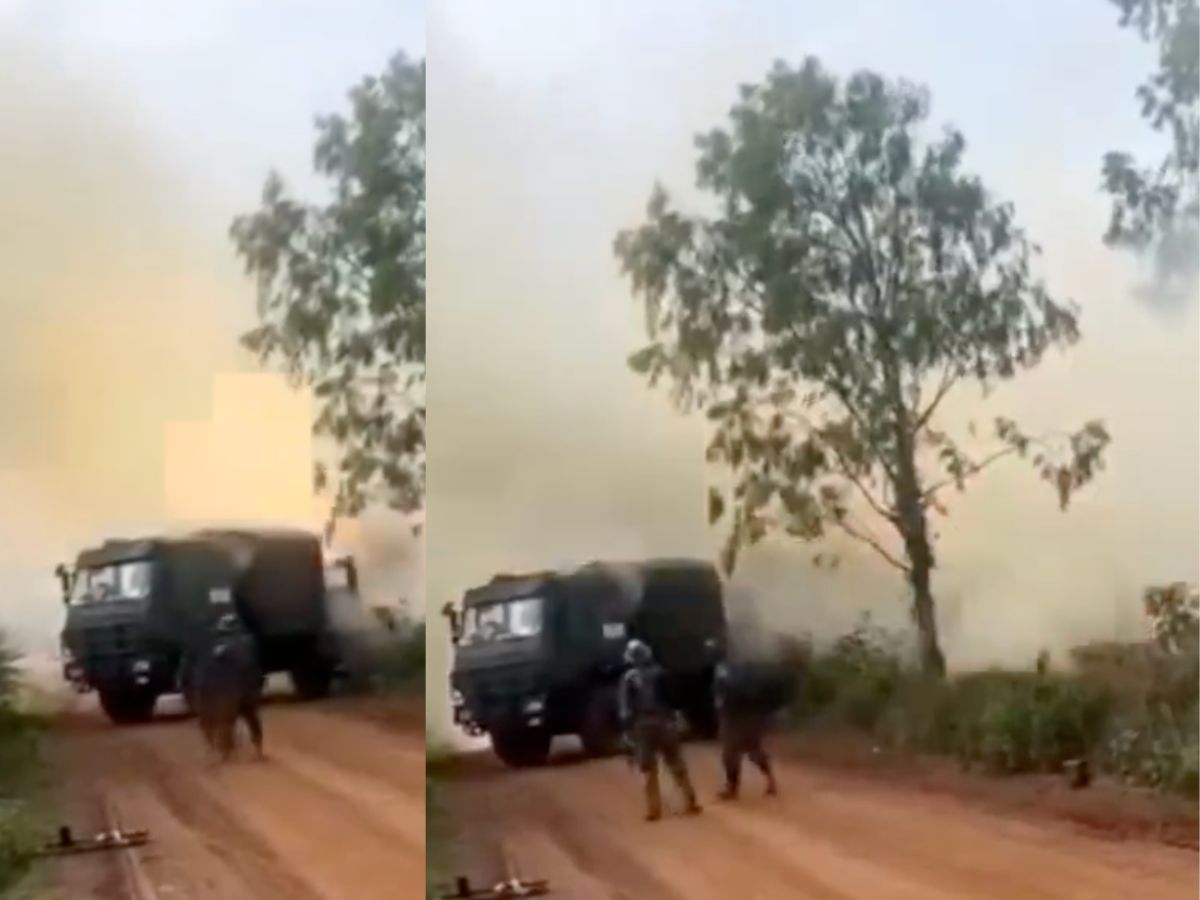

Thailand has launched air strikes along its disputed border with Cambodia, its military said officially, after both countries accused each other of breaching a ceasefire brokered by US President Donald Trump.
Tensions between Thailand and Cambodia have been rising since Bangkok suspended de-escalation measures last month, after a Thai soldier was severely injured in a landmine explosion that Thailand alleges was caused by newly planted mines along the border claims Cambodia strongly denies.
The dispute unfolds against the backdrop of Cambodia’s military capacity, supported by a defence budget of $1.3 billion in 2024 and approximately 124,300 active personnel.
Formed in 1993 through the unification of the country’s former Communist forces and two resistance armies, the Royal Cambodian Armed Forces rely heavily on their army wing, which consists of around 75,000 troops, reinforced by more than 200 battle tanks and roughly 480 artillery systems.
Thailand, which the U.S. classifies as a major non-NATO ally, has a large, well-funded military, with a defence budget of $5.73 billion in 2024 and over 360,000 active armed forces personnel.
The Thai army has a total of 245,000 personnel, including an estimated 115,000 conscripts, around 400 battle tanks, over 1,200 armoured personnel carriers and some 2,600 artillery weapons.
The army has its own fleet of aircraft, comprising passenger planes, helicopters such as dozens of U.S.-made Black Hawks, and unmanned aerial vehicles.
Air forces
Cambodia‘s air force has 1,500 personnel, with a relatively small fleet of aircraft, including 10 transport planes and 10 transport helicopters.
It doesn’t possess any fighter aircraft but has 16 multi-role helicopters, including six Soviet-era Mi-17s and 10 Chinese Z-9s.
Thailand has one of the best equipped and trained air forces in Southeast Asia, with an estimated 46,000 personnel, 112 combat capable aircraft, including 28 F-16s and 11 Swedish Gripen fighter jets, and dozens of helicopters.
Navies
The Cambodian navy has an estimated 2,800 personnel, including 1,500 naval infantry, with 13 patrol and coastal combat vessels and one amphibious landing craft.
Thailand‘s navy is much larger, with nearly 70,000 personnel, comprising naval aviation, marines, coastal defence and conscripts.
It has one aircraft carrier, seven frigates, and 68 patrol and coastal combat vessels. The Thai fleet also contains a handful of amphibious and landing ships capable of holding hundreds of troops each and 14 smaller landing craft.
Thailand‘s naval aviation division has its own fleet of aircraft, including helicopters and UAVs, besides a marine corps that has 23,000 personnel, backed by dozens of armed fighting vehicles.
(With Reuters Inputs)
Sofia Babu Chacko is a journalist with over five years of experience covering Indian politics, crime, human rights, gender issues, and stories about marginalized communities. She believes that every voice matters, and journalism has a vital role to play in amplifying those voices. Sofia is committed to creating impact and shedding light on stories that truly matter. Beyond her work in the newsroom, she is also a music enthusiast who enjoys singing.




