
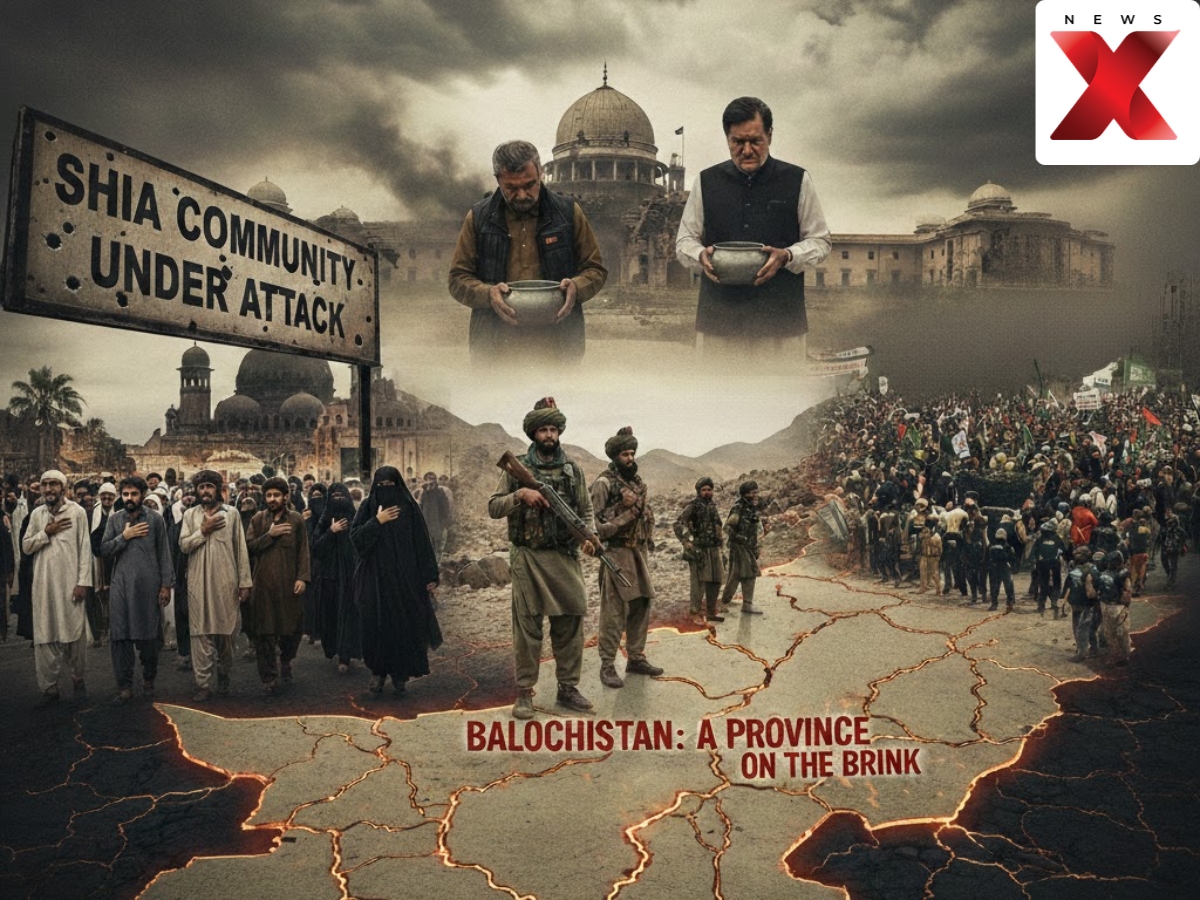

Pakistan is exploding internally. The cash-strapped nation is facing multiple challenges as its political elite, including the army and puppet civilian government, continue to amass large swathes of wealth in Pakistan and foreign countries. Asim Munir and Shehbaz Sharif have publicly admitted that they are ashamed of touring the world and begging for the country.
From sectarian violence against Shias to armed rebellion in resource-rich Balochistan and rising nationalist sentiments in Sindh, Pakistan faces multiple internal fault lines. The country does not need any foreign invasion to disintegrate.
Pakistan Shia Community Under Attack
For more than two decades, Pakistan’s Shia community has lived under the shadow of sustained discrimination and recurrent violence. The recent attack brings back the haunting, sad memories that the community faces. The attacks they have faced are neither isolated nor spontaneous. Instead, they reveal a disturbing and consistent pattern, one that points to a long, brutal history of targeted killings unfolding across cities, provinces, and years.
Shia civilians have been attacked in some of the most vulnerable settings of daily and religious life. Mosques, Imambargahs, shrines, buses, funeral gatherings, and public spaces have repeatedly turned into sites of bloodshed. These assaults have not only caused mass casualties but have also left deep psychological scars within the community.
One of the deadliest phases of this violence unfolded between 2012 and 2015. Within a span of just three years, Pakistan witnessed one of the most severe spikes in sectarian killings.
Balochistan: A Province on the Brink
More recently, renewed violence in Balochistan has once again drawn attention to Pakistan’s largest province, one that has long been marked by separatist movements and deep-rooted resentment against the central government.
Home to a distinct ethnic identity, Balochistan has seen growing tensions between the Baloch people and the Pakistani state. The core grievance, according to Baloch groups, is the alleged exploitation of the province’s vast natural resources without any meaningful benefit to the local population.
At the centre of this conflict is the Baloch Liberation Army (BLA), a militant organisation that has been waging a guerrilla war against the Pakistani military. While Pakistan, the United States, and the United Kingdom have designated the BLA as a terrorist organisation, many Baloch people view its actions as a fight for self-determination and freedom.
The BLA describes itself as a Baloch nationalist armed organisation seeking independence for Balochistan. Despite being Pakistan’s largest province, Balochistan remains its least populated and among the most underdeveloped, even as it is rich in gas reserves, minerals, and coastal assets.
Independent Sindhudesh
Another old fault has gained traction over the years in Sindh, Pakistan’s third-largest province. Tensions flared in Karachi last year when protests demanding a separate Sindhudesh turned violent, leading to stone-pelting, vandalism, and clashes with police.
The protesters in this province are calling for the creation of an independent Sindhudesh. Large groups of Sindhis march under the banner of the Jiye Sindh Muttahida Mahaz (JSSM).
The protests reflected a long-standing sentiment among Sindhi nationalist outfits that argue for liberation from what they describe as political and cultural marginalisation.
Sindh, located along the Indus River, became part of Pakistan following the Partition in 1947. According to the Mahabharata, Sindhudesh was the ancient name for what is now modern Sindh.
During the colonial period, Sindh existed as a separate administrative unit under British India before being annexed. The demand for a separate Sindhudesh first emerged in 1967, led by GM Syed, one of the early supporters of Partition, and Pir Ali Mohammed Rashdi. The movement gained momentum after the 1971 liberation of Bangladesh.
Sindhi nationalist groups have long alleged sustained political repression and human rights violations in the province.
Zubair Amin is a Senior Journalist at NewsX with over seven years of experience in reporting and editorial work. He has written for leading national and international publications, including Foreign Policy Magazine, Al Jazeera, The Economic Times, The Indian Express, The Wire, Article 14, Mongabay, News9, among others. His primary focus is on international affairs, with a strong interest in US politics and policy. He also writes on West Asia, Indian polity, and constitutional issues. Zubair tweets at zubaiyr.amin




