

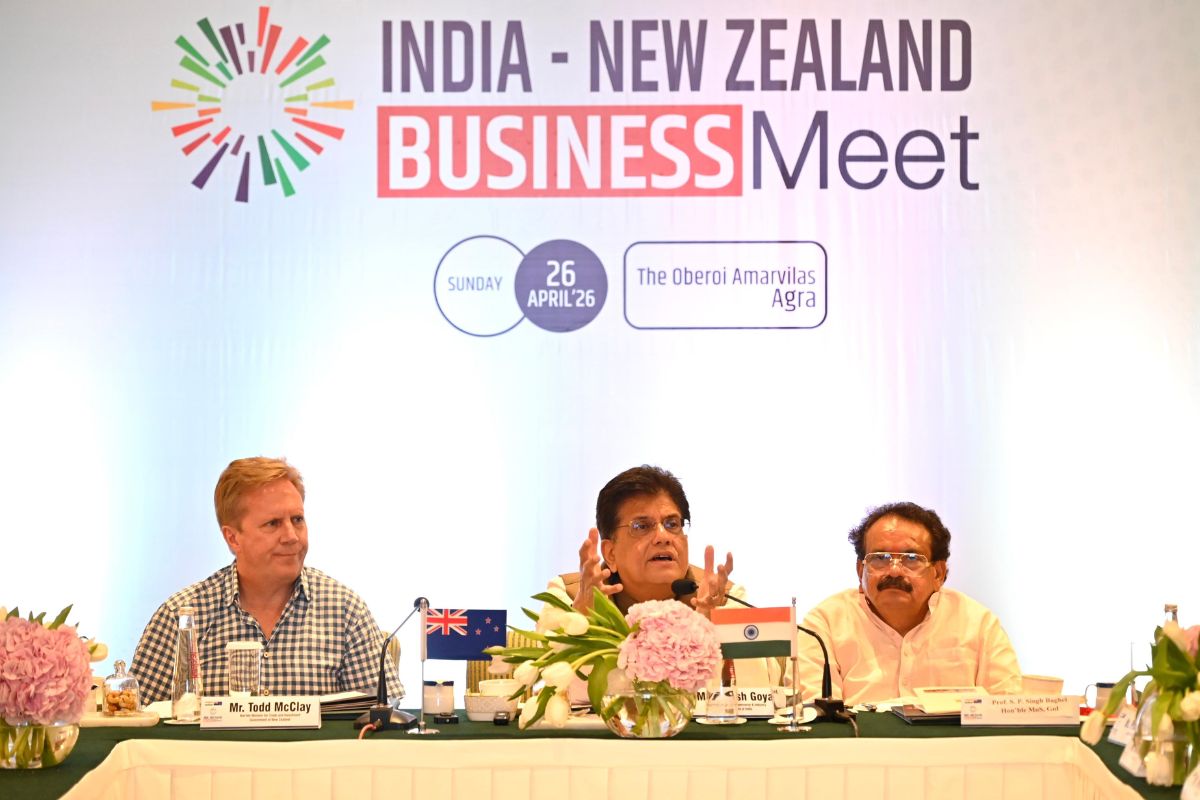
Two countries that share a warm friendship and a lot of mutual respect are now ready to take their relationship to a whole new level. India and New Zealand are set to sign a Free Trade Agreement on Monday, April 27, and leaders from both sides are calling it a landmark moment that has been years in the making.
New Zealand Prime Minister Christopher Luxon announced on Sunday that the two countries will formally sign the Free Trade Agreement on Monday night. He called it “a once-in-a-generation agreement” that will open one of the biggest markets in the world to New Zealand exporters. India’s Union Commerce and Industry Minister Piyush Goyal also confirmed the signing during his visit to Agra, where he was accompanied by New Zealand’s Minister for Trade and Investment, Todd McClay.
This agreement did not happen overnight. Goyal made it clear that the deal was the result of years of serious discussions at the very highest levels of both governments. “After many years of discussions, which was also discussed by Prime Minister Narendra Modi and New Zealand’s Prime Minister Christopher Luxon, it was finalised. It is going to be signed tomorrow,” he said.
The fact that both heads of government were personally involved in pushing this deal forward shows how much importance both sides place on getting this right.
For India, the deal opens up real opportunities for several sectors that have long been waiting for better market access. Goyal highlighted that approximately 70 per cent of goods exported from India to New Zealand will now reach there without any import duty. That is a significant reduction in trade barriers and will make Indian products much more competitive in the New Zealand market.
Goyal specifically mentioned the Agra leather industry, Uttar Pradesh handloom and handicrafts, the One District One Product initiative, carpenters, and handcarvers as sectors that stand to benefit directly. These are industries that employ ordinary working people, and easier access to a new market could mean more jobs and better income for thousands of families.
For New Zealand, the deal is equally exciting. Luxon talked about giving Kiwi exporters access to 1.4 billion people in an economy that is set to become the third largest in the world. He pointed to key New Zealand export products like Kiwifruit from the Bay of Plenty, wine from Central Otago, seafood, meat, and honey as sectors that will benefit from better access to India’s rapidly expanding middle class.
Luxon also made a point that one in four jobs in New Zealand are already linked to trade. More trade means more jobs on farms and orchards and more money flowing into local communities across the country.
Todd McClay, who was in India for the signing preparations, did not hold back when describing how strong the relationship between the two countries feels right now. “It is probably the strongest relationship that I have ever known,” he said. He also expressed excitement about what the coming years could bring, including the possibility of direct flights between India and New Zealand and a big boost in tourism on both sides.
This agreement is more than just a trade deal. It is a signal that India and New Zealand see each other as long-term partners in a changing world. For Indian exporters, it is a door opening to a new and developed market. For New Zealand, it is a foot in the door of one of the fastest-growing economies on earth. Both sides have a lot to gain, and the signing on Monday marks only the beginning of what could be a very productive chapter for both countries.
(ANI)
Syed Ziyauddin is a media and international relations enthusiast with a strong academic and professional foundation. He holds a Bachelor’s degree in Mass Media from Jamia Millia Islamia and a Master’s in International Relations (West Asia) from the same institution.
He has work with organizations like ANN Media, TV9 Bharatvarsh, NDTV and Centre for Discourse, Fusion, and Analysis (CDFA) his core interest includes Tech, Auto and global affairs.
Tweets @ZiyaIbnHameed





