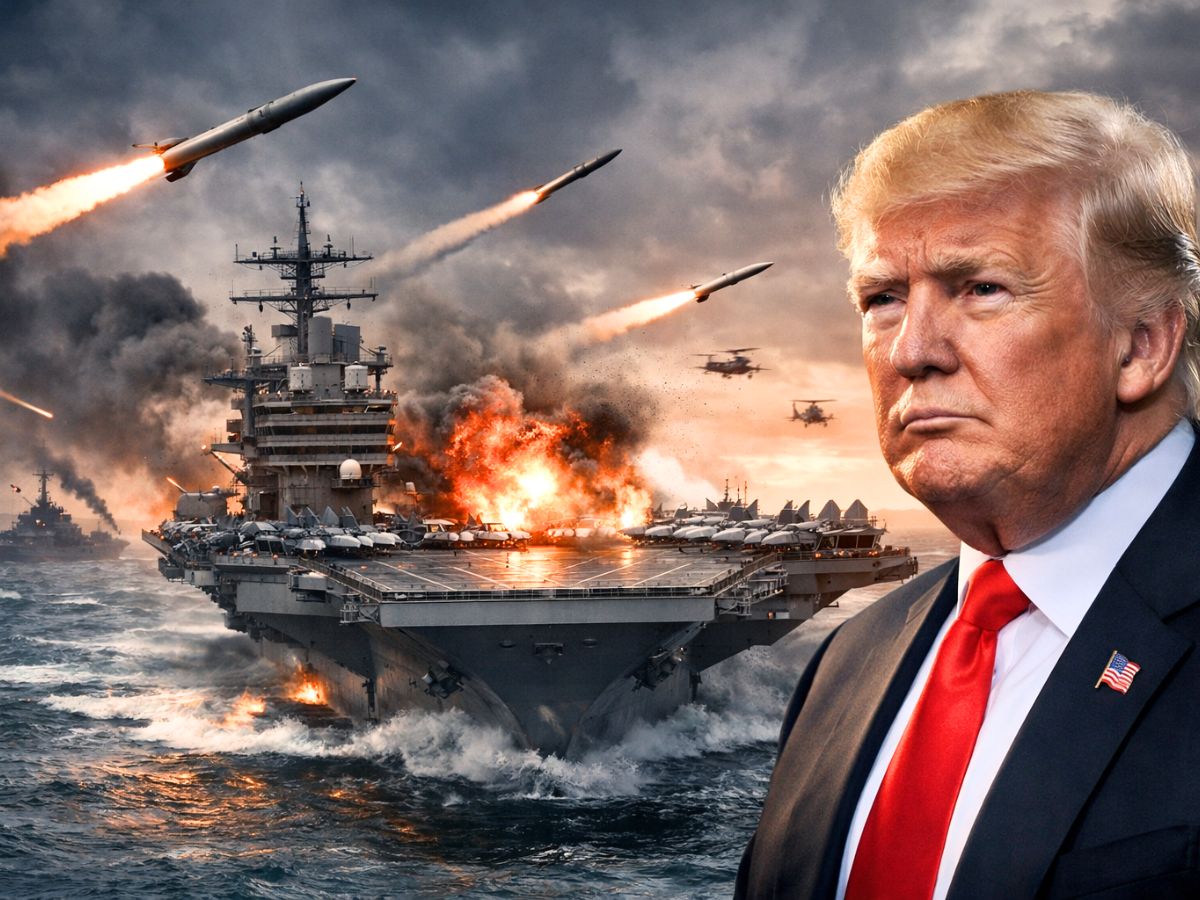

The Middle East crisis has deepened after Iran claimed it struck the US aircraft carrier USS Abraham Lincoln with four ballistic missiles in the Gulf.
The claim comes in the aftermath of the reported killing of Iran’s Supreme Leader Ayatollah Ali Khamenei in joint US-Israeli strikes, a development that has sharply escalated tensions between Tehran and Washington.
While Iranian state media reported that the carrier was hit, the claim has not been independently verified. The United States has not confirmed any successful strike on its warship.
Iran Vows Retaliation After Khamenei’s Death
Iran officially confirmed Khamenei’s death and declared 40 days of public mourning along with a seven-day public holiday. US President Donald Trump acknowledged the development and issued a stern warning to Tehran amid rising threats of retaliation.
In a televised address, Iranian President Mahmoud Pezeshkian said the country would continue its military campaign and remain committed to the path set by the Supreme Leader.
He described Khamenei’s death as martyrdom and vowed that Iran’s armed forces would intensify operations and “continue to strike hard” against their enemies.
USS Abraham Lincoln Strike Claim: What We Know
Iran’s Islamic Revolutionary Guard Corps said four ballistic missiles struck the USS Abraham Lincoln and warned that American forces would face severe consequences.
The Guards declared that “the land and sea will increasingly become the graveyard of the terrorist aggressors,” signaling further escalation.
However, United States Central Command (CENTCOM) did not confirm any successful Iranian strike. Instead, it stated that US forces targeted an Iranian Jamaran-class corvette during the launch of Operation Epic Fury, indicating that both sides are actively engaging in military operations in the region.
Can Iran Sink a Nimitz-Class Supercarrier?
The USS Abraham Lincoln is a Nimitz-class aircraft carrier weighing approximately 100,000 tonnes and designed to withstand heavy combat damage.
Modern supercarriers feature double hulls, multiple watertight compartments and sophisticated damage control systems. Even if a missile were to penetrate its defences, it would more likely damage the flight deck or temporarily disrupt operations rather than sink the vessel entirely.
Aircraft carriers also operate with layered defence systems. They are escorted by destroyers and cruisers equipped with advanced missile interceptors, while electronic warfare aircraft such as the EA-18G Growler can jam enemy radar and guidance systems. These measures significantly reduce the likelihood of a successful strike.
Iran’s Missile Capabilities and Naval Strategy
Iran possesses a diverse missile arsenal, including anti-ship cruise missiles such as the Abu Mahdi and hypersonic systems like the Fattah-2, which reportedly travels at speeds exceeding Mach 5. In addition, Iran has deployed large numbers of Shahed-136 drones in past conflicts, often using saturation tactics aimed at overwhelming air defence systems.
However, striking a fast-moving aircraft carrier in open waters presents major challenges. A Nimitz-class carrier can travel at speeds above 25 knots and constantly alters its course. Without real-time satellite tracking and precise targeting data, accurately hitting such a vessel becomes extremely difficult.
Is Trump’s Fleet Truly at Risk?
While Iran’s claim of hitting the USS Abraham Lincoln has intensified global attention, there is no independent confirmation that the carrier sustained critical damage. Military analysts note that such claims are often part of psychological and strategic messaging during wartime escalation.
What remains certain is that the confrontation between Washington and Tehran has entered a dangerous new phase. With retaliatory threats mounting and naval assets operating in close proximity in the Gulf, the risk of a broader regional conflict continues to grow.
For now, whether Trump’s warships are truly in danger remains unclear but the geopolitical stakes have rarely been higher.
Sofia Babu Chacko is a journalist with over five years of experience covering Indian politics, crime, human rights, gender issues, and stories about marginalized communities. She believes that every voice matters, and journalism has a vital role to play in amplifying those voices. Sofia is committed to creating impact and shedding light on stories that truly matter. Beyond her work in the newsroom, she is also a music enthusiast who enjoys singing.