

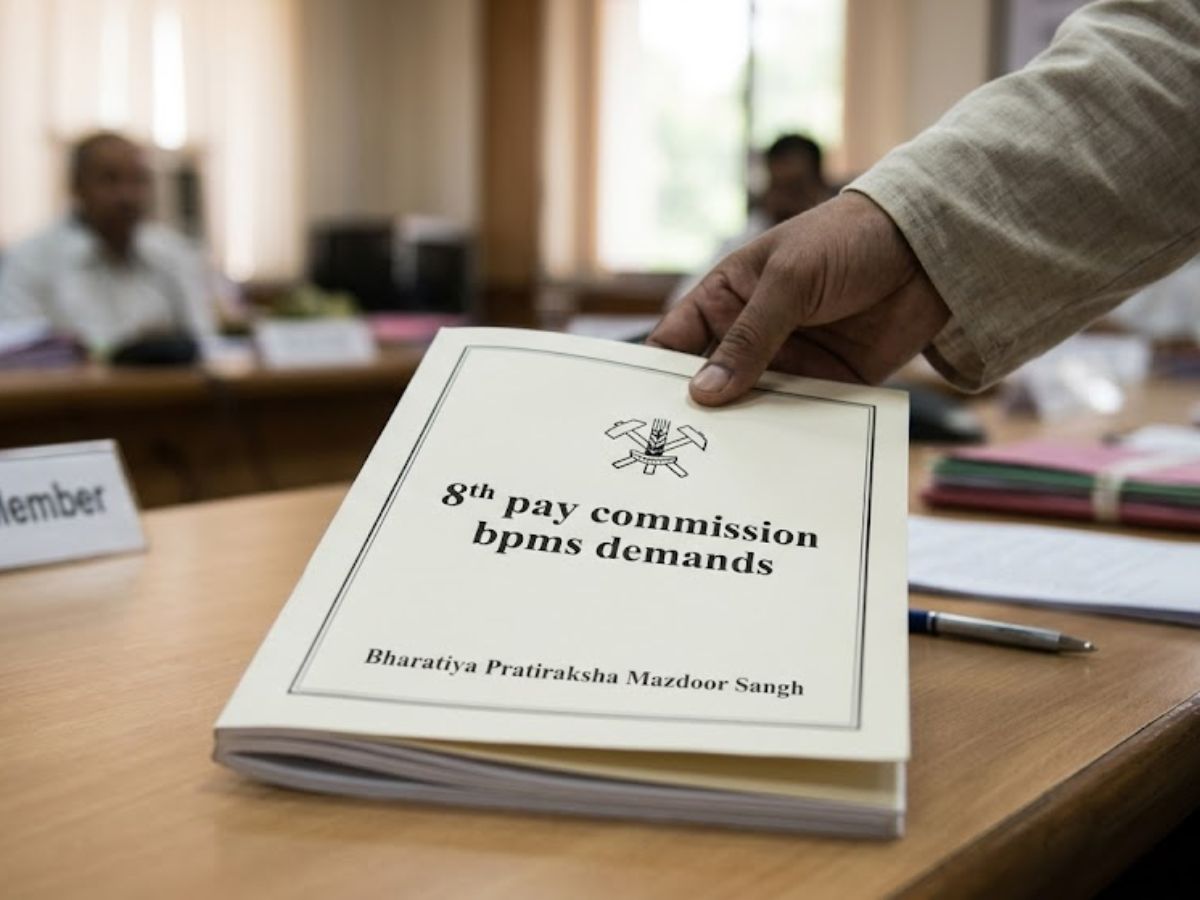
The Bharatiya Pratiraksha Mazdoor Sangh (BPMS) has submitted a detailed memorandum to the upcoming pay panel, putting forward sweeping changes in salaries, allowances, and pay structures. At the centre of the 8th pay commission bpms demands is a sharp increase in minimum pay to ₹72,000 per month, a move the union says is necessary to match current economic realities.
Reports say that, the proposal is part of a broader push to ensure that entry-level government employees can maintain a dignified standard of living. The union has argued that the 8th pay commission bpms demands are carefully designed to balance employee needs with fiscal discipline, keeping in mind both inflation and rising living costs.
8th pay commission bpms demands focus on minimum salary and income linkage
According to BPMS, the current minimum pay of ₹18,000 is no longer sufficient. The union has suggested raising it to ₹72,000, saying this figure reflects the growth in income levels and the rising cost of living across the country. It also proposed linking minimum wages directly to per capita income growth to make salary revisions more transparent and logical.
According to the union, they presented their case with official government data by the Ministry of Statistics and Programme Implementation (MoSPI). This data confirms that India’s Net National Income per Capita has risen from Rs 1,03,219 in 2016-2017 to Rs 1,92,774 in 2024-2025, an increase of precisely 86.76% over that period. The BPMS union has pointed out that such extensive increases justify the need for a well-documented case for a reasonably significant increase in government employees’ salaries because of the level of increase exposed by those statistics.
8th Pay Commission BPMS demands include higher fitment factor and increments
As per reports, There are two more critical demands to increase the fitment factor from its current level of approximately 2.57 to a factor of 4, under the 7th Pay Commission. The Union maintains that this fitment factor/multiplier is necessary to adjust for both inflation, dearness allowance, and total wage growth, as well as to ensure consistency at each pay level.
Another bpms demand for the 8th Pay Commission is to double the annual increment from 3% to 6%. The Union contends that while DA helps to offset inflation, increments are critical for true wage/income growth. The Union also states that the current increment percentage does not correspond with rising costs or with private sector counterparts, according to reports.
8th Pay Commission BPMS demands seek change in family unit concept
In addition to salary-related changes, BPMS has proposed revising the ‘family unit’ concept used in pay calculations. Currently based on three members, the union wants it expanded to five members. This, according to the 8th pay commission bpms demands, would better reflect the real financial responsibilities of employees, including support for parents along with spouses and children.
A summary of the proposals highlights major changes across key areas. Minimum pay is proposed to rise from Rs 18,000 to Rs 72,000. The fitment factor is suggested to increase to 4.00. Annual increments are recommended to go up from 3% to 6%. The family unit size would move from three to five members. The basis for pay revision would shift from inflation and benchmarks to a direct link with per capita income.
8th Pay Commission BPMS demands aim for fairness and transparency
The union has maintained that all these recommendations are aimed at building a fair, transparent, and sustainable pay system. It said the proposals would improve employee welfare, boost morale, and still maintain fiscal balance for the government.
The 8th Pay Commission BPMS (Bharatiya Pratap Mohan Sangh) is being asked to make various recommendations to the Central Government. Currently, there are many issues surrounding the 8th pay commission, especially with regard to its formation. On January 17, 2025, the Government of India made an official announcement that the 8th Pay Commission will be created in early 2025. Typically, pay commissions have been created every 10 years to review and make recommendations concerning pay, pension and allowances.
The 8th Pay Commission BPMS demands come before a very important date for the 8th Pay Commission.
The 8th Pay Commission is a temporary body created to provide recommendations on the existing pay structure and address other related issues. The Union Cabinet approved the Terms of Reference for the 8th Pay Commission on October 28, 2025. The 8th Pay Commission will be led by Justice Ranjana Prakash Desai and will have one part time member and one member secretary.
It has been given 18 months to submit its report, with an option to present interim findings if required. Importantly, April 30, 2026, is the deadline for stakeholders to submit their memorandums. The 8th pay commission bpms demands will now be reviewed along with other proposals before the panel finalises its recommendations.
Khalid Qasid is a media enthusiast with a strong interest in documentary filmmaking. He holds a Master’s degree in Convergent Journalism from AJK MCRC. He has also written extensively on esports at Sportsdunia. Currently, he covers world and general news at NewsX Digital.