
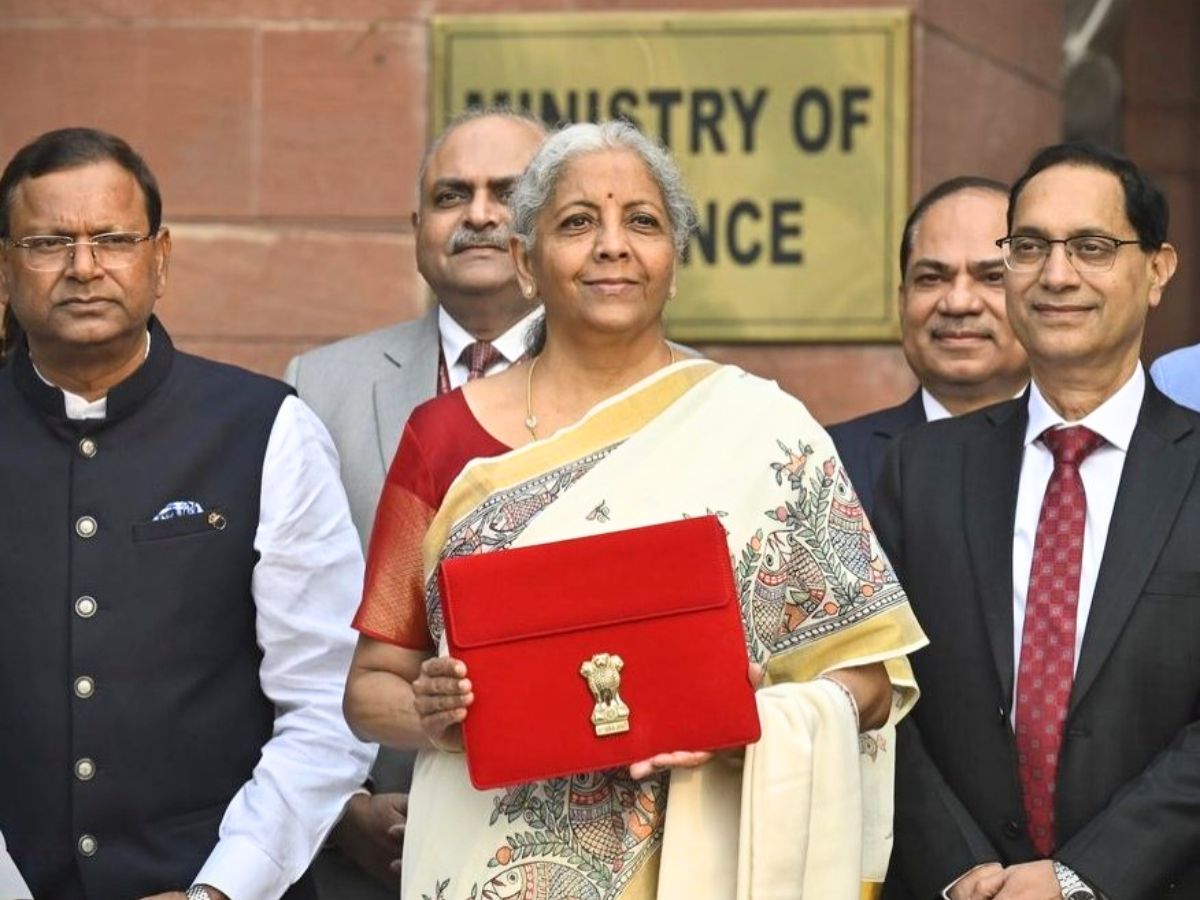

India is preparing for a landmark financial moment as Finance Minister Nirmala Sitharaman gets ready to present the Union Budget 2026 on February 1 a Sunday.
In only the second such instance in India’s parliamentary history, a Union Budget will be tabled on a weekend. But the timing is only one part of what makes this Budget historic.
Sitharaman is set to become the first Finance Minister to present nine consecutive Union Budgets, a record that places her in a unique position in India’s political and economic history.
While former Prime Minister Morarji Desai presented 10 Budgets and P. Chidambaram presented nine, neither did so in consecutive years.
This continuity, combined with a major shift in how the Budget speech itself will be structured, is why Budget 2026 is being closely watched by economists, markets, and policymakers alike.
Breaking a 75-year Budget speech tradition
What truly sets Union Budget 2026 apart is an expected break from a practice followed for nearly 75 years.
Traditionally, Part A of the Budget speech has contained the core economic vision, sectoral allocations, and policy priorities, while Part B has been largely reserved for taxation announcements and procedural changes.
This year, however, sources indicate that Sitharaman is likely to use Part B to lay out a broader and more detailed roadmap for India’s economic future blending immediate fiscal measures with long-term strategic goals.
If this happens, it would mark a structural shift in how Union Budgets are presented in India, moving beyond routine tax proposals toward a comprehensive economic vision as the country enters the second quarter of the 21st century.
A Sunday Budget with markets open
The Budget’s presentation on a Sunday has triggered another unusual development: stock exchanges NSE and BSE, along with commodity exchanges MCX and NCDEX, will remain open for trading. Markets are usually shut on Sundays, but trading will follow regular hours to allow investors to react in real time to key announcements.
This move underscores the high expectations surrounding the Budget, particularly around tax simplification, GST rationalisation, AI-led innovation policies, and capital expenditure push.
The live speech will begin at 11 am from Parliament’s Central Hall and will be broadcast on Sansad TV, DD National, and across major news platforms and digital channels.
Ninth consecutive Budget: A rare political and economic continuity
Sitharaman took charge as Finance Minister on May 31, 2019, and has since steered India’s economy through the COVID-19 pandemic, global supply chain disruptions, and geopolitical tensions. On January 31, 2026, she completed six years and eight months in office.
Her ninth straight Budget reflects a rare continuity in India’s finance leadership. Prime Minister Narendra Modi has already described this milestone as a matter of pride in India’s parliamentary history.
For comparison, C. D. Deshmukh served about six years as Finance Minister in the early years of the Republic, while Manmohan Singh, Pranab Mukherjee, Arun Jaitley, Y. B. Chavan, and Yashwant Sinha all had long but non-consecutive stints.
From ‘bahi-khata’ to paperless Budget
Sitharaman has symbolically redefined Budget traditions before. In 2019, she replaced the colonial-era leather briefcase with a traditional red ‘bahi-khata’, signalling a shift toward Indian symbolism. Over the last four years, the Budget has also gone fully paperless, continuing that break from the past.
Budget 2026 now appears ready to bring a similar transformation in substance and structure.
Focus on fiscal roadmap and capital expenditure
Having met the fiscal consolidation target of keeping the deficit below 4.5% of GDP in fiscal 2026, markets will be closely watching whether the government outlines a clear debt-to-GDP reduction plan and provides a specific fiscal deficit number for fiscal 2027.
The government’s capital expenditure for the current fiscal stands at ₹11.2 lakh crore, and expectations are that the capex target could see a 10–15% increase, especially as private sector investment remains cautious.
Nominal GDP projections for fiscal 2027 likely estimated between 10.5% and 11% will offer signals about the inflation trajectory and growth outlook.
Trade deals, AI push, and sectoral spotlight
Another key area of focus is India’s ongoing trade negotiations. The pending India-US trade deal and progress on the India-EU Free Trade Agreement will be watched for potential tariff changes, especially on sectors like automobiles, wine, and manufacturing exports.
Policy signals may also emerge around precious metals like gold and silver, which have seen price volatility, and renewed thrust for Make in India, electronics, defence, MSMEs, renewable energy, railways, infrastructure, urban development, healthcare, tourism, agriculture, logistics, and AI-driven innovation.
Carrying forward last year’s tax momentum
In Budget 2025, Sitharaman offered major relief to the middle class by making income up to ₹12 lakh tax-free under the new regime, extending to ₹12.75 lakh for salaried individuals after standard deduction. She also announced the New Income Tax Act, 2025, set to come into effect from April 1.
This year, expectations are high that the government may build on that momentum through tax simplification rather than dramatic tax cuts.
A Budget watched beyond India
Economists in India and abroad are closely tracking this Budget, expecting not just fiscal announcements but a broader statement of intent as India positions itself as the world’s fastest-growing major economy with global ambitions.
Union Budget 2026 is therefore not just another annual financial statement. With a Sunday presentation, open markets, a record ninth consecutive speech, and a likely shift in the very structure of the Budget address, FM Sitharaman’s ninth Budget is poised to rewrite multiple traditions at once making it one of the most closely watched Budgets in recent decades.
Sofia Babu Chacko is a journalist with over five years of experience covering Indian politics, crime, human rights, gender issues, and stories about marginalized communities. She believes that every voice matters, and journalism has a vital role to play in amplifying those voices. Sofia is committed to creating impact and shedding light on stories that truly matter. Beyond her work in the newsroom, she is also a music enthusiast who enjoys singing.




