
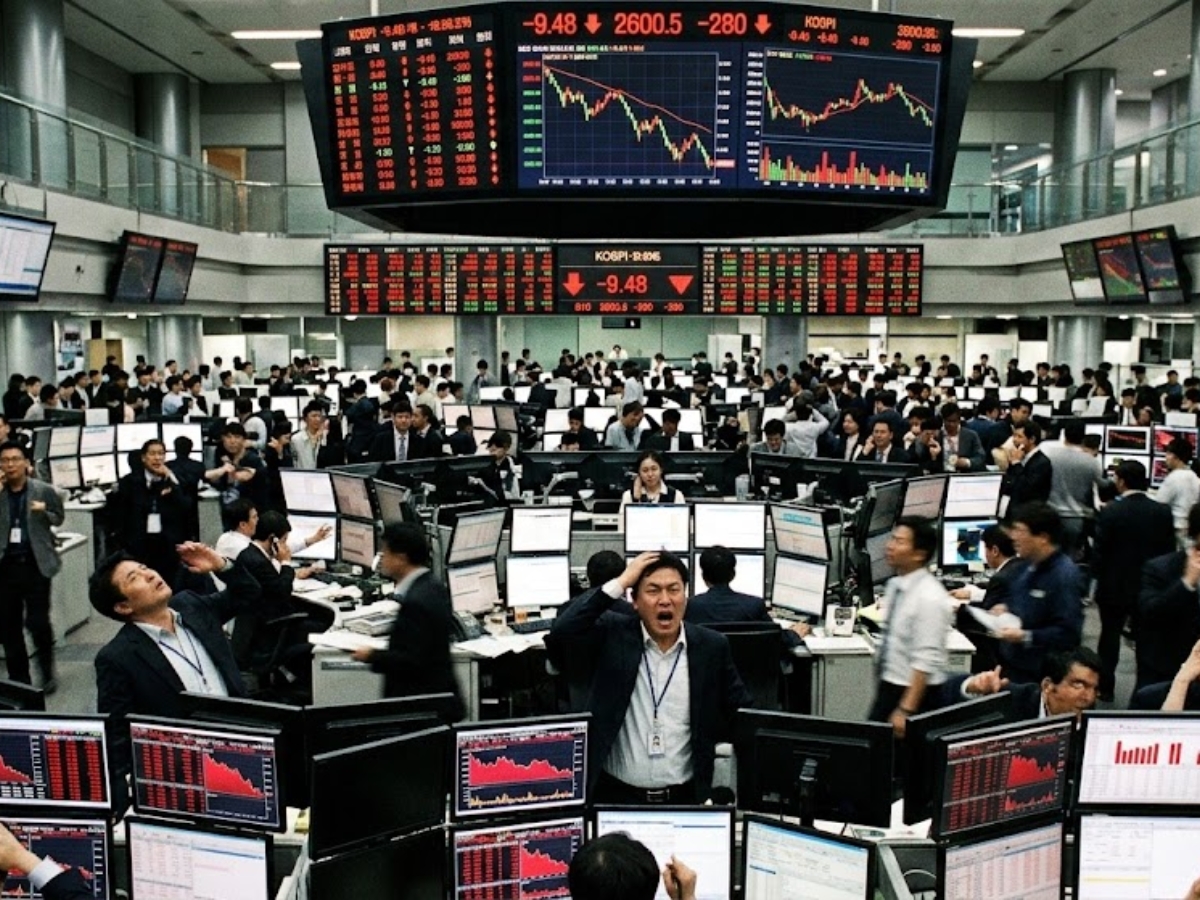

South Korea’s benchmark index, the KOSPI, plunged 9.48% on Tuesday at the time of writing this story. This is the steepest single-day decline the index has witnessed since 2024, jolting investor confidence.
The drop was particularly striking given the market’s recent momentum. Since the start of 2025, the index had surged 34%, rebounding strongly from its April lows. The abrupt reversal has therefore come as a significant shock to sentiment.
What Led To South Korea’s KOSPI Crash?
A key vulnerability behind the sell-off was market concentration. Much of the KOSPI’s rally this year had been powered by just two heavyweights, Samsung Electronics and SK Hynix.
When both stocks declined sharply, the broader index immediately felt the impact.
Samsung fell 10% following reports that mass production at its US semiconductor facility in Texas may be postponed until 2027.
SK Hynix suffered an even steeper fall, dropping 11.5%. The scale of the decline underscored how rapidly confidence can erode when expectations around the semiconductor sector are reassessed.
Circuit Breakers Triggered as Losses Deepen at Korea Exchange
The Korea Exchange confirmed on March 4 that it activated circuit breakers on the KOSPI after the benchmark index plunged 8%, halting trading for 20 minutes.
However, the pause did little to stem the slide. Within minutes of trading resuming, losses extended to 11%.
This is the first activation of circuit breakers on the index since August 2024.
Over the past three sessions alone, the KOSPI has shed 14%.
Regional Markets Slide Amid Oil Supply Concerns
The sell-off was not confined to South Korea. Markets across Asia declined sharply for a third consecutive session, as escalating US-Iran military tensions heightened concerns about potential disruptions to oil supplies and rising energy costs.
In Japan, the Nikkei 225 fell 2.5%, extending its losing streak to three sessions. Both Japan and South Korea are heavily reliant on energy imports, making them particularly sensitive to oil price volatility.
Oil Surges, Then Eases on US Assurances
Benchmark Brent crude futures have climbed more than 12% this week, reaching $81.40 per barrel. Prices, however, retreated from their highs after US President Donald Trump ordered an insurance guarantee for Gulf shipping.
Trump also indicated that the US Navy may escort oil tankers through the Strait of Hormuz if necessary, moves aimed at calming fears of supply disruptions.
The week’s turbulence has reverberated across asset classes.
Gold dropped about 4.5% overnight as traders unwound profitable positions to offset losses elsewhere. Early in the Asian session, bullion steadied at $5,128 per ounce.
The Australian dollar slipped 0.8%, reflecting broader risk aversion. Meanwhile, U.S. and European futures attempted to stabilise, with S&P 500 futures showing signs of consolidation after recent volatility.
Zubair Amin is a Senior Journalist at NewsX with over seven years of experience in reporting and editorial work. He has written for leading national and international publications, including Foreign Policy Magazine, Al Jazeera, The Economic Times, The Indian Express, The Wire, Article 14, Mongabay, News9, among others. His primary focus is on international affairs, with a strong interest in US politics and policy. He also writes on West Asia, Indian polity, and constitutional issues. Zubair tweets at zubaiyr.amin




