
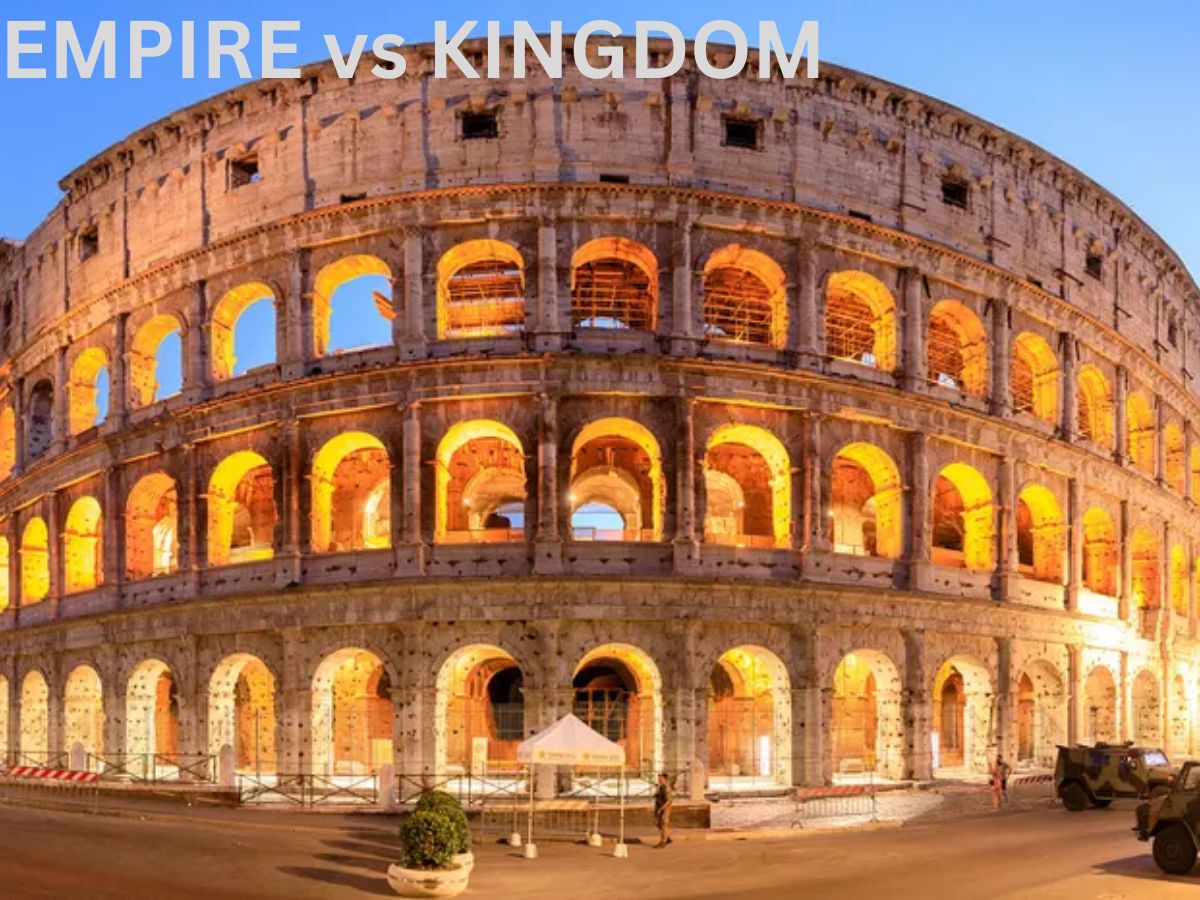

Throughout history, the terms empire and kingdom have often been used interchangeably, but they represent two very different political structures. Both play significant roles in shaping civilizations, yet they differ in size, governance, and influence. Understanding these differences is essential to appreciate how societies evolved over centuries.
What Is Kingdom?
A kingdom is a state or territory ruled by a king or queen. It is usually smaller and more centralized, with a unified culture, language, and political system. The ruler’s authority is generally hereditary, passing from one generation to another.
-
Examples: The kingdom of England, Kingdom of France, and present day constitutional monarchies like Thailand and United Kingdom.
- Kingdoms often focus on internal governance, stability, and maintaining cultural traditions. Their influence is usually limited to a single region or country.
What Is Empire?
An empire is a vast political entity that rules over multiple kingdoms, regions, or nations. It is usually led by an emperor or empress, whose power extends across diverse cultures, languages, and ethnic groups. Empires are built through conquest, colonization, and alliances, often spanning continents.
- Examples: The Roman Empire, British Empire, and Mughal Empire.
- Empires prioritize expansion, resource control, and maintaining dominance over multiple territories, making them much larger and more complex than kingdoms.
Key Differences Between Empire and Kingdom
Size and Scope-
- A kingdom is smaller and limited to one region
- An empire covers vast areas, often consisting of several kingdoms.
Leadership-
- A kingdom is ruled by a king or queen
- An empire is ruled by an emperor or empress, who often commands kings under them.
Cultural Diversity-
- Kingdoms usually share a common culture and language
- Empires govern diverse populations, which may lead to challenges in unity.
Governance-
- Kingdoms have simpler administrative systems, focusing on local governance.
- Empires have complex administrations to manage vast territories.
Goal and Focus-
- Kingdoms focus on stability and tradition.
- Empires focus on expansion and control over other states.
Historical Perspective
Historically, many powerful kingdoms grew into empires through conquest and expansion. For example, the Kingdom of England eventually became part of the British Empire, which spanned multiple continents. Similarly, the Roman Kingdom evolved into the mighty Roman Empire. This shows how kingdoms can act as a foundation for future empires.
Conclusion
While both kingdoms and empires are forms of monarchy, their scale, governance, and purpose set them apart. A kingdom represents unity and tradition within a specific region, while an empire symbolizes power, diversity, and control over vast territories. Understanding this distinction helps us better appreciate world history and the evolution of human civilization.




