
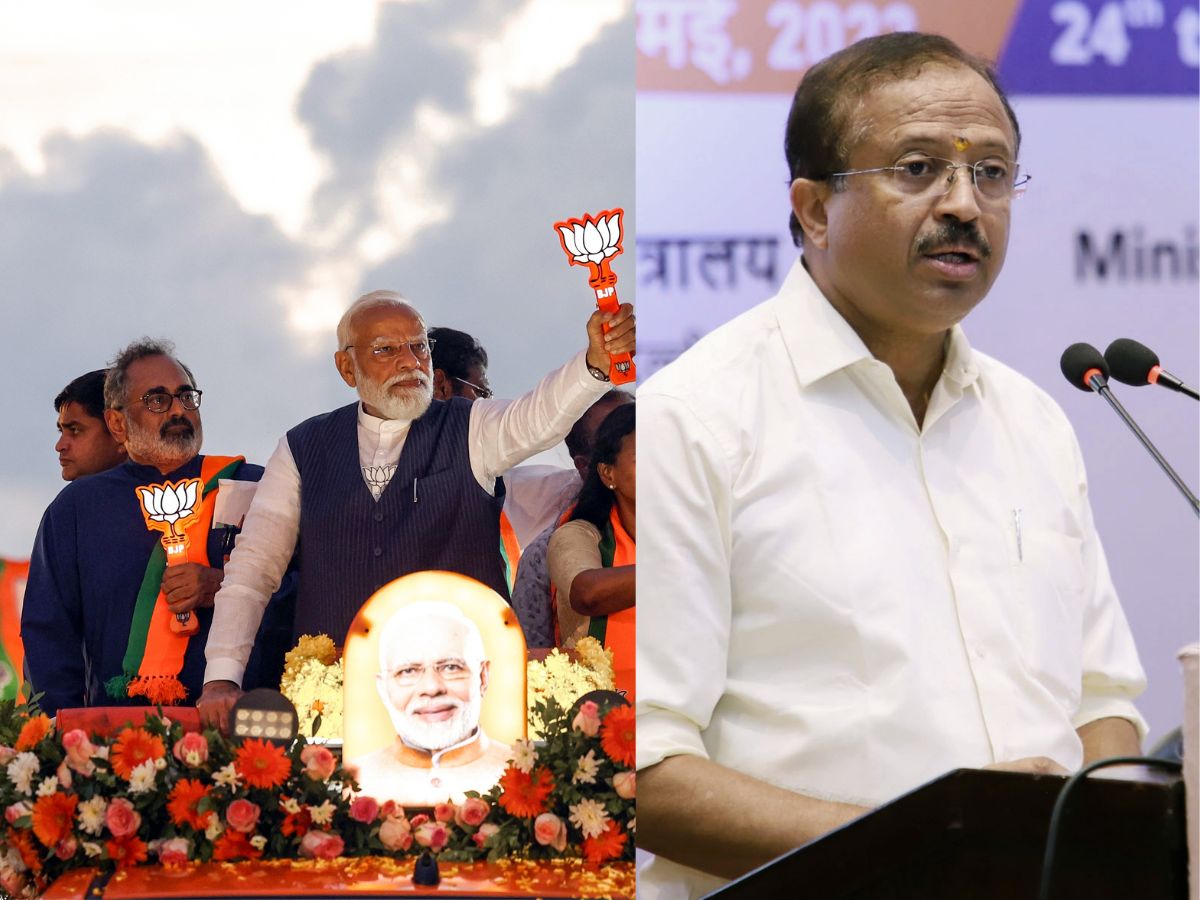

A big political upset happened in Kerala today on May 4. Pinarayi’s Red fort has crumbled in to pieces. In a state where politics is a bipolar contest between Left Democratic Front (LDF) and United Democratic Front (UDF), BJP’s performance in 2026 Kerala assembly elections is not about its size, but it’s presence. By winning just 3 seats- Nemom, Kazhakkoottam and Chathannoor- it has managed to write a narrative change in a land that has been hermetically sealed against its ideology. Even as Congress-led UDF swept to power, BJP’s narrow wins signal a calculated advance. At the helm of this growth is state BJP chief Rajeev Chandrasekhar. He proved that Kerala soil is not just ‘red’ but also suitable for lotus to bloom. However the previous BJP Chief K Surendran could not do it. Rajeev’s campaign strategy, leadership appeal, and candidate selection have played a crucial role in penetrating what Pinarayi Vijayan once claimed as ‘Red Bastion’.
Why Do 3 Seats Change the Equation?
In a 140-member Assembly, three seats may sound negligible. But Kerala does not have much political space. BJP had not won a single seat in the 2021 elections. So, its ability to enter the 2026 elections is notable enough. The wins in Nemom, Kazhakkoottam and Chathannoor mark a crack in the Left’s long-held stronghold, particularly in urban and semi-urban areas.
However, the significance lies in the fact that these BJP victories came even as the UDF swept the state, suggesting that these are not just anti-incumbency votes.
Rajeev Chandrasekhar’s Poll magic in Nemom
Nemom is BJP’s most secure base in Kerala. But in this year’s election, it became a contested battleground in a triangular contest. Rajeev Chandrasekhar defeated CPI(M) minister V Sivankutty while Congress leader KS Sabarinathan came third.
Are These Results a Setback for Pinarayi Vijayan’s LDF?
Yes, these big 3 seats win seems to be a big slap for LDF led government. Pinarayi has to rethink where he failed. While Pinarayi Vijayan managed to retain his seat in Dharmadam after early setbacks, the broader picture is less comfortable for the LDF. Several ministers trailed, and the front saw a significant decline compared to its 2021 dominance.
BJP’s entry into the Assembly however small challenges the narrative of an impregnable ‘Red Bastion’. It suggests that cracks are beginning to appear, especially in regions where development concerns outweigh ideological loyalty.
Is This the Beginning of a Long-Term Shift?
However, BJP’s three-seat win does not alter Kerala’s power structure overnight. UDF remains firmly in control. But politics is often about momentum and perception. By combining leadership, targeted campaigning, and strategic candidate placement, Rajeev Chandrasekhar and his team have laid the groundwork for future growth. The message is clear: Kerala may still resist BJP, but it is no longer entirely out of reach.
ALSO READ: Who Will Be Next Kerala CM: Shashi Tharoor, KC Venugopal Or VD Satheesan?
Sofia Babu Chacko is a journalist with over five years of experience reporting on Indian politics, crime, human rights, gender issues, and stories about marginalized communities. She believes journalism plays a crucial role in amplifying unheard voices and bringing attention to issues that truly matter. Sofia has contributed articles to The New Indian Express, Youth Ki Awaaz, and Maktoob Media. She is also a recipient of the 2025 Laadli Media Awards for gender sensitivity. Beyond the newsroom, she is a music enthusiast who enjoys singing. Connect with Sofia on X: https://x.com/SBCism




